
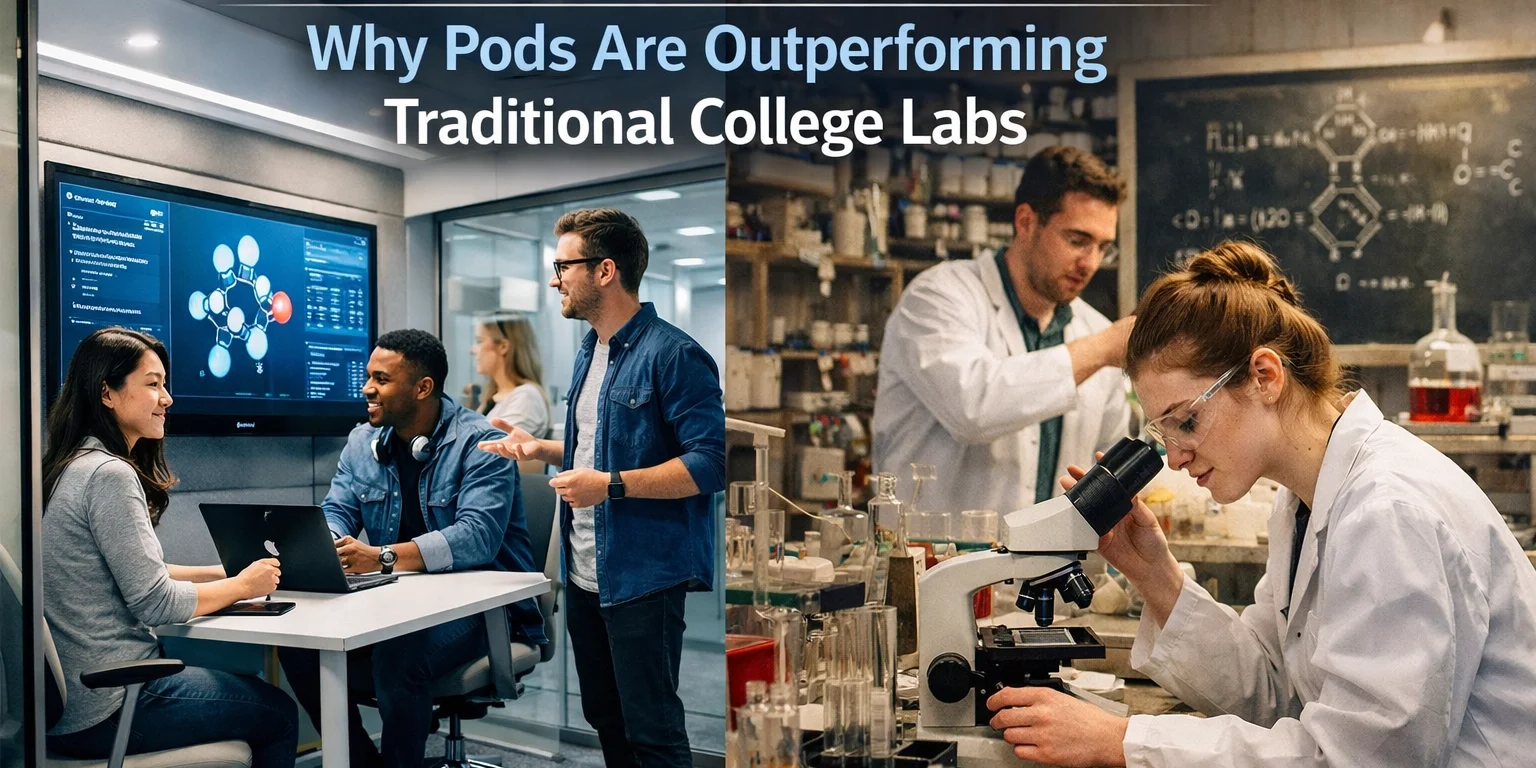
Let’s be honest for a second: the traditional college computer lab is where dreams: and lower back health: go to die. We’ve all been there. You walk into a room that smells faintly of ozone and old carpet, filled with rows of identical beige or black towers, tethered to desks that haven't been moved since the late nineties. It’s a setup designed for the industrial age, not the digital one.
At USA Entertainment Ventures LLC, we spend a lot of time thinking about how physical spaces influence professional outcomes. Our CEO, Dan Kost, has always been a proponent of the idea that if you want someone to think outside the box, you shouldn’t force them to sit in a cubicle that feels like a prison cell. That’s why we’re seeing a massive shift in the educational landscape. The "Pod" is officially taking over, and it’s not just because they look like something out of a sci-fi movie.
Physical infrastructure matters. It’s the difference between a student just "getting through" a project and a student launching a career. Today, we’re breaking down why modular pods are outperforming traditional labs and how they are paving the way for the next generation of logistics experts, cybersecurity gurus, and content kings.
The "Row" Problem: Why Traditional Labs are Failing
Traditional computer labs were built on a model of standardization. The goal was simple: get as many bodies in front of as many screens as possible for the lowest cost. While that worked when the height of technology was learning how to use a spreadsheet, it’s a disaster for modern learning.
Standardization has become a liability. If you’re training a group of students in high-end video editing, but the lab was optimized for basic word processing, you’re stuck. Reconfiguring a traditional lab requires a massive investment in time, money, and probably a few calls to an electrician to move floor outlets that were bolted down during the Bush administration.
Moreover, the physical layout: rows of students staring at the backs of each other's heads: actively kills collaboration. In the real world, work happens in teams. It happens in "war rooms" and "scrum circles." Traditional labs are anti-social by design.

Enter the Pod: Flexibility as a Service
Pods are the antidote to the "static lab." Unlike a traditional renovation, which can take months of construction noise and dust, a pod can be dropped into a library, a student union, or even a dorm lobby in a matter of hours.
Take Indiana Tech, for example. They realized that their library needed quiet, tech-enabled study zones, but they didn't want to lose floor space to permanent walls. They opted for pods, and the installation took less than two hours. That’s not a renovation; that’s an upgrade.
This operational flexibility is a game-changer. Pods can be outfitted with specific hardware: high-end GPUs for creators, specialized servers for cybersecurity students, or multi-screen setups for logistics managers. If the curriculum changes next semester, you don't need a sledgehammer. You just need to swap the tech inside the pod.
Career Pathway #1: The Logistics Revolution
When people hear "logistics," they often think of trucks and warehouses. But modern logistics is about the flow of information and resources. The move toward pods is a masterclass in logistics itself.
Managing a fleet of modular pods across a campus requires a different kind of thinking than managing a single stationary lab. We’re talking about "just-in-time" infrastructure. Students entering the logistics field today need to understand how to deploy resources rapidly and efficiently.
At USA Entertainment Ventures, we see this trend across all our projects. Whether it’s Mobile HWY Ads or EV infrastructure, the world is moving toward modularity. Learning in a pod environment teaches students that the physical environment is something to be manipulated and optimized, not just something to be endured.
Career Pathway #2: Cybersecurity and the "Secure Cell"
Cybersecurity isn’t just about code; it’s about the environment. Traditional labs are a nightmare for security. Open rows mean "shoulder surfing" is a constant risk, and centralized networks are harder to segment for "white hat" hacking exercises.
Pods provide a naturally "gated" environment. They offer privacy and a controlled physical space where students can dive into the complexities of network security without distractions. It’s the closest thing a student can get to a real-world Security Operations Center (SOC).
In a pod, you can create a localized, air-gapped network for testing vulnerabilities. Try doing that in a 50-person computer lab without bringing down the entire school’s Wi-Fi. (Actually, don't try that. Your IT department will hate us.)

Career Pathway #3: Content Creation and the E-Sports Boom
This is where pods really shine. We are currently living in the "Creator Economy." Whether it's producing a podcast, editing a viral video, or competing in high-stakes gaming, the environment matters.
Traditional labs are too loud, too bright, and have the acoustic properties of a gymnasium. Pods, however, are designed with acoustics and lighting in mind. They are mini-studios. Our own E-Sports Pod project is a prime example of this. It’s an environment built specifically for the high-performance needs of gamers and creators.
For a student looking to get into digital marketing or multimedia journalism, the pod is their laboratory. It’s where they learn to manage sound levels, lighting, and multi-stream inputs. It’s collaborative, it’s sleek, and frankly, it makes them feel like the professionals they are striving to become.
The Cost-Benefit Reality Check
Let’s talk numbers, because as much as we love "vibes," the CFO usually loves "ROI" more. Traditional lab renovations are expensive. You’re looking at HVAC adjustments, lighting overhauls, and permanent furniture costs.
Pods are significantly more cost-effective. Because they are self-contained, they don't require the same level of facility modification. They are also ADA-compliant right out of the box (or, rather, they are the box), ensuring that every student has equal access to the best tech.
Furthermore, pods have a longer "useful life" in terms of relevance. If a building's purpose changes, you can move the pod. You can't move a renovated room. This portability makes them an asset rather than a sunk cost.
Why USA Entertainment Ventures LLC Cares
You might be wondering why a business consulting firm like us is so hyped about college pods. It’s simple: we look for efficiency and future-proofing in everything we do. From Zoo Imagery to our various media projects, we know that the right tools in the wrong environment are a waste of money.
We help companies and institutions see around the corner. And right now, the corner is telling us that the "one-size-fits-all" model of education and workspace is dead. People want privacy, they want specialized tech, and they want to work in environments that don't feel like they were designed by a committee of people who still use AOL.
The Future is Modular
As we look toward the 2030s, the "college lab" will likely disappear entirely, replaced by hubs of modular pods that can be adapted for whatever the "hot new tech" is that year. This isn't just a trend; it's an evolution of how we treat physical space.
By investing in pods, institutions are telling their students that they value their time, their comfort, and their professional future. It’s about creating a "collision space" where ideas can actually happen.
If you’re still sitting in a row of computers, looking at the back of someone’s head while trying to solve the world’s cybersecurity problems, it might be time to ask your administration why they haven’t looked into pods yet. And if you’re an administrator wondering how to make your campus feel like it belongs in the 21st century, give us a shout. We’ve got a few ideas.

Key Takeaways for the Future-Focused:
- Adaptability Wins: If your infrastructure can’t change in a weekend, it’s already obsolete.
- Privacy is a Tool: For cybersecurity and deep work, pods provide the necessary focus traditional labs lack.
- Collaboration Over Rows: pods mirror the team-based reality of the modern workplace.
- Infrastructure is Marketing: Students want to go where the tech looks and feels like the future.
Physical infrastructure isn't just about walls and wires; it's about potential. Let’s stop putting students in boxes that limit them, and start putting them in pods that launch them.





