
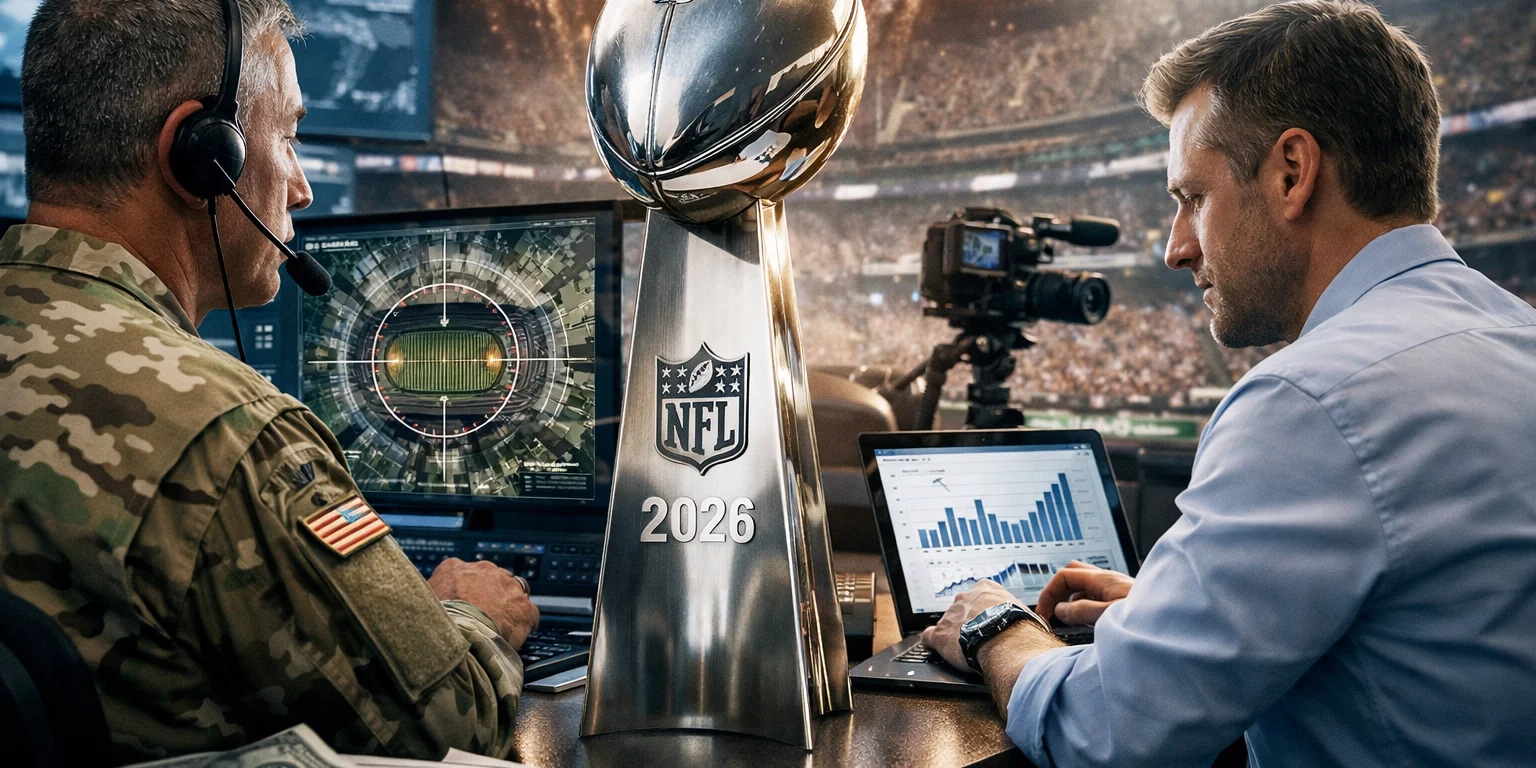
When eight military aircraft roared over Levi's Stadium on February 8, 2026, synchronized down to the millisecond with the final note of the national anthem, they represented more than patriotic spectacle. That flyover: a joint Air Force-Navy operation featuring B-1B Lancers, F-15C Eagles, F/A-18E Super Hornets, and F-35C Lightning IIs: demonstrated the same operational precision that has made Super Bowl broadcasts America's most predictable return on investment for four decades.
The connection isn't coincidental. Both military operations and sports media production at this scale share identical requirements: flawless timing, coordinated multi-team execution, zero tolerance for error, and months of meticulous planning. The Super Bowl has become the annual proving ground where these principles translate directly into measurable business outcomes.
The ROI Numbers Don't Lie
Super Bowl advertising has delivered consistent returns since the mid-1980s, a track record virtually unmatched in marketing. The average 30-second spot for Super Bowl 2026 commanded $7 million, yet brands continue to queue for availability years in advance. Why? Because the data validates the investment.
According to industry analysis, Super Bowl advertisements generate an average brand awareness lift of 10-25% in the weeks following the game. More importantly, companies that maintain consistent Super Bowl presence report measurable sales increases averaging 5-8% in the subsequent quarter. These aren't projections or estimates: they're documented outcomes tracked across multiple product categories and market segments.

The military flyover coordination for Super Bowl 2026 required FAA collaboration, airspace management around three major Bay Area airports, and precision navigation systems accurate to within meters. Similarly, a Super Bowl broadcast involves 120+ cameras, 200+ production personnel, coordination with multiple broadcast trucks, satellite uplinks, and real-time integration of graphics, replays, and commercial breaks. Both operations leave nothing to chance.
Veteran Leadership Makes the Difference
The sports media industry employs a disproportionately high percentage of military veterans in production, logistics, and operations management roles. This isn't happenstance. The skill sets align perfectly.
Consider the typical Super Bowl production timeline: 18 months of advance planning, six months of intensive preparation, three weeks of on-site setup, and one day of execution with zero room for error. This mirrors military operational planning cycles, where contingency planning, resource allocation, and mission-critical timing determine success or failure.
Veterans bring specific competencies to sports media operations:
Hierarchical Command Structures: Clear chains of authority prevent decision-making bottlenecks during live broadcasts when seconds matter.
Crisis Management Protocols: When equipment fails or unexpected situations arise, military-trained personnel default to rehearsed contingency plans rather than improvising.
Resource Optimization: Military logistics training translates directly to managing hundreds of personnel, millions in equipment, and complex supply chains under tight deadlines.
Performance Under Pressure: The ability to execute precisely when stakes are highest: exactly what live television demands.
https://www.youtube.com/watch?v=l6J-0zileKE
Four Decades of Measurable Evolution
The Super Bowl's transformation from a major sporting event to America's premier marketing platform didn't happen accidentally. It resulted from systematic improvements in broadcast technology, audience measurement, and production methodology: all guided by data-driven decision making.
In 1985, Super Bowl XIX attracted 85.5 million viewers and commanded $525,000 for 30-second commercials. Super Bowl 2026 drew 120+ million viewers with ad rates exceeding $7 million. That's more than market inflation: it's value creation through operational excellence.
The measurement systems evolved alongside the broadcast capabilities. Nielsen ratings gave way to multi-platform audience tracking. Simple viewership counts expanded to include social media engagement, streaming analytics, second-screen interaction, and real-time sentiment analysis. Advertisers now receive granular data showing exactly how their investment performed across demographic segments, geographic markets, and engagement channels.

This data infrastructure didn't emerge organically. It required the same disciplined, systematic approach that characterizes military planning: identify objectives, develop metrics, implement systems, measure results, refine processes, repeat. The sports media industry applied this cycle consistently for 40 years, creating increasingly reliable ROI models.
Business Lessons from the Super Bowl Model
Companies outside sports media can extract valuable principles from the Super Bowl's sustained success. The event demonstrates how operational precision directly enables commercial outcomes.
Standardized Processes Create Predictability: Every Super Bowl broadcast follows documented procedures refined through decades of iteration. This standardization doesn't stifle creativity: it provides the foundation that makes creative risks possible. Advertisers know their commercials will air exactly when scheduled, at precise quality standards, reaching guaranteed audience sizes. That predictability justifies premium pricing.
Investment in Infrastructure Compounds: The broadcast technology, personnel training, and coordination systems supporting Super Bowl 2026 represent billions in cumulative investment. Those costs were justified because they improved outcomes incrementally year after year. Companies that view infrastructure as expense rather than investment miss opportunities for compound returns.
Measurement Enables Optimization: The sports media industry measures everything: viewership by minute, engagement by demographic, conversion by market segment. This measurement culture drives continuous improvement. Organizations that track outcomes systematically can optimize systematically.

Cross-Functional Integration Multiplies Value: A Super Bowl broadcast requires seamless coordination between production, engineering, sales, marketing, digital platforms, social media teams, and external partners. No single department could execute independently. This integrated approach creates value greater than the sum of individual contributions.
Military Precision as Business Advantage
The eight-aircraft flyover at Super Bowl 2026 required months of preparation coordinating multiple military branches, civilian aviation authorities, weather contingencies, and split-second timing. The pilots executed their approach at 300+ knots, converging from different altitudes and directions, to arrive at a single point within a two-second window.
That same operational discipline applies to sports media production at scale. Camera operators must capture specific shots on cue. Directors must call transitions precisely. Graphics operators must integrate real-time statistics instantly. Replay technicians must identify and queue key moments within seconds. Commercial breaks must hit exact time marks. All simultaneously, all flawlessly, with 120 million people watching.
Organizations that adopt military-style operational precision: clear objectives, defined processes, rehearsed contingencies, measured outcomes: create competitive advantages in any industry. The Super Bowl proves these principles work at the highest scale, under maximum pressure, with consistent results.
The 2026 Milestone and Forward Momentum
Super Bowl 2026 represented a culmination point where four decades of incremental improvement, technological advancement, and operational refinement converged. The event showcased 8K camera technology, AI-assisted replay systems, real-time augmented reality graphics, and multi-platform streaming integration that didn't exist even five years earlier.
Yet the fundamental principles remained unchanged: meticulous planning, disciplined execution, systematic measurement, continuous improvement. The same principles that guided Super Bowl XIX in 1985 still drive outcomes in 2026: applied through evolved technology and refined processes.

For business leaders evaluating the Super Bowl model, the lesson isn't about entertainment or sports marketing specifically. It's about how sustained operational excellence creates predictable, measurable returns. It's about how military precision: attention to detail, contingency planning, performance under pressure: translates directly to commercial outcomes.
Applying These Principles
Organizations seeking to replicate the Super Bowl's ROI reliability should examine their own operational frameworks. Do you have standardized processes for core functions? Are outcomes measured systematically? Do leadership teams include individuals trained in high-stakes operational execution? Are infrastructure investments evaluated for long-term compound returns rather than immediate payback?
The sports media industry didn't achieve four decades of consistent ROI growth through creative genius alone. They achieved it through disciplined application of operational principles, many borrowed directly from military methodology. They achieved it by making precision execution a organizational value rather than a occasional aspiration.
Super Bowl 2026 demonstrated these principles at maximum scale. The military flyover symbolized the broader operational reality: when precision matters, military-style discipline delivers results. When ROI must be predictable, systematic processes outperform improvisation. When execution cannot fail, proper planning prevents poor performance.
The business consulting implications are clear. Companies that adopt these operational disciplines: regardless of industry: position themselves for sustained, measurable success. The Super Bowl proves the model works. The four-decade track record removes doubt.
For organizations ready to elevate their operational precision and create more predictable returns, USA Entertainment Ventures LLC brings consulting expertise grounded in these exact principles. The lessons from Super Bowl 2026 apply far beyond sports media; they apply anywhere excellence matters and results are measured.





