
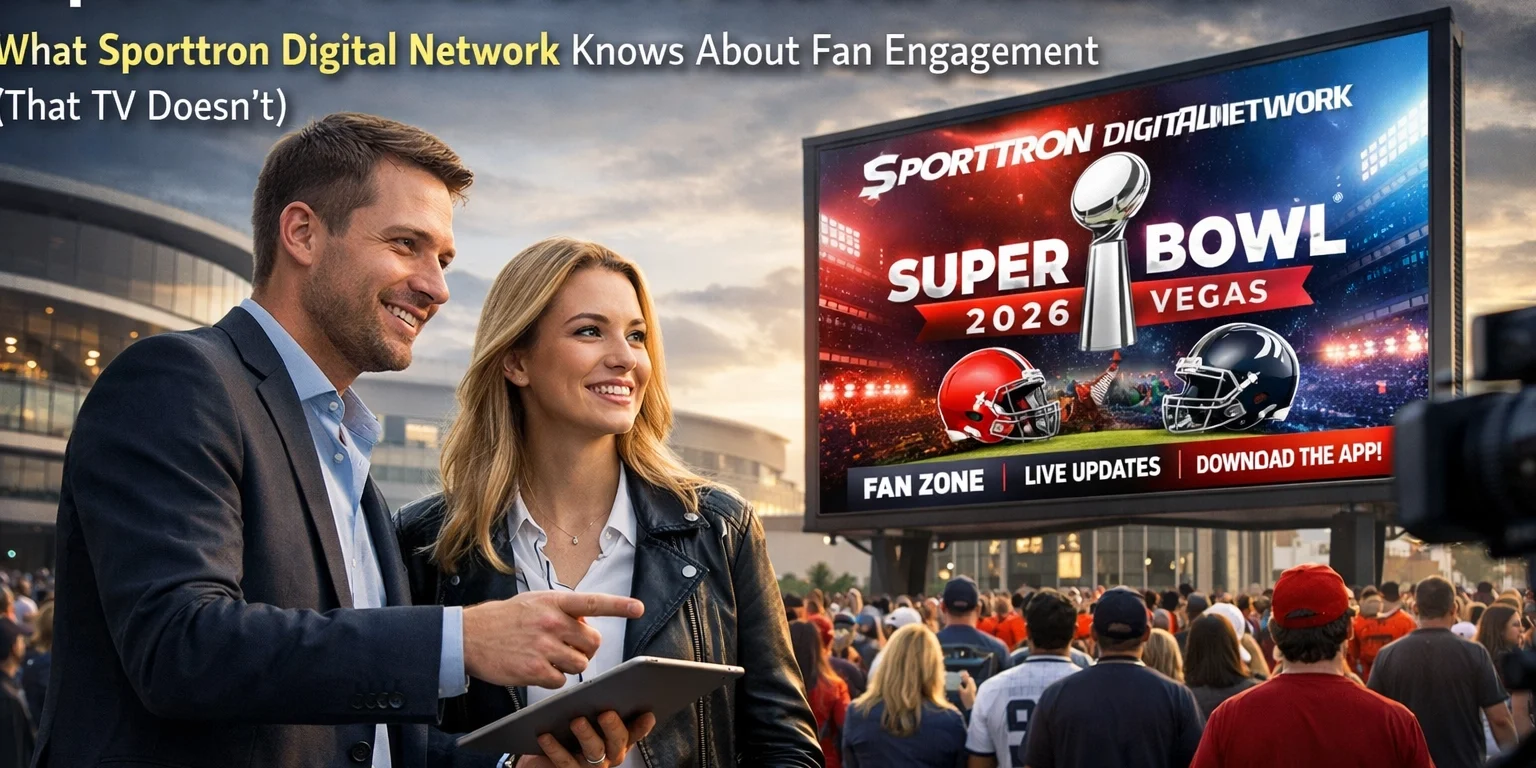
When millions tune into the Super Bowl, brands spend upwards of $7 million for thirty seconds of television airtime. Yet while advertisers obsess over broadcast reach, a quiet revolution in out-of-home (OOH) advertising has been unfolding: one that understands something fundamental about fan engagement that television never could.
Sporttron Digital Network has cracked a code that traditional broadcast advertising simply cannot replicate: they've mapped the psychological journey of event attendees in ways that transform how brands connect with audiences during major sporting events. The difference isn't just about location: it's about understanding that fan attention during Super Bowl week operates in an entirely different cognitive dimension than passive home viewing.
The Psychology of Repeated Environmental Encounters

Television advertising operates on a simple premise: deliver a complete message in thirty seconds, then hope viewers remember it. Sporttron discovered something far more nuanced. Attendees exist in a heightened psychological state across multiple days, and this fundamentally changes how messaging is processed and retained.
The network found that six exposures accumulated across a three-day journey create a cognitive impact that differs markedly from six isolated exposures to different brands. This isn't merely frequency: it's the recognition that repeated encounters at predictable locations build cumulative psychological effect. Each touchpoint reinforces the previous one, creating a narrative arc impossible to achieve through broadcast spots that vanish the moment they air.
This insight reveals a critical distinction: event contexts differ dramatically from traditional media consumption where audiences passively receive messaging. Super Bowl attendees are actively navigating an environment, making decisions, seeking experiences. They're not sitting on a couch waiting for content to come to them: they're immersed in a multi-day experience where environmental cues become part of the journey itself.
Mapping Audiences Across Time, Not Just Space
Understanding where fans will be matters far less than understanding when different audiences arrive and what they need in those moments. Sporttron's research uncovered that different demographic segments experience the same event at entirely different times with distinct psychological contexts.
Business executives arriving Thursday afternoon occupy a different mindset than families arriving Sunday morning. This temporal mapping enabled something television cannot achieve: adaptive messaging that shifts based on time of day and arrival patterns. A single billboard placement can promote breakfast specials at 8 AM for early arrivals, transition to lunch offerings by noon, and feature post-game dining options by evening.
Television delivers the same message to everyone simultaneously, regardless of viewer context or intent. OOH networks like Sporttron recognize that time of exposure matters as much as frequency. The family looking for kid-friendly activities on Saturday afternoon needs different messaging than the corporate group seeking upscale entertainment Thursday evening: even if both groups eventually attend the same game.
The Extended Visibility Advantage

Television visibility compresses into brief moments that vanish immediately, relying entirely on memory retention. Sporttron's approach operates across an extended timeline spanning five days before the game through three days after, capturing arriving audiences, maintaining presence during the event, and reaching departing fans.
This sustained presence enables sequential storytelling where early exposures can introduce concepts and later touchpoints build complexity, knowing audiences will encounter multiple messages. A brand can seed anticipation on arrival day, deliver a value proposition mid-week, provide directional guidance on game day, and offer post-event engagement opportunities as fans depart.
The psychology here matters enormously. Research in environmental psychology demonstrates that messages encountered in physical space during heightened emotional states: excitement, anticipation, celebration: create stronger memory encoding than messages received during passive media consumption. Fans aren't just seeing advertisements; they're experiencing brand presence as part of their Super Bowl journey.
Real-Time Responsiveness That Broadcast Can't Match
Perhaps the most significant advantage Sporttron has demonstrated involves predictive modeling and fan sentiment analysis to identify which themes resonate with audiences and adjust creative messaging within hours. When nostalgia for a previous Super Bowl surges on social media, coordinated OOH messaging can echo those themes in real-time.
Television spots require weeks of production, network approval, and scheduling commitments. By the time a broadcast campaign airs, cultural moments have often passed. The agility traditionally reserved for digital-only campaigns now extends to physical environments through networks like Sporttron, creating a hybrid approach that combines the impact of physical presence with the responsiveness of digital platforms.
This responsiveness extends beyond creative adjustments. Weather changes, traffic patterns, event schedule modifications: all can trigger strategic messaging shifts. If unexpected delays occur, OOH networks can provide wayfinding assistance or entertainment venue promotions. If celebrations extend longer than anticipated, messaging can adapt to capture extended engagement opportunities.
Behavioral Data That Reveals Hidden Opportunities

While television networks estimate viewership through sampling and modeling, Sporttron works with granular behavioral traffic pattern data. The discovery that 73% of Super Bowl attendees arrive at least ninety minutes before kickoff creates substantial dwell time in surrounding entertainment districts: insight that transforms strategic placement decisions.
This understanding of movement patterns and timing enables placement in high-traffic corridors and venue-adjacent areas where fans cannot avoid exposure. Unlike television audiences who can skip ads or multitask during commercials, attendees navigating physical spaces encounter OOH messaging as an integral part of their environment.
The behavioral data extends beyond timing to purchase intent and decision-making moments. Sporttron identified that fans make dining, entertainment, and retail decisions in distinct phases throughout their journey. Morning arrivals seek coffee and breakfast. Mid-afternoon brings restaurant research and reservation decisions. Post-game triggers celebration venue searches. Each phase represents a distinct engagement opportunity that broadcast advertising cannot target with comparable precision.
The Future of Event-Based Marketing
As Super Bowl 2026 approaches, the lessons from Sporttron's approach reveal a broader truth about modern marketing: context matters more than reach alone. Television delivers impressive audience numbers, but OOH networks positioned at major events capture audiences in moments of heightened engagement, repeated exposure, and active decision-making.
The integration of digital capabilities with physical presence creates opportunities that neither medium achieves independently. Real-time responsiveness, temporal adaptation, behavioral targeting, and sequential storytelling combine to form an engagement strategy that recognizes how audiences actually experience major events.
For brands evaluating their Super Bowl investment strategies, the question isn't whether television or OOH performs better: it's how understanding the distinct advantages of each medium creates comprehensive engagement. Television introduces and reminds. OOH accompanies, guides, and converts.
The insights Sporttron has revealed about fan behavior during major events extend well beyond the Super Bowl. Any large-scale gathering where audiences travel, navigate unfamiliar environments, and make real-time decisions represents an opportunity for brands that understand how environmental psychology differs from broadcast consumption patterns. The future of event marketing belongs to those who recognize that owning the environment means owning the experience: something no thirty-second spot can replicate.





