The landscape of professional recruitment has undergone a seismic shift. In years past, the battle for top-tier talent began at the university level. Recruiters would descend upon college campuses, looking for seniors about to cross the stage with degrees in hand. However, as we navigate the mid-2020s, that strategy is no longer sufficient. The demand for specialized skills: specifically in Cloud Computing, Artificial Intelligence (AI), and Data Analytics: has far outpaced the traditional supply chain of human capital.
To remain competitive, forward-thinking companies are moving "upstream." They are no longer waiting for talent to come to them; they are building a Next-Gen Talent Funnel that begins in high school. This guide explores why this shift is necessary and how your organization can implement a strategy that secures its technological future.
The Reality of the Modern Talent Gap
The rapid advancement of technology means that by the time a student completes a four-year degree, the specific tools and platforms they studied may already be evolving into something new. According to recent industry observations, the half-life of a technical skill is now approximately five years. This creates a perpetual cycle of "catch-up" for traditional HR departments.
Furthermore, the competition for experienced professionals in AI and Cloud infrastructure has driven salaries to levels that are unsustainable for many mid-sized firms. The solution is not to bid higher, but to build better. By identifying potential and nurturing it early, companies can create a loyal, highly skilled workforce that is custom-tailored to their specific technological stack and corporate culture.

Why High School is the New Recruitment Frontier
Engaging with high school students might seem premature to some, but the data suggests otherwise. Today’s high schoolers are "digital natives" who often begin coding, managing databases, or experimenting with AI models before they even have a driver’s license.
1. Early Skill Acquisition
Students are now specializing earlier than ever. Many high school vocational and STEM programs offer certifications in AWS, Microsoft Azure, or Python programming. By the time these students are 17, they often possess foundational knowledge that rivals entry-level applicants from a decade ago.
2. Brand Affinity
When a company invests in a student’s growth during their formative years, it builds a level of brand loyalty that is difficult to replicate later. You aren't just another employer on a job board; you are the organization that provided their first "real-world" opportunity.
3. Cost-Effective Scaling
The cost of engaging a high school student through a mentorship or a micro-internship is a fraction of the cost of a headhunter fee for a senior developer. Over time, the ROI of a home-grown talent pipeline significantly outperforms traditional external hiring.
Defining the Next-Gen Talent Funnel
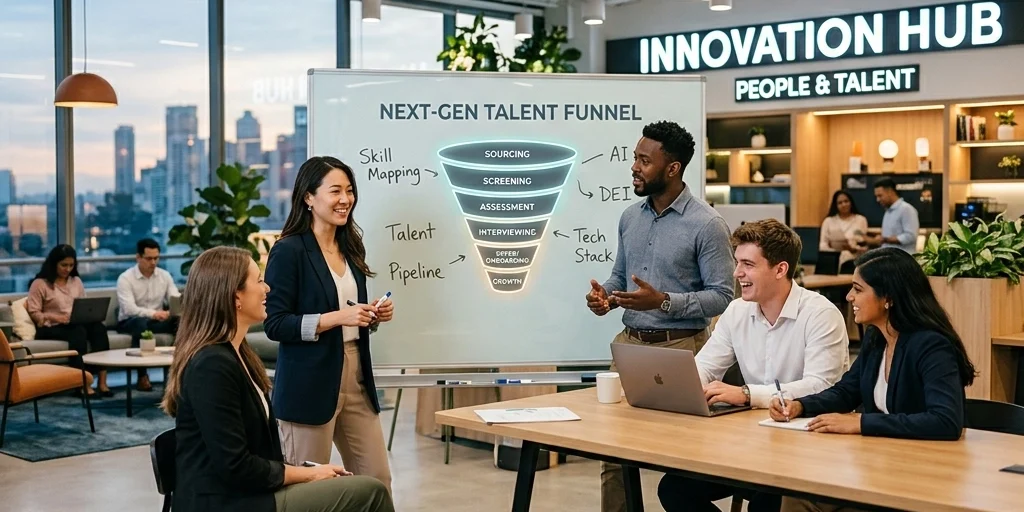
A Next-Gen Talent Funnel is a strategic framework designed to identify, engage, and nurture potential employees over a multi-year period. It is not a one-time event, but a continuous process. You can learn more about how business strategies are evolving in our business category.
The funnel typically consists of six distinct stages:
1. Awareness
At this stage, the goal is to introduce your brand to students. This isn't about job offers; it’s about inspiration. Companies participate in career days, sponsor STEM competitions, or host "Day in the Life" webinars. The message is simple: "This is what we do, and this is why it matters."
2. Attraction
Once awareness is established, you must attract the high-performers. This is where you highlight the impact of Cloud and AI. Students want to know how their work will change the world. Demonstrating how Data Analytics is used in areas like conservation or media can make technical roles feel more tangible and purposeful.
3. Engagement
Engagement involves two-way interaction. This could be through a "Mentor Circle" where your current engineers spend an hour a month answering student questions, or through online challenges where students solve simplified versions of real-world problems.

4. Selection
Unlike traditional hiring, selection in a next-gen funnel is based on "skill signals" rather than a resume. You are looking for curiosity, logic, and the ability to learn. AI-driven assessments can help identify students who have a natural aptitude for data structures or cloud architecture, even if they haven't had formal training yet.
5. Work Exposure
This is the "bridge" between education and employment. Micro-internships: short, project-based assignments: allow students to experience your company’s workflow. It provides them with a "low-stakes" environment to apply their skills in technology while giving you a chance to evaluate their work ethic and cultural fit.
6. Conversion
The final stage is the transition into a formal role. This could be a part-time position while they continue their education, a full-time apprenticeship, or a guaranteed internship-to-hire path. The goal is to make the transition into your company the most logical and rewarding next step for the student.
Key Pillars: Cloud, AI, and Data Analytics
While the funnel framework can be applied to many fields, it is most critical in the high-growth areas of Cloud, AI, and Data.
The Cloud Infrastructure
As businesses move away from physical servers, the demand for Cloud architects is soaring. Students who understand the basics of virtualization and cloud security are already ahead of the curve. Engaging them early allows you to steer their learning toward the specific platforms your company uses.
The AI Revolution
Artificial Intelligence is no longer a futuristic concept; it is a current business necessity. By the time today's high schoolers enter the workforce, AI literacy will be as fundamental as typing. Companies need talent that can not only use AI tools but understand the ethics and data structures behind them.
Data Analytics: The New Language of Business
Data is the "oil" of the 21st century. The ability to interpret large datasets and find actionable insights is a skill that crosses all industries, from sports media to zoo management.

Step-by-Step Implementation Strategy
Building a talent funnel requires a shift in mindset from "HR as a reactive function" to "HR as a strategic pipeline."
Step 1: Audit Your Future Needs
Look at your three-to-five-year roadmap. What technologies will you be using? What roles will be the hardest to fill? If your roadmap includes heavy AI integration, your funnel should prioritize students with a background in mathematics and logic.
Step 2: Establish Local Partnerships
You don't need to reach every student in the country. Start with local high schools or regional STEM hubs. Establish a relationship with guidance counselors and career-technical education (CTE) directors. They are often looking for industry partners to help validate their curriculum.
Step 3: Prioritize Skills Over Credentials
In the next-gen funnel, a portfolio of projects or a specific certification often carries more weight than a GPA. "The industry is moving toward a competency-based model," notes many HR experts. "If a 17-year-old can demonstrate proficiency in Python through a GitHub repository, that is a more reliable indicator of success than a traditional interview."
Step 4: Leverage Technology for Nurturing
Managing a funnel of hundreds of students over several years requires technology. A Recruitment CRM (Candidate Relationship Management) system allows you to track interactions, send relevant content to students based on their interests, and flag high-potential candidates for further engagement.
The Business Case for Early Intervention
The skepticism often surrounding high school recruitment usually centers on the "time to value." Why invest in someone who won't be a full-time employee for three or four years?
The answer lies in stability and cost. The "war for talent" is expensive. High turnover in technical roles is often caused by employees jumping for a slightly higher salary at a competitor. However, "home-grown" talent: those who have been nurtured by a company since their teen years: tend to have significantly higher retention rates. They understand the "why" behind the company's mission and feel a sense of belonging that external hires often lack.
Furthermore, by the time these students reach "full-time" status, their onboarding time is virtually zero. They already know your systems, your culture, and your expectations.

Moving Forward: A Scalable Future
The Next-Gen Talent Funnel is not just a recruiting tactic; it is a commitment to the future of the workforce. It acknowledges that the traditional boundaries between "school" and "work" are blurring.
As we look toward the future, the companies that thrive will be those that view themselves as educators as much as employers. By reaching into high schools today, you are securing the innovators of tomorrow. This proactive approach ensures that when the next wave of technological disruption hits, your team will be ready to lead rather than react.
For more insights into how USA Entertainment Ventures LLC is helping businesses navigate these strategic shifts, we invite you to explore our project portfolio and see the diverse industries currently benefiting from forward-thinking consulting.
The talent is out there. They are in classrooms, they are in coding clubs, and they are waiting for a signal that their skills have a place in the professional world. It is time to open the funnel.