
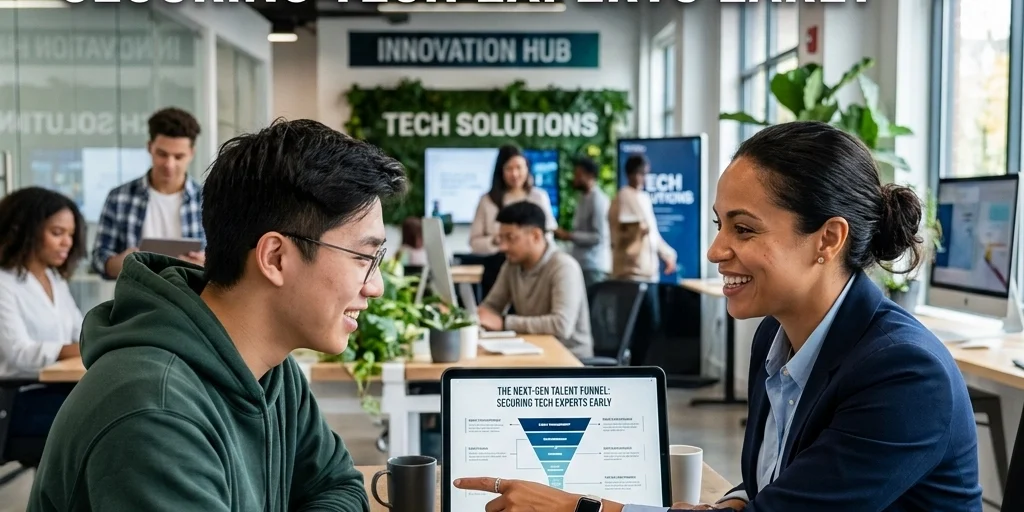
The global landscape of technology is shifting at a velocity that traditional education systems often struggle to match. As of 2026, the demand for specialized skills in Artificial Intelligence (AI), Cloud Computing, and Data Analytics has reached a critical peak. For many organizations, the standard recruitment model: waiting for students to complete a four-year degree before initiating contact: is no longer a viable strategy. In the modern economy, waiting until graduation means you are already four years too late.
The "Next-Gen Talent Funnel" represents a proactive shift in human resources and business strategy. It involves engaging potential experts while they are still in high school, fostering relationships early, and prioritizing skills-based evaluation over traditional credentials. This guide explores why high school engagement is the new frontier for securing the technical backbone of your business.
The Crisis of Traditional Tech Recruitment
For decades, the pipeline for technical talent was linear: high school, university, internship, and finally, entry-level employment. However, this model is fundamentally broken in the context of rapid technological evolution. According to industry research, the half-life of a learned technical skill is now roughly five years. This means that by the time a student enters their senior year of college, the foundational technologies they studied as freshmen may already be outdated.
Furthermore, the "AI-native" generation: those currently in their mid-teens: is learning to code and deploy models using tools that didn't exist when current mid-level managers were in school. These students are experimenting with Large Language Models (LLMs) and cloud-native applications in their bedrooms. If your organization is not visible to them now, your competitors likely are.

Why the High School Level is the New Strategic Entry Point
Engaging with high schools is not merely a philanthropic endeavor; it is a strategic business necessity. There are three primary drivers making high school engagement the most effective way to secure future talent.
1. Early Brand Loyalty
The concept of brand loyalty is often applied to consumers, but it is equally vital in the labor market. When a company provides resources, mentorship, or exposure to a high school student, it establishes a "first-mover advantage." Students who see a clear path from their high school interests to a professional career at a specific firm are more likely to remain in that ecosystem through their higher education and early career.
2. Access to Self-Taught Innovators
Modern tech experts are increasingly self-taught. Through platforms like GitHub, YouTube, and specialized coding bootcamps, high schoolers are gaining proficiency in Python, SQL, and AWS architecture long before they set foot on a college campus. By identifying these "outlier" talents early, businesses can bypass the high-cost, high-competition environment of university career fairs.
3. Diversity and Inclusion at the Source
To build a truly diverse workforce, intervention must happen before students self-select out of STEM paths. By engaging with a diverse range of high schools, companies can encourage underrepresented groups to pursue careers in Cloud and AI, effectively widening the talent pool for the entire industry.
The Pillars of the Next-Gen Funnel: AI, Cloud, and Data
To build an effective talent funnel, organizations must focus on the three pillars driving modern business transformation.
Artificial Intelligence (AI)
AI is no longer a niche field for PhDs; it is a fundamental layer of software engineering. High school students are already using AI to automate tasks and build applications. Companies should look for students who understand how to leverage AI tools and those who demonstrate an interest in the ethics and governance of machine learning.
Cloud Computing
The cloud is the infrastructure upon which all modern business is built. Students who understand the basics of virtualization, serverless architecture, and cloud security are ahead of the curve. Engaging with schools that offer vocational certifications in cloud services can provide a direct line to ready-to-work talent.
Data Analytics
Data is the new currency of business consulting and strategy. Students with a natural aptitude for statistics and data visualization are the future architects of business intelligence. Organizations like USA Entertainment Ventures LLC recognize that the ability to interpret complex data sets is a foundational skill for any modern consultant.

Implementing a Skills-Based Hiring Model
The most significant hurdle to a successful Next-Gen Talent Funnel is the traditional reliance on a university degree as a proxy for talent. To secure tech experts early, companies must transition to a skills-based hiring model.
Moving Beyond the Degree
While degrees remain valuable, they should not be the sole gatekeeper for entry-level positions. Organizations should evaluate candidates based on:
- Portfolio Projects: What have they actually built? A GitHub repository often reveals more about a candidate’s skill than a GPA.
- Technical Assessments: Real-world coding challenges and data analysis tasks.
- Certifications: Industry-recognized certifications from major cloud and AI providers.
By removing the "Bachelor’s degree required" barrier for specific junior roles, companies can tap into a motivated pool of high school graduates and vocational students who are ready to contribute immediately.
Strategic Action Steps for Businesses
Building a talent funnel requires a shift in how leadership views human capital. It is an investment in the long-term health of the organization.
1. Partner with "Future-Ready" Schools
Identify 2-4 local high schools with strong STEM or Career and Technical Education (CTE) programs. Rather than just attending a career day, work with administrators to sponsor hackathons or provide guest speakers for computer science classes. This creates a presence within the school community that is both professional and supportive.
2. Create "Micro-Internships"
Traditional three-month internships are often too long for high school schedules. Consider "micro-internships": one-week or two-week intensives where students can work on a specific, contained project. This gives the company a chance to evaluate the student's aptitude and gives the student a taste of the professional environment.
3. Establish Mentorship Programs
Pairing senior tech staff with high school students through structured mentorship programs is one of the most effective ways to transfer institutional knowledge and build early career excitement. Mentorship provides a "human face" to the corporation, making the prospect of a future career there more tangible.

The Economic Impact: A Long-Term Perspective
From a business consulting perspective, the ROI of a Next-Gen Talent Funnel is found in the reduction of long-term recruitment costs. The cost of hiring a mid-level AI engineer in an open market is astronomical. By developing talent from the high school level, companies can "grow" their own experts, resulting in lower turnover rates and higher cultural alignment.
Furthermore, these early-career hires often bring a fresh perspective on consumer trends and technology usage that older generations may miss. They are the primary users of the next generation of software, making them invaluable for product development and market strategy.
Modernizing the Recruiting Stack
To manage an early-stage talent funnel, HR departments must utilize modern technology.
- Advanced ATS: Use an Applicant Tracking System that can process diverse inputs, such as portfolio links and non-traditional certifications.
- Data Dashboards: Visualize the pipeline. Track how many students from high school programs eventually apply for full-time roles.
- Asynchronous Interviews: Allow younger candidates to showcase their communication skills through video platforms, which often feels more natural to digital natives than a formal phone screen.
More information on how businesses can optimize their internal structures can be found through our portfolio sitemap.

The Role of Industry Experts and Leadership
As Dan Kost, CEO of USA Entertainment Ventures LLC, often emphasizes, the strength of a business is entirely dependent on the quality of its people. Leadership must be vocal about the importance of early engagement. It is not enough for the HR department to lead this initiative; it must be a core component of the company’s growth strategy.
Industry experts suggest that the most successful companies of the 2030s will be those that started building their high school pipelines in the mid-2020s. The urgency is grounded in the reality of the global talent shortage. As technical roles become more specialized, the "talent war" will only intensify.
Conclusion: Preparing for the Decade Ahead
The Next-Gen Talent Funnel is more than a recruitment trend; it is a response to the fundamental restructuring of the global workforce. By engaging with high school students in the realms of Cloud, AI, and Data Analytics, businesses can secure their future in an increasingly competitive landscape.
The transition requires a commitment to simplicity, professional engagement, and a willingness to look beyond traditional credentials. Organizations that act now to establish themselves as anchors for young talent will not only survive the coming shifts in the tech industry but will lead them.
Investing in the next generation is an investment in the sustainability of the global economy. It is time to look toward the high schools: the tech experts of tomorrow are already there, waiting for the right opportunity to lead.






