
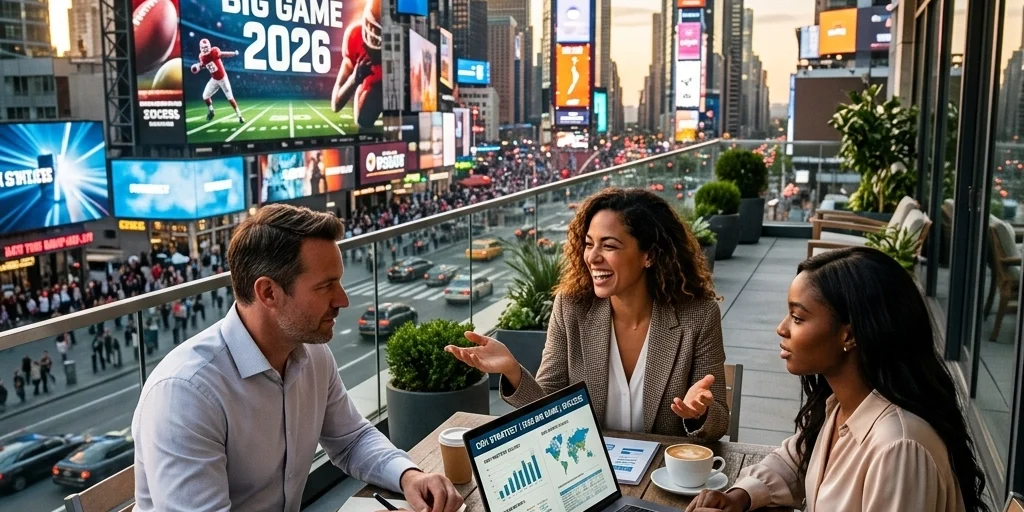
Now that the dust has settled on the 2026 Big Game, we’ve had a chance to look back at what really worked. If you were in Los Angeles this past February, you saw it firsthand: the city didn't just host a football game; it became a living, breathing advertisement. At USA Entertainment Ventures LLC, we watched the landscape shift. The brands that won didn't just buy a few billboards; they mastered the art of Out-of-Home (OOH) advertising.
As CEO Dan Kost often says, "It’s not about being seen; it’s about being felt." In the high-stakes environment of the Big Game, mastery means owning the environment. Whether you’re looking back at your 2026 campaign performance or planning your strategy for the next major event, this is the definitive guide to OOH mastery.
The Sporttron Digital Network: A Game Changer
The centerpiece of OOH success in 2026 was the Sporttron Digital Network. In previous years, OOH was often synonymous with static vinyl billboards that sat unchanged for weeks. Sporttron changed the math. By turning high-traffic urban areas into responsive digital canvases, brands were able to interact with fans in real-time.
Owning the environment isn't just a catchy phrase; it's a technical achievement. When you combine the reach of the Sporttron Digital Network with strategic placement, you create a "surround sound" effect for the eyes. Check out this look at how the network transforms the visual landscape:
https://www.youtube.com/watch?v=l6J-0zileKE
This isn't just advertising; it's digital immersion. The ability to update creative on the fly: responding to a game-changing interception or a halftime show highlight: is what separates the masters from the amateurs.

The Strategic Framework for OOH Mastery
To succeed at an event as massive as the Big Game, you need more than a big budget. You need a framework. Based on our work at USA Entertainment Ventures, we’ve identified five essential pillars for OOH success.
1. High-Traffic Zone Mapping
The fan journey doesn't start at the stadium gates. It starts at the airport, continues through the hotel lobby, moves into the fan zones, and finally hits the stadium concourse. Mastery involves identifying these "choke points" where eye dwell-time is highest. For 2026, this meant dominating the transit corridors leading to SoFi Stadium and the entertainment hubs in downtown LA.
2. The "Stacking Effect"
One billboard is a message. Ten billboards in a two-block radius is an environment. We call this the "stacking effect." By coordinating placements across multiple screens within a single line of sight, brands create a sense of omnipresence. If a fan sees your brand at the airport, then on a bus wrap, and finally on a giant digital display near the stadium, your brand becomes part of the fabric of their trip.
3. Real-Time Agility
The 2026 Big Game proved that "static" is dead. Digital Out-of-Home (DOOH) allows for dynamic content triggers. If the score changes, your ad should reflect it. If the weather turns, your creative should pivot. This level of agility makes a brand feel like a fellow fan rather than a distant corporation.

Caption: A conceptual look at real-time digital OOH displays reacting to live game events.
4. Bridging the Physical and Digital
OOH mastery requires a bridge to the smartphone in the fan's pocket. In 2026, the most successful campaigns used "Instagrammable" visual displays that practically begged to be shared. By integrating QR codes that led to exclusive AR filters or digital experiences, brands turned a 10-second glance into a 10-minute engagement.
5. Data-Driven Attribution
We’ve moved past the era of "estimated impressions." With modern OOH, we use device ID tracking to see exactly how many people passed a display and then visited a website or a retail location. This data allows us to prove ROI with the same precision as a Google Ads campaign.
Mapping the Fan Journey
To truly own the environment, you have to walk in the fan's shoes. The "Big Game" is a ten-day festival, not a four-hour window. Here is how the masters mapped the 2026 journey:
- The Arrival Phase: Dominating airport digital displays and rideshare wraps. This sets the tone the moment the fan touches down.
- The Exploration Phase: High-impact placements in "Fan Central" zones. This is where fans spend hours walking, eating, and engaging with activations.
- The Game Day Phase: This is where the Sporttron Digital Network shines. From the highway leading to the stadium to the massive Oculus videoboard inside SoFi Stadium, the messaging must be high-energy and simple.
As we often discuss in our services overview, the goal is to create a seamless narrative that follows the fan from point A to point B.
Creative Mastery: Simple, Punchy, Emotional
In an OOH environment, you have roughly three seconds to capture attention. Many brands make the mistake of trying to say too much. Mastery requires restraint.
The best creative for the 2026 Big Game followed three rules:
- High Contrast: Bold colors that stand out against the urban gray or the blue California sky.
- Short Copy: Five words or less. If they can’t read it while driving 60 mph or walking through a crowded terminal, it’s too long.
- Local Context: References to the host city or specific game rivalries build instant rapport with the audience.

Caption: A fan interacting with a high-impact digital display using a smartphone.
Why Business Consulting Matters in OOH
You might wonder why a Business Consulting firm like USA Entertainment Ventures LLC is so focused on billboards. The reason is simple: OOH is a massive capital investment. Without the right strategy, it’s easy to waste millions on "pretty pictures" that don't drive business results.
We help our clients navigate the complex world of inventory booking: which often starts 12 to 18 months before the game: and ensure that their creative strategy aligns with their broader business goals. Whether it's through our agency services or direct consulting, we ensure that every pixel on the Sporttron network is working toward a measurable outcome.
The Measurement Revolution
One of the biggest takeaways from the 2026 season was the leap in measurement technology. We are no longer guessing. By using geofencing and mobile location data, we can track the "conversion funnel" of a physical billboard.
For example, a major beverage brand at the 2026 game used OOH to drive traffic to local convenience stores. By tracking the mobile IDs of fans who spent more than 30 seconds in front of their "Big Game" displays, they were able to see a direct 15% lift in store visits within a three-mile radius. That is the power of mastery. It’s taking a traditional medium and giving it the brains of a digital campaign.
Looking Forward: The Future of Sporttron and OOH
The 2026 Big Game was a landmark event, but it’s just the beginning. As we look toward future championships and global events, the integration of AI-driven creative and even more responsive digital networks will continue to evolve.
If you’re ready to stop just "buying ads" and start "owning the environment," it’s time to rethink your approach to OOH. It requires a blend of creative intuition and technical precision. Most importantly, it requires a partner who understands the high-stakes world of sports and entertainment.

As we move forward, the lessons from 2026 remain clear: be bold, be agile, and be everywhere the fan is. That is how you succeed at the Big Game.
If you have questions about how to implement these strategies for your brand, feel free to check out our Q&A section or reach out to us directly. The road to the next Big Game starts today, and the inventory won't wait.
Ready to dominate? Let’s get to work.





