
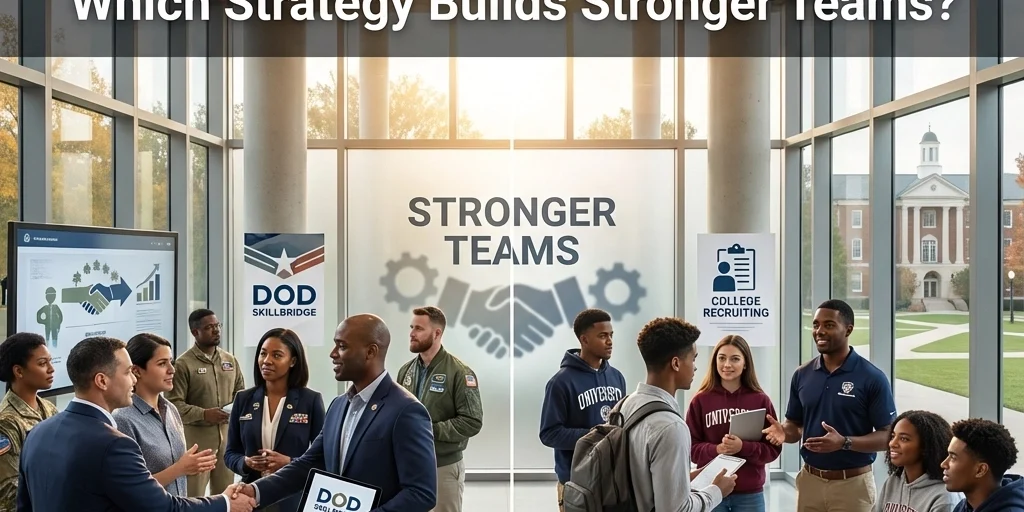
The modern business landscape demands strategic thinking about talent acquisition that extends far beyond traditional hiring practices. Companies today face a critical decision: continue relying on conventional college recruiting pipelines or embrace innovative programs like the Department of Defense SkillBridge initiative. This choice directly impacts not only immediate hiring outcomes but also long-term branding strategy and team composition.
Recent data indicates that 73% of companies struggle with talent retention within the first two years of hiring recent college graduates, while organizations participating in SkillBridge programs report 89% retention rates for program participants who transition to full-time positions. These statistics reveal a fundamental shift in how successful companies approach team building through strategic recruiting partnerships.
Understanding the Two Recruitment Paradigms
Traditional college recruiting has dominated corporate talent acquisition strategies for decades. This approach focuses on campus visits, career fairs, internship programs, and partnerships with university placement offices. Companies typically invest substantial resources in building relationships with specific institutions, targeting students based on academic performance and degree specialization.

The DOD SkillBridge program represents a different paradigm entirely. Established to facilitate civilian career transitions for active-duty service members, SkillBridge allows participants to gain hands-on industry experience during their final 180 days of military service. Companies receive access to motivated, disciplined candidates who bring unique perspectives and proven leadership capabilities to civilian teams.
The fundamental difference lies not just in candidate sourcing but in the entire approach to team development. College recruiting often emphasizes potential and academic achievement, while SkillBridge focuses on demonstrated performance under pressure and real-world problem-solving experience.
Branding Strategy Implications
Your recruitment approach directly reflects your company's brand identity and values. Traditional college recruiting positions organizations as academic-oriented employers who value theoretical knowledge and fresh perspectives. This branding strategy resonates with innovation-focused industries and appeals to companies seeking to project cutting-edge thinking and youthful energy.
SkillBridge participation, conversely, brands your organization as patriotic, supportive of military families, and committed to diversity through veteran hiring initiatives. This branding strategy particularly benefits companies in defense contracting, government services, and industries where security clearances provide competitive advantages.
The branding implications extend beyond external perceptions to internal culture development. Companies emphasizing college recruitment often cultivate environments focused on learning, mentorship, and gradual skill development. Organizations embracing SkillBridge typically develop cultures emphasizing results, accountability, and rapid adaptation to changing circumstances.
Team Composition and Performance Outcomes
Research from the Society for Human Resource Management indicates that teams combining military veterans with traditional civilian hires demonstrate 23% higher performance metrics in project completion rates and 31% better crisis response capabilities compared to homogeneous teams composed entirely of traditional college hires.

SkillBridge participants bring distinct advantages to team dynamics. Military training emphasizes mission accomplishment, attention to detail, and collaborative problem-solving under stress. These candidates often possess experience managing complex logistics, leading diverse teams, and adapting quickly to new technologies and procedures.
Traditional college recruits contribute different strengths to team composition. Recent graduates typically bring current academic knowledge, familiarity with emerging technologies, and fresh perspectives unconstrained by established industry practices. They often excel in creative thinking, digital native capabilities, and theoretical problem-solving approaches.
The most successful organizations recognize that optimal team strength emerges from strategic combination rather than exclusive reliance on either approach. Companies achieving the highest performance metrics typically maintain 60-70% traditional hiring complemented by 30-40% veteran recruitment through programs like SkillBridge.
Cost-Benefit Analysis of Each Strategy
Financial considerations significantly impact recruitment strategy selection. Traditional college recruiting involves substantial upfront investments in campus partnerships, career fair participation, internship program development, and lengthy interview processes. The average cost per hire through college recruiting ranges from $4,200 to $7,500, not including training and development expenses.
SkillBridge programs offer different cost structures. While participants receive continued military compensation during their industry experience period, companies avoid initial salary expenses while evaluating candidate fit. The average cost per successful hire through SkillBridge approximates $2,800 to $4,100, representing significant savings compared to traditional methods.
Hidden costs also differ substantially between approaches. College recruits typically require 6-12 months to reach full productivity, during which companies invest heavily in training and mentorship. SkillBridge participants often achieve productive contribution within 2-4 months due to their pre-existing work ethic and adaptability training.
Long-term Strategic Advantages
The long-term implications of recruitment strategy selection extend far beyond immediate hiring outcomes. Companies emphasizing college recruitment build pipelines with specific universities, creating predictable talent flows but potentially limiting diversity of thought and experience. This approach works exceptionally well for organizations requiring cutting-edge technical knowledge or rapid innovation cycles.

SkillBridge partnerships provide access to candidates with security clearances, leadership experience, and proven performance under pressure. These advantages become particularly valuable for companies pursuing government contracts, handling sensitive information, or operating in high-stress environments where reliability and accountability matter more than theoretical knowledge.
The combination approach offers maximum strategic flexibility. Organizations maintaining both recruitment streams can adjust their hiring mix based on current business needs, economic conditions, and specific project requirements. This flexibility becomes crucial during economic uncertainties when adaptable, experienced team members provide stability while fresh perspectives drive continued innovation.
Implementation Recommendations for Optimal Results
Successful integration of both recruitment strategies requires systematic planning and cultural preparation. Companies should begin by assessing their current team composition, identifying skill gaps, and determining the optimal balance between experience and innovation for their specific industry and goals.
Organizations new to SkillBridge participation should start with pilot programs, accepting 2-3 participants initially to evaluate program fit and develop internal support systems. This gradual approach allows companies to learn program mechanics while minimizing disruption to existing team dynamics.
Training managers to work effectively with both traditional college hires and military veterans requires specific attention to communication styles, feedback mechanisms, and career development expectations. Military veterans often prefer direct communication and clear performance metrics, while college graduates may benefit from more collaborative feedback and exploratory career conversations.
Creating mentorship programs that pair experienced team members with both types of new hires accelerates integration and knowledge transfer. The most effective programs establish cross-mentoring relationships where veterans share leadership and accountability insights while college graduates contribute current academic knowledge and fresh perspectives.
Measuring Success and Optimizing Your Approach
Establishing clear metrics enables continuous improvement of your recruitment strategy mix. Key performance indicators should include retention rates, time to productivity, performance review scores, and promotion rates for both recruitment streams. Additionally, tracking team performance metrics before and after implementing mixed recruitment approaches provides valuable data on optimal team composition.
Companies should also monitor brand perception changes resulting from their recruitment strategy adjustments. Survey existing employees, customers, and industry partners to understand how your hiring approach affects external perception and internal culture development.
The most successful organizations treat recruitment strategy as an ongoing optimization process rather than a fixed decision. Regular evaluation of results, adjustment of approach ratios, and refinement of support systems ensure continued improvement in team building outcomes and overall business performance. This data-driven approach to strategic hiring positions companies for sustained competitive advantage in an evolving business environment.





