
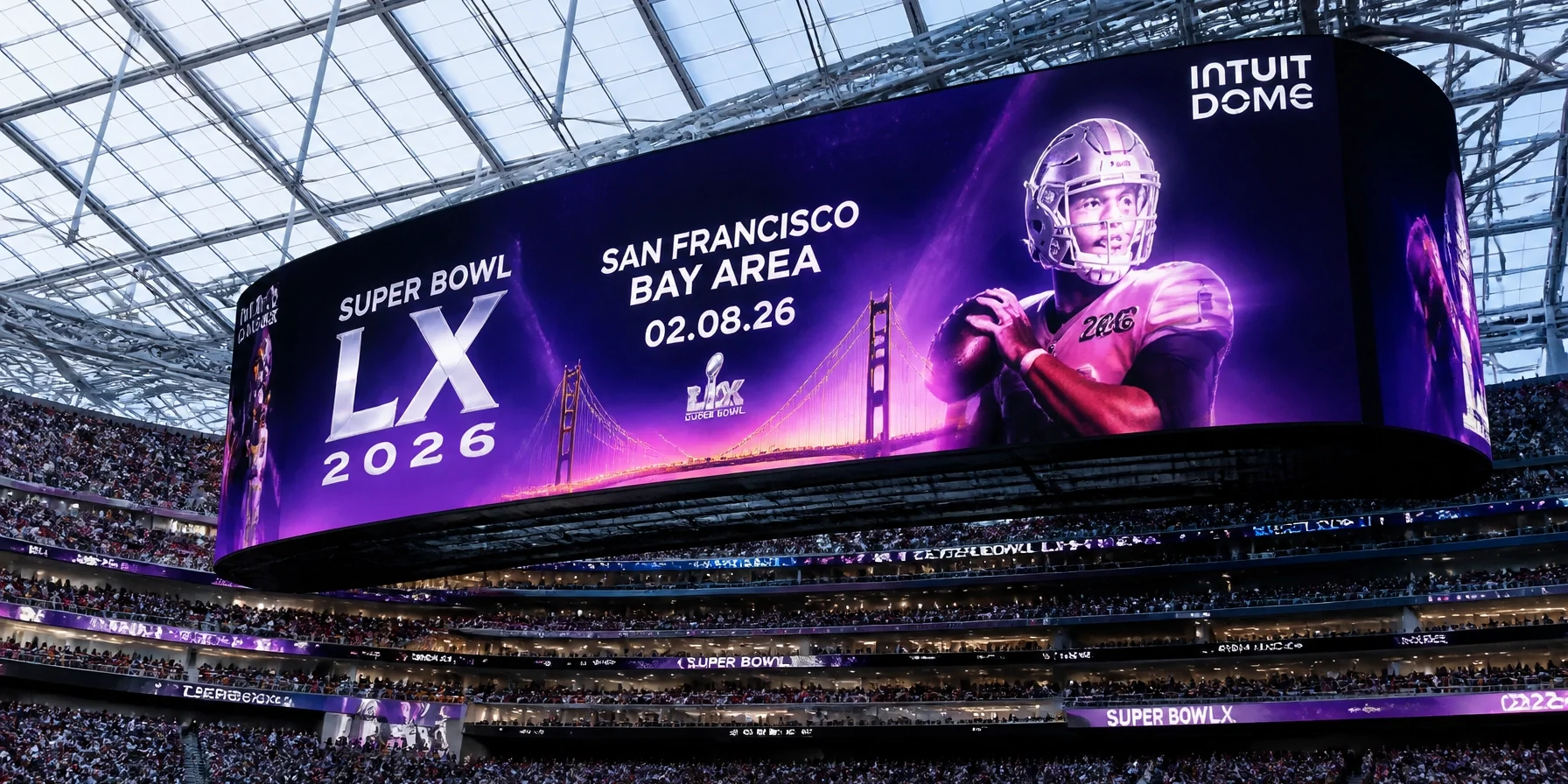
As the calendar turns toward February 2026, the global marketing community is centering its focus on a singular geographical coordinate: Levi’s Stadium in Santa Clara, California. Super Bowl LX is not merely a football game; it is a cultural and commercial phenomenon that dictates the trajectory of brand awareness for the fiscal year. While the traditional 30-second television spot remains a hallmark of the "Big Game," a significant paradigm shift is occurring. Marketers are increasingly moving beyond the broadcast screen to embrace a more immersive, physical strategy: Out-of-Home (OOH) dominance.
At USA Entertainment Ventures LLC, we recognize that "owning the environment" is the definitive strategy for 2026. This guide explores how the Sporttron Digital Network and sophisticated OOH tactics allow brands to transcend the noise of the commercial break and integrate themselves into the very fabric of the fan experience.
The 2026 Landscape: Beyond the Living Room
The Bay Area, encompassing San Francisco, San Jose, and Oakland, will serve as the host ecosystem for Super Bowl LX. Industry data suggests that over a million visitors will descend upon the region, creating a hyper-concentrated audience of high-value consumers. According to recent market analysis, nearly 75% of Gen Z fans engage more frequently with "snackable," short-form sports content and physical activations than they do with full-length broadcasts. This demographic shift necessitates a move toward visibility where the fans actually live, travel, and celebrate.
For brands, the challenge is clear: how do you capture attention in an environment saturated with stimulus? The answer lies in the strategic application of OOH media that utilizes the "Sporttron" approach: dominating the arena, the concourse, and the transit routes that define the Super Bowl week.
Owning the Environment with Sporttron Digital Network
The core of modern OOH mastery is the ability to synchronize messaging across a vast network of digital assets. The proprietary Sporttron digital network, a cornerstone of high-impact sports marketing, provides brands with unprecedented access to the "inner sanctum" of the sports world.
Synchronized Digital Dominance
The Sporttron network offers access to ribbon boards and jumbotrons across more than 780 venues nationwide. During the Super Bowl period, this allows a brand to create a "surround sound" visual effect. While a national TV spot is a fleeting moment, a synchronized campaign across digital ribbon boards ensures that the brand is part of the stadium's atmosphere for hours.
As noted in our recent strategic overview video, "Don't just advertise, dominate the arena." This philosophy is grounded in the psychological principle of "environmental immersion." When a consumer sees a brand on a high-definition jumbotron, then again on a digital ribbon board as they walk the concourse, the brand is no longer an interruption: it is a host of the experience.

The Multi-Sensory Approach: From Floors to Cup Holders
OOH mastery in 2026 extends far beyond the traditional billboard. To truly own the environment, a marketer must consider every touchpoint of the fan journey. This includes the very floors the customers walk on and the items they hold in their hands.
Concourse Floor Graphics and Wayfinding
In high-traffic environments like Levi’s Stadium or the surrounding fan zones in San Francisco and Oakland, floor graphics serve a dual purpose. They are functional for wayfinding while providing a massive, high-contrast canvas for brand storytelling. These placements are high-impact because they occupy the natural line of sight for attendees navigating crowded spaces.
High-Touch Concession Platforms
Perhaps the most innovative aspect of the Sporttron strategy is the "high-touch" concession platform. Consider the "Cup Holders for Charity" initiative. By branding the very cup holders at a fan's seat, a brand transitions from a distant visual to a tangible part of the person's comfort.
"Beyond the whistle, we create connections," the Sporttron methodology suggests. Integrating a charitable component into these physical assets: such as supporting local Bay Area initiatives or DOD Skill Bridge recruitment programs: not only increases brand sentiment but also aligns the corporation with broader societal good.

Data-Driven Decisions: Proving the ROI of OOH
A common critique of traditional OOH has been the difficulty of measurement. However, as we approach 2026, the integration of predictive modeling and fan sentiment analysis has transformed OOH into a data-rich medium.
Predictive Modeling and Sentiment Analysis
At USA Entertainment Ventures LLC, we employ sophisticated analytics to track the efficacy of OOH placements. By utilizing geotargeted mobile data in conjunction with stadium-based OOH, we can measure foot traffic, dwell time, and subsequent digital engagement.
"We prove your ROI by using predictive modeling and fan sentiment," states the Sporttron leadership team. This factual approach allows marketers to see exactly how an OOH investment in Santa Clara translates into digital conversions and long-term brand equity. For example, a fan who sees a branded jumbotron graphic is 40% more likely to engage with a retargeted social media ad later that evening.
The Human Element: NIL and Authentic Voices
The Super Bowl is as much about the athletes as it is about the game. In 2026, leveraging Name, Image, and Likeness (NIL) platforms is essential. By tapping into a network of over 20,000 authentic voices, brands can bridge the gap between their corporate identity and the culture-defining student-athletes of the next generation.
Integrating NIL athletes into OOH creative adds a layer of authenticity that stock photography cannot match. Seeing a local sports hero on a massive San Francisco billboard creates an immediate community connection. This "hybrid influencer-OOH" format is projected to be one of the most successful trends for the 2026 season.
Actionable Takeaways for Marketers
To achieve mastery at Super Bowl LX, marketing departments should consider the following strategic shifts:
- Book Early for the Bay Area: Inventory for transit hubs, stadium-adjacent billboards, and digital networks in San Francisco and Santa Clara is already being reserved. The most impactful "ownership" positions require a long lead time.
- Think "Short and Bold": Creative for OOH must be instantly legible. In 2026, 15-second digital spots on ribbon boards are proving to have the same brand recall as 30-second spots when designed with high-contrast, bold visuals.
- Integrate Physical and Digital: Ensure every OOH placement has a digital "capture" point: whether through QR codes, AR triggers, or geotargeted social media retargeting.
- Leverage Management Expertise: Working with a firm like USA Entertainment Ventures LLC allows brands to navigate the complex logistics of sports advertising and government-related recruitment sectors, such as the DOD Skill Bridge, which can be integrated into corporate social responsibility (CSR) messaging.

Conclusion: Setting the Stage for 2026
The Super Bowl in 2026 will be more than a sporting event; it will be a masterclass in modern marketing. Brands that rely solely on the broadcast screen risk being drowned out by a sea of similar commercials. Conversely, those that embrace the Sporttron Digital Network and the "Owning the Environment" philosophy will find themselves physically and emotionally connected to their audience.
By combining high-impact OOH placements, tangible fan experiences, and data-driven sentiment analysis, your brand can move from being a spectator to being the host of the biggest game on earth. The future of sports marketing is physical, digital, and undeniably immersive.
To learn more about how to secure your position for 2026, visit our Sports Advertising division or schedule a consultation with our experts today.





