
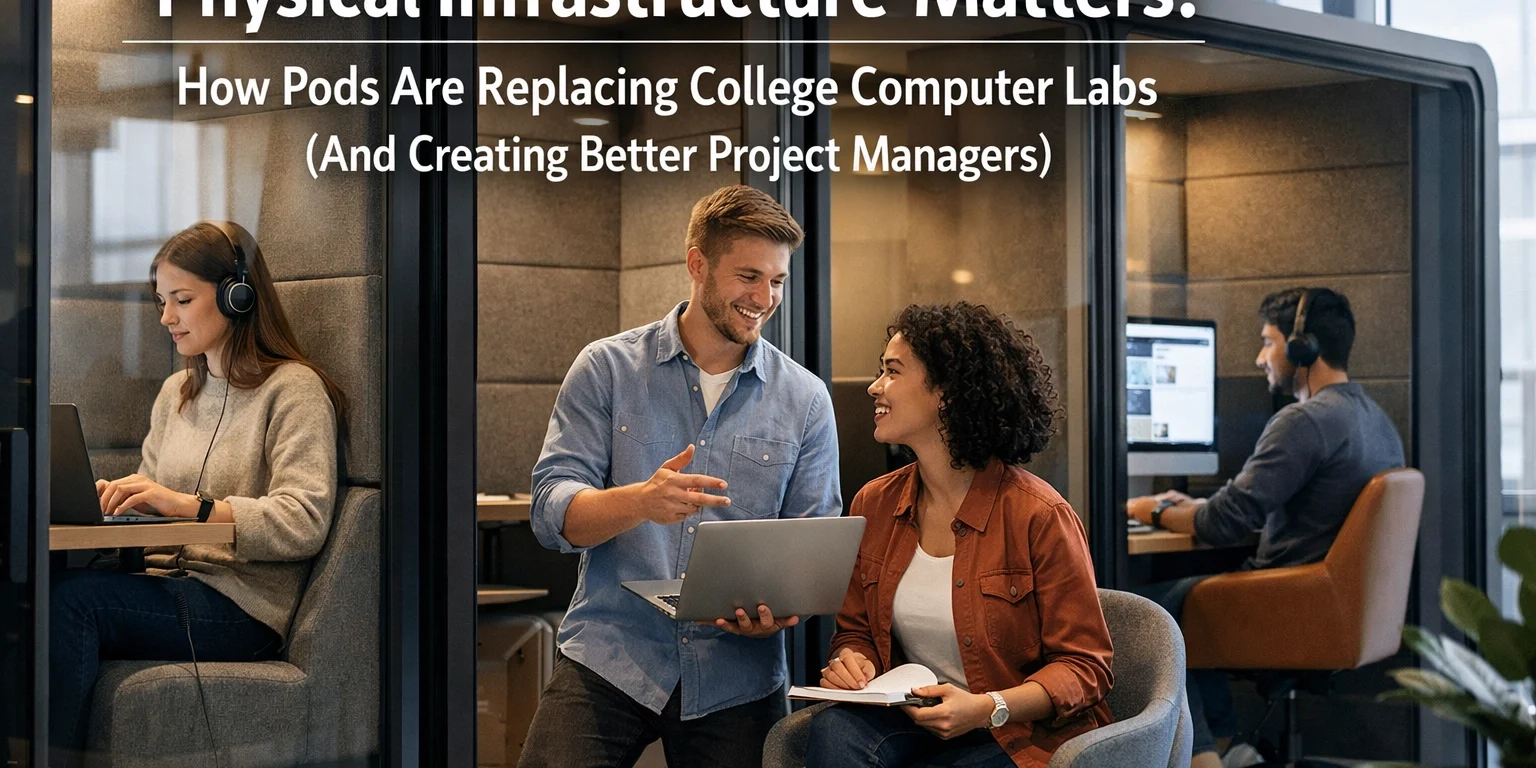
Remember those endless rows of beige desktop computers, fluorescent lighting humming overhead, and the strict "no food or drinks" signs plastered everywhere? Traditional college computer labs are going the way of dial-up internet and floppy disks. With 95% of students now carrying their own laptops to class, these once-essential campus fixtures are being reimagined: or eliminated entirely.
But here's where things get interesting: while general-purpose computer labs fade into memory, a new type of physical infrastructure is emerging. Enter the learning pod: a modular, specialized workspace that's not trying to be everything to everyone, but rather something specific to someone focused on building real-world skills.
The Problem With Traditional Labs
Traditional computer labs operated on a simple premise: provide students with computing power they couldn't afford at home. That made perfect sense in 1995. In 2026, it's an expensive solution to a problem that largely no longer exists.
The numbers tell the story. Hardware refreshes every few years drain institutional budgets. Dedicated lab space consumes valuable real estate on campuses where every square foot carries premium pricing. Many institutions have already pivoted their IT investments toward cloud technology and laptop loan programs, effectively duplicating their computing infrastructure: once in fixed labs, once in portable devices.

Beyond the financial burden, traditional labs imposed a learning model that increasingly conflicts with how modern work actually happens. Students sat in isolation, working independently on general-purpose machines loaded with every conceivable software package. This approach neither reflected the collaborative nature of professional environments nor prepared students for the specialized toolsets they'd encounter in specific career pathways.
As Penn State and Grand Valley State University discovered through usage tracking, overall lab visits declined significantly over the past decade. Interestingly, however, time spent per session increased: suggesting that students were using labs for more substantive, focused work rather than basic tasks they could accomplish anywhere.
What Makes Pods Different
Learning pods represent a fundamental rethinking of educational infrastructure. Rather than general-purpose computing stations, pods are purpose-built platforms organized around specific skill pathways and career outcomes.
The typical pod integrates several capabilities into one deployable unit:
Collaborative workspaces designed for team-based projects. Unlike the enforced independence of traditional lab rows, pods encourage the group dynamics essential to modern project execution.
Cloud computing curriculum access. Students can engage with structured learning paths aligned to industry certifications and real-world competencies, rather than simply accessing software.
Streaming studio capabilities for content creation. Recognizing that digital communication and multimedia production are no longer niche skills but universal professional requirements, pods incorporate the tools needed to develop these competencies.
Real-time analytics dashboards tracking learner progress. Both students and instructors gain visibility into skill development, helping identify gaps and accelerate advancement.
Industry-aligned career pathway modules. Instead of generic computing access, pods focus on the specific technical stacks and workflows used in target industries.

The Hybrid Advantage
Perhaps the most significant innovation in the pod model is its hybrid architecture. Unlike cloud-dependent systems that become useless when connectivity fails, pods house core computing resources locally while using internet connectivity to enhance rather than enable the learning experience.
This distinction matters enormously for equitable access. Rural communities and underserved areas often struggle with inconsistent broadband availability. A pure cloud solution effectively locks out these populations during connectivity interruptions. Pods solve this problem by ensuring that learning continues even when internet access fluctuates: the cloud components add value when available but don't constitute a single point of failure.
This architectural approach mirrors modern software development practices, where edge computing and local processing increasingly complement cloud services rather than being entirely replaced by them. Students working with pods inadvertently learn principles of resilient system design simply by using infrastructure built on these principles.
Career Pathways and Practical Skills
The modular nature of pods enables specialization around distinct career trajectories. Three pathways have emerged as particularly well-suited to pod-based learning environments: logistics, cybersecurity, and content creation.
Logistics and Supply Chain Management
Modern logistics professionals operate at the intersection of physical goods movement and digital information systems. They track shipments across multiple carriers, optimize routing through algorithmic tools, coordinate warehouse operations through management software, and analyze supply chain performance through data visualization platforms.
Pods configured for logistics training integrate transportation management systems, inventory control software, route optimization tools, and real-time tracking dashboards. Students work through scenarios that require coordinating multiple systems simultaneously: precisely the kind of multi-platform orchestration that defines contemporary supply chain operations.
This hands-on approach develops project management competencies organically. Students must establish priorities when multiple shipments face delays, allocate limited resources across competing needs, communicate status updates to various stakeholders, and adapt plans when circumstances change. These aren't abstract exercises in project management theory: they're practical applications embedded within domain-specific challenges.

Cybersecurity Operations
Cybersecurity roles demand comfort with specialized tools, rapid decision-making under pressure, and the ability to communicate technical findings to non-technical audiences. Traditional computer labs, with their locked-down configurations and limited software stacks, poorly served students pursuing these careers.
Cybersecurity-focused pods provide access to network monitoring tools, vulnerability scanning platforms, incident response frameworks, and threat intelligence feeds. More importantly, they create environments where students can safely conduct penetration testing, analyze malware samples, and simulate security incidents without risking institutional networks.
The project management dimension emerges through incident response simulations. Students must triage multiple simultaneous threats, coordinate response efforts across team members with different specializations, document actions for compliance purposes, and brief leadership on both technical details and business impact. These scenarios develop the same communication, prioritization, and coordination skills that define effective project management: grounded in high-stakes security contexts rather than generic case studies.
Content Creation and Digital Media
Content creation has evolved far beyond hobbyist blogging. Modern content professionals must understand video production workflows, audio engineering basics, graphic design principles, content management systems, SEO optimization, analytics interpretation, and audience development strategies.
Pods equipped for content creation integrate streaming equipment, editing software suites, publication platforms, and performance analytics tools. Students produce actual content rather than simply learning about production: they write, record, edit, publish, promote, and measure real work that audiences consume and evaluate.
Project management skills develop through the content production cycle itself. Students must plan editorial calendars, coordinate with collaborators, manage revision processes, meet publication deadlines, respond to audience feedback, and adapt strategies based on performance data. This iterative cycle of planning, execution, measurement, and adjustment mirrors the project management frameworks used across industries, but grounds them in tangible creative output rather than abstract methodology.
Collaboration as Infrastructure
The shift from isolated workstations to collaborative pods reflects broader changes in how organizations structure work. The rise of cross-functional teams, agile methodologies, and distributed collaboration has made individual contributor work models increasingly obsolete.
Educational institutions reimagining their lab spaces have recognized this shift. Rather than eliminating computing facilities entirely, forward-thinking schools are rebuilding them around collaboration and flexibility. Large monitors facilitate group work. Open floor plans enable spontaneous team formation. Access to specialized software justifies the dedicated space when such tools remain impractical for individual laptops. Extended hours accommodate diverse student schedules: bringing tools to where and when students need them rather than forcing everyone into rigid time blocks.

This physical infrastructure sends a message about what matters in professional development. When learning environments emphasize collaboration over isolation, students internalize that individual brilliance means less than team effectiveness. When spaces are organized around career-specific toolsets rather than general computing, students understand that deep expertise in particular domains creates more value than shallow familiarity with everything.
The Project Management Connection
The connection between pods and project management skill development operates at multiple levels. Most obviously, the collaborative nature of pod-based learning requires students to coordinate with others: dividing responsibilities, integrating contributions, resolving conflicts, and delivering cohesive outcomes.
More subtly, the specialized nature of pods forces students to work within constraints. Unlike general-purpose labs where any software could theoretically be installed, pods come configured for specific purposes. Students must accomplish objectives using available tools rather than defaulting to familiar applications. This constraint breeds creativity and adaptability: hallmarks of effective project managers who must deliver results despite limited resources.
The real-time analytics built into many pod systems provide immediate feedback on progress and performance. Students develop habits of measurement, adjustment, and continuous improvement: the iterative mindset that distinguishes competent project managers from those who simply follow plans until they fail.
Perhaps most importantly, pods create contexts where technical skills and project management capabilities develop simultaneously rather than sequentially. Students aren't learning project management theory and then applying it to technical work. They're managing projects within technical domains from the outset, building an integrated skill set rather than separate competencies that must later be combined.
Looking Forward
The transition from general-purpose computer labs to specialized learning pods represents more than a facilities update. It signals a fundamental shift in how educational institutions prepare students for professional environments.
As organizations continue emphasizing cross-functional collaboration, specialized expertise, and adaptive problem-solving, learning environments that cultivate these capabilities will deliver increasingly significant value. Pods: with their focus on specific career pathways, collaborative workflows, and integrated skill development: align educational infrastructure with workplace realities in ways traditional labs never could.
The physical infrastructure of learning matters. Where we learn shapes what we learn and how we learn it. As pods replace rows of isolated desktops with purpose-built collaborative environments organized around career outcomes, they're not just changing where students compute: they're fundamentally altering how students develop the integrated technical and project management competencies that define professional success.





