Remember the computer lab? Rows of beige towers humming under fluorescent lights, the smell of warm electronics mixing with carpet cleaner, and that one keyboard where the space bar stuck. For decades, these rooms represented the gateway to digital literacy. But walk into most educational institutions or training centers today, and you'll find something different taking shape: something more flexible, more purposeful, and significantly more aligned with how modern industries actually operate.
The traditional computer lab isn't quite dead, but it's certainly been reimagined. What's replacing it represents a fundamental shift in how we think about workforce development infrastructure.
The Evolution Beyond Rows of Desktops
The conventional computer lab model emerged when personal computing was expensive and internet connectivity was scarce. It made perfect sense: centralize resources, maximize access, and teach foundational skills in a controlled environment. But as personal device ownership exceeded 85% among working-age adults and cloud computing became ubiquitous, the value proposition changed dramatically.
Educational institutions began adopting "bring your own device" (BYOD) policies, converting old labs into collaborative spaces with strong Wi-Fi and comfortable furniture. This worked well for general computing needs, but it created a significant gap. How do you teach specialized, hardware-intensive skills when everyone's working on their personal laptop? How do you simulate enterprise-level cybersecurity scenarios or logistics management systems on consumer-grade equipment?
The answer isn't going backward to centralized labs. It's moving forward to something more modular, more specialized, and more directly connected to career outcomes. Enter the concept of training "pods."

What Makes a Pod Different from a Lab
While there's no universal definition, workforce training pods represent a departure from the one-size-fits-all computer lab model. Think of them as purpose-built learning environments configured around specific industry needs rather than general computing access.
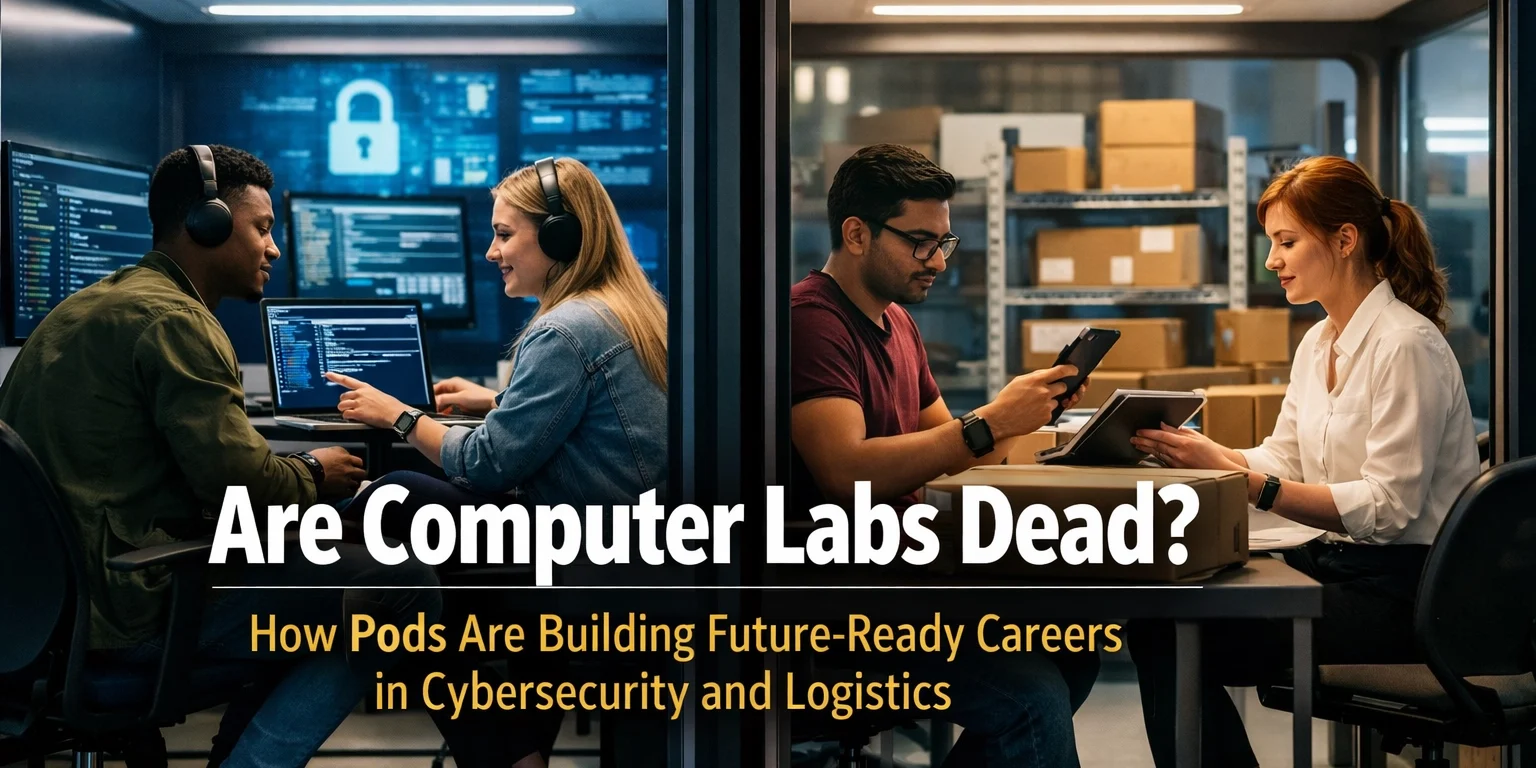
A cybersecurity pod might feature isolated network environments, virtual machine clusters, and penetration testing equipment. A logistics pod could incorporate RFID technology, warehouse management software terminals, and supply chain simulation platforms. A content creation pod might offer professional-grade editing workstations, recording equipment, and rendering servers.
The distinction matters because these aren't just rooms with different software installed. They're physical infrastructure investments that mirror actual workplace environments. When someone trains in a pod configured for their target industry, they're not learning abstract concepts on generic machines: they're developing muscle memory on the same tools they'll use professionally.
Building Cybersecurity Careers Through Immersive Infrastructure
The cybersecurity workforce shortage remains one of the most pressing challenges facing organizations globally. By 2025 estimates, unfilled cybersecurity positions exceeded 3.5 million worldwide. Traditional education struggles to close this gap partially because cybersecurity can't be taught effectively through textbooks and theory alone.
Cybersecurity pods address this by creating safe spaces for hands-on learning with real consequences: or at least, consequences that feel real. Participants work within isolated network environments where they can practice both offensive and defensive techniques without risking actual systems. They learn to identify vulnerabilities, respond to simulated attacks, and manage security operations center (SOC) workflows.
This infrastructure approach accelerates skill development in several ways. First, it removes the fear factor that paralyzes many learners when they're told to "break into" a system or test security controls. When the environment is designed for experimentation, students engage more freely. Second, it provides immediate feedback. Rather than waiting for an instructor to grade a theoretical response to a security incident, learners see the consequences of their decisions play out in real-time simulations.
Perhaps most importantly, pod-based cybersecurity training creates portfolio evidence. Employers in this field increasingly value demonstrated capability over credentials alone. When a candidate can walk through specific incidents they responded to, tools they mastered, and systems they successfully defended: even in a training environment: they present more compelling evidence of readiness than someone with a certificate but no hands-on experience.

Logistics Pathways: Where Physical and Digital Convergence Happens
If cybersecurity represents the purely digital career frontier, logistics represents the fascinating intersection of physical operations and digital optimization. Modern supply chain management relies on sophisticated software for inventory tracking, route optimization, demand forecasting, and warehouse automation. Yet it also requires understanding physical space, material handling, and the real-world constraints that no algorithm fully captures.
Logistics-focused training pods bridge this divide by incorporating both digital tools and physical components. Participants might use actual barcode scanners, RFID readers, and warehouse management terminals while simultaneously learning the software platforms that orchestrate these systems at scale. They work through scenarios involving inventory discrepancies, rush orders, and supply disruptions: experiencing the cognitive load of real-time decision-making.
This approach matters because logistics careers increasingly demand hybrid skills. A warehouse supervisor needs to understand both how to organize physical space efficiently and how to extract actionable insights from warehouse management system data. A transportation coordinator must know both routing software and the practical realities of driver hours-of-service regulations. Pod-based training environments teach these complementary competencies simultaneously rather than sequentially.
The infrastructure investment also signals something important to learners: this career pathway is real, professional, and valued. When someone enters a pod equipped with industry-standard technology, they internalize that they're preparing for a legitimate profession, not a placeholder job. This psychological shift affects retention, engagement, and ultimately, career outcomes.
Content Creation: The Underestimated Career Pathway
While cybersecurity and logistics attract considerable attention as high-demand career fields, content creation represents an equally significant but often undervalued opportunity. The creator economy now supports millions of full-time professionals, and businesses across every sector recognize content as essential infrastructure for customer engagement, brand development, and digital marketing.
Yet content creation training often suffers from the same problems that plagued general computer labs: inadequate hardware, consumer-grade software, and no connection to professional workflows. A student learning video editing on a five-year-old laptop with budget software isn't really preparing for professional content work any more than someone playing chess on their phone is preparing for competitive tournament play.
Content creation pods address these limitations by providing professional-grade equipment configured for actual production workflows. Participants learn to operate the same cameras, microphones, lighting systems, and editing platforms used by industry professionals. They experience the computational requirements of 4K video rendering, understand color grading workflows, and develop familiarity with asset management systems that handle large media libraries.
This infrastructure approach also facilitates collaborative learning that mirrors professional environments. Content creation is rarely solitary work: most professional content involves teams with specialized roles. Pod environments can accommodate multiple learners working on different aspects of the same project, building not just technical skills but also the communication and coordination abilities that employers value.

The Economic Logic of Specialized Infrastructure
Outfitting training pods with industry-specific equipment and software represents a significant investment. Why commit resources to this approach rather than continuing with general-purpose computer labs or fully online training?
The answer lies in outcomes. Generalized training produces generalized capabilities, which struggle to compete in specialized labor markets. Someone who learns "basic computer skills" faces steeper employment barriers than someone who can demonstrate proficiency with specific platforms and tools that employers actually use.
Specialized pods improve completion rates because learners see direct connections between their training and career opportunities. They increase employment rates because graduates possess demonstrable, job-specific competencies. And they support higher wages because participants aren't entering the labor market at the bottom rung: they're entering with professional-level capabilities that command professional-level compensation.
From a workforce development perspective, this infrastructure investment makes economic sense. The cost of establishing and maintaining specialized pods is substantial, but considerably less than the economic cost of unemployment, underemployment, and workforce skill gaps. Communities that build this infrastructure see returns through increased tax revenue, reduced social service utilization, and stronger local economies.
Moving Forward: Infrastructure as Career Access
The question "are computer labs dead?" misses the larger point. The relevant question is: what physical infrastructure best supports workforce development in an economy where digital capabilities underpin virtually every career?
Generic computer access no longer represents the primary barrier to digital inclusion. Most people can access computing devices and internet connectivity through various means. The new barrier is access to specialized, professional-grade tools and learning environments that build career-specific capabilities.
Training pods represent one approach to lowering this barrier. They're not the only approach, and they're not appropriate for every learning context. But in fields like cybersecurity, logistics, and content creation: where hands-on experience with specific tools dramatically accelerates career readiness: they offer compelling advantages over both traditional labs and purely online training.
Organizations investing in workforce development infrastructure would do well to consider how purpose-built learning environments might improve outcomes in their target industries. The old computer lab served its purpose for its era. The next generation of workforce infrastructure needs to be more specialized, more connected to actual career pathways, and more responsive to how modern industries operate.
The future of workforce training infrastructure isn't about nostalgia for computer labs or wholesale abandonment of physical learning spaces. It's about thoughtfully designing environments that give learners genuine preparation for careers that matter: careers in securing our digital infrastructure, managing our supply chains, and creating the content that connects us all.