
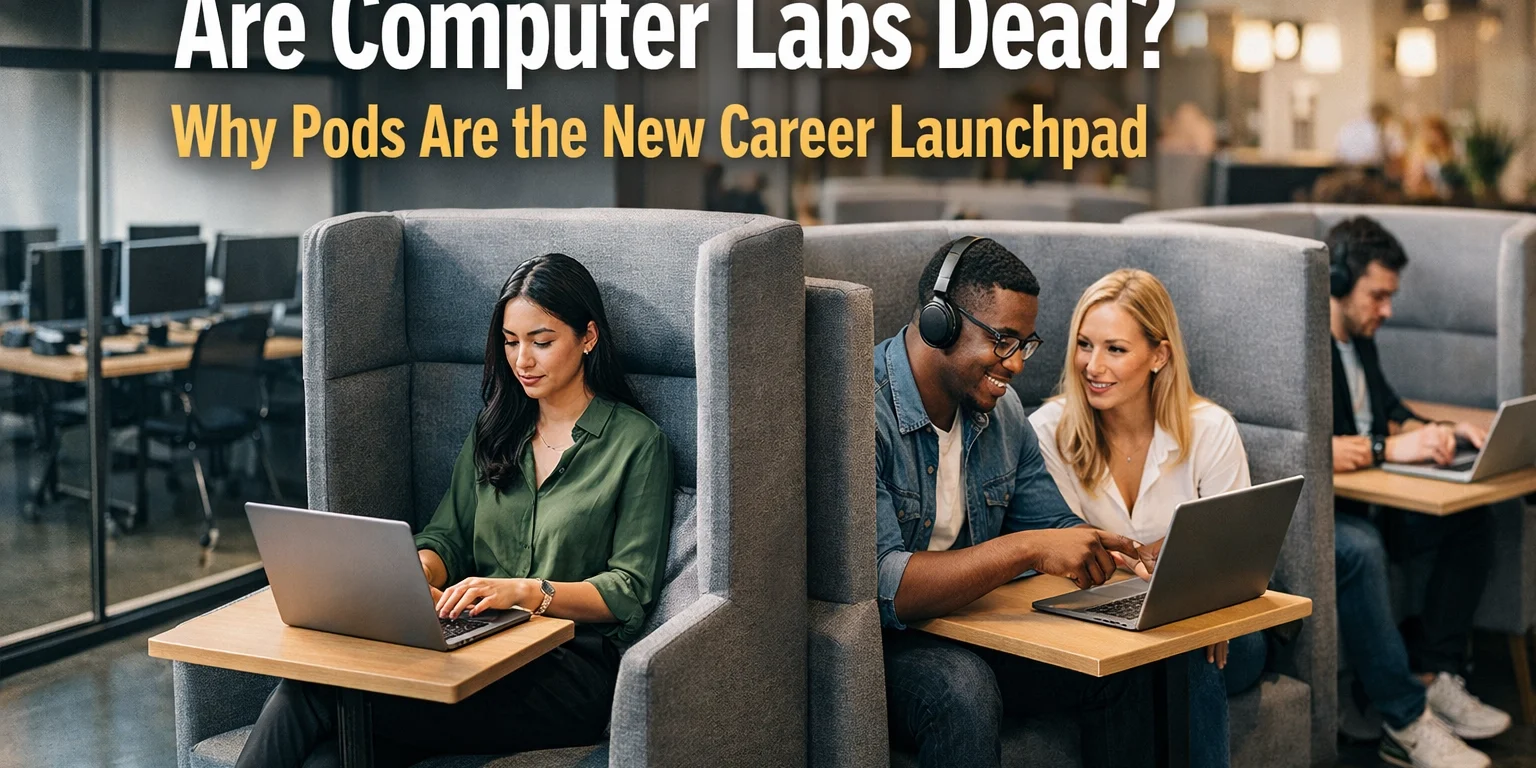
Remember those rows of beige desktop towers and flickering monitors from high school or college? The ones where you'd sit in isolation, clicking through the same Microsoft Office tutorials as twenty other people, each pretending not to check social media when the instructor wasn't looking? Yeah, those computer labs are going the way of the dinosaur: and honestly, good riddance.
But here's where it gets interesting: they're not just disappearing. They're evolving into something far more practical, engaging, and career-focused. Enter the "pod": a specialized learning environment that's less "1990s DMV waiting room" and more "actual workplace where professionals collaborate on real projects."
Why Traditional Computer Labs Are Checking Out
The writing has been on the wall for years. Usage data from Penn State and Grand Valley State University showed that while overall lab visits dropped significantly year after year, the students who did show up spent more time per session. Translation? Students weren't avoiding computers: they were avoiding the lab experience itself.
Traditional computer labs operated on a one-size-fits-all philosophy: identical machines, standardized software, isolated workstations. It made sense decades ago when just having access to a computer was novel. But today's job market doesn't reward people who can work alone on generic tasks. It rewards collaboration, specialization, and the ability to use industry-specific tools in team environments.
The traditional lab model promoted exactly the wrong habits for modern careers. Students sat in rows, working independently, using general-purpose software that barely scratched the surface of what professionals actually use in the field. It's the equivalent of teaching someone to drive using only a parking lot simulator: technically you're learning vehicle operation, but you're nowhere near ready for the real highway.

What Exactly Is a Pod?
Think of pods as career-focused learning hubs rather than generic computer rooms. Instead of rows of identical stations, each pod is purpose-built around a specific skill domain or career pathway. The physical layout differs dramatically from traditional labs: you'll find shared displays, collaborative workspaces, and equipment arranged to facilitate teamwork rather than isolation.
A pod isn't just a room with computers. It's an integrated learning environment where the physical infrastructure, software, and equipment are all selected to mirror actual professional settings. The furniture arrangement matters. The tool selection matters. The workflow setup matters. Everything is designed to prepare learners for real workplace scenarios in specific industries.
Pods typically employ a hybrid architecture: core computing resources remain local to ensure equity for students in underserved communities who might have limited internet access at home, while cloud connectivity supplements the experience with collaborative tools and online resources. This approach addresses a critical concern: not every learner has high-speed internet or powerful personal devices, but pods provide professional-grade infrastructure accessible to everyone.
The Cybersecurity Pod: Where Digital Defenders Are Born
A cybersecurity pod looks nothing like a traditional computer lab. You'll find network simulation equipment, penetration testing tools, virtual machine environments, and security monitoring stations: the same technologies professionals use to protect organizations from actual threats.
The physical setup encourages team-based incident response exercises. Students don't just learn about firewalls by reading about them; they configure them, test them, break them, and fix them in collaborative scenarios that mirror real security operations centers. The workstations are arranged to facilitate communication during simulated security incidents because in the real world, cybersecurity is never a solo sport.
Career pathways in cybersecurity are booming: the Bureau of Labor Statistics projects growth rates far exceeding average occupations. Organizations desperately need security analysts, penetration testers, security architects, and incident responders. Traditional computer labs couldn't possibly prepare students for these roles because they lacked the specialized infrastructure and collaborative environment that defines actual security work. Pods solve this problem by bringing the security operations center experience into the training environment.

The Content Creation Pod: From Idea to Publish
Content creation pods are where aspiring YouTubers, podcasters, videographers, and social media managers learn their craft using professional equipment. These spaces feature streaming studios, professional lighting setups, green screens, multi-camera configurations, and editing workstations powerful enough to handle 4K video rendering.
The physical layout matters enormously here. Content creation is inherently collaborative: you need someone managing audio while someone else handles camera work, with a third person monitoring the live stream or directing the shoot. The pod environment facilitates this team-based workflow with equipment positioned to support multiple people working simultaneously on different aspects of the same project.
Career opportunities in content creation have exploded beyond traditional media jobs. Every organization now needs video content, podcast production, social media management, and digital storytelling capabilities. From corporate communications teams to marketing agencies to independent creators building their own brands, the demand for content professionals who understand both the creative and technical aspects of production continues growing. Pods provide hands-on experience with professional workflows that generic computer labs simply cannot offer.
The Logistics Pod: Moving the World Efficiently
Logistics might not sound as sexy as cybersecurity or content creation, but it's the backbone of modern commerce: and it offers tremendous career opportunities. A logistics pod focuses on supply chain management software, route optimization tools, inventory management systems, and data analytics platforms that companies use to move products efficiently.
These pods emphasize data visualization and collaborative problem-solving. Students work in teams to optimize delivery routes, manage inventory across multiple locations, and respond to supply chain disruptions: the same challenges logistics professionals face daily. The physical setup includes shared displays showing real-time dashboards and collaborative workspaces where teams can analyze data together and make decisions.
The logistics sector offers diverse career pathways: supply chain analysts, operations managers, logistics coordinators, transportation planners, and procurement specialists. E-commerce growth has made logistics expertise more valuable than ever. Pods prepare students for these roles by providing hands-on experience with industry software and collaborative decision-making processes that traditional computer labs never addressed.

The Numbers Tell the Story
Organizations implementing pod-based models report cost savings between 50 and 75 percent compared to maintaining traditional computer labs. That's not a typo: pods are significantly cheaper to operate despite providing more specialized, higher-quality learning environments.
How? Traditional labs required maintaining dozens of identical high-end machines, constantly upgrading software licenses for general-purpose applications, and managing extensive hardware replacement cycles. Pods concentrate resources on specialized equipment that serves specific purposes, reducing overall infrastructure needs while increasing educational value.
Beyond cost savings, pods cultivate cross-functional skills that employers consistently rank as more important than purely technical knowledge: collaboration, communication, adaptability, and problem-solving. These are the competencies that determine career progression once someone lands their first job. A traditional lab might teach you Excel formulas, but a pod teaches you how to work with a team to solve real business problems using Excel and other tools in combination.
When Traditional Labs Still Make Sense
Let's be honest: pods aren't universally superior in every situation. Traditional computer labs retain advantages in specific contexts, particularly for organizations with limited IT staffing, tight budgets, or programs focused on developing narrow technical skills in standardized environments.
Labs offer undeniable benefits: hardware standardization simplifies maintenance, processing power per dollar can be maximized with bulk purchases, and physical security is straightforward when equipment is centralized and identical. For some organizations, these factors outweigh the collaborative and specialized benefits of pods.
The most effective approach might combine both models: individual lab time for developing foundational technical skills, paired with pod-based training for applying those skills in collaborative, realistic scenarios. This hybrid strategy provides both the technical foundation and the workplace readiness that modern careers demand.
The Infrastructure of Tomorrow
The shift from computer labs to pods represents more than a physical redesign of learning spaces. It reflects a fundamental rethinking of how we prepare people for careers in a collaborative, specialized, digitally-driven economy. Traditional labs served their purpose in an era when computer access itself was the primary barrier. Today, the barrier isn't access to computers: it's access to realistic, collaborative training environments that mirror actual professional settings.
Pods address this challenge by building physical infrastructure around career pathways rather than generic computing. Whether you're training for cybersecurity, content creation, logistics, or countless other fields, pods provide the specialized tools, collaborative layouts, and industry-relevant workflows that transform learners into workplace-ready professionals.
The question isn't whether computer labs are dead: it's whether we're ready to embrace the infrastructure model that better serves both learners and the organizations that will eventually employ them. Based on cost savings, usage patterns, and employer feedback, that answer seems increasingly clear: pods aren't just the future. They're the present, waiting for more organizations to catch up.





