
If you grew up anytime between 1990 and 2015, the phrase “computer lab” probably conjures a very specific, slightly depressing image. You likely picture a windowless room, rows of beige towers or dusty monitors, and a strict “no liquids” policy enforced by a librarian who viewed human interaction as a bug rather than a feature. You sat in a row, stared at a screen, and hoped the person next to you wasn’t looking at your awkward formatting in Word.
Fast forward to 2026. The world has changed, but in many places, the infrastructure for training the next generation of professionals is still stuck in that "row-and-column" mindset. At USA Entertainment Ventures LLC, we’ve seen that the most successful businesses aren't looking for people who can sit quietly in a row; they’re looking for teams who can solve problems in a circle.
Enter: The Pod.
The Pod isn’t just a fancy piece of furniture or a clever way to hide cables (though it does that too). It is a fundamental shift in how we think about the physical space where learning meets earning. By moving away from generic computing access and toward purpose-built, collaborative infrastructure, we are finally aligning our training environments with the reality of the modern workforce.
The Death of the Row (And Why We Won't Miss It)
The traditional computer lab was designed for one thing: efficiency of supervision. If everyone is facing the same direction, one teacher can walk the back of the room and make sure nobody is playing Solitaire. It was an assembly line for digital literacy.
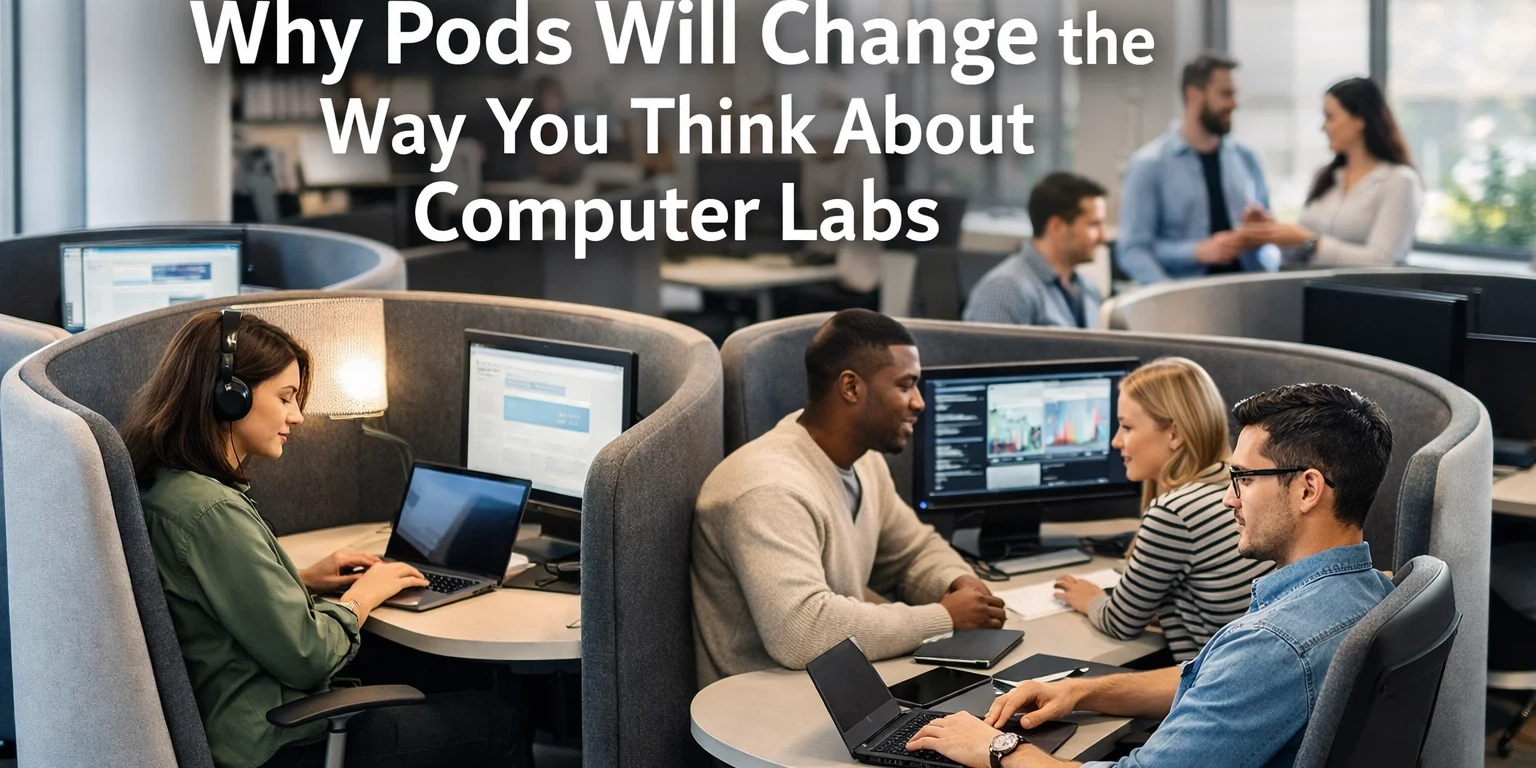
But the assembly line is dead. Modern careers in logistics, cybersecurity, and content creation don’t happen in a vacuum. They are messy, collaborative, and fast-paced. When you put students in pods: clusters of 4 to 6 workstations facing inward: you change the psychology of the room. Research shows that students in pod configurations show significantly higher levels of interaction, not just with their peers but with their instructors. They move from "isolated problem-solving" to "collaborative troubleshooting."
In a pod, the person to your left isn't a distraction; they are your teammate. The person to your right isn't a rival; they are your consultant. This mirrors the real world. If you walk into a top-tier tech firm or a modern business consulting hub today, you won’t see rows. You’ll see pods.

Logistics: The Digital War Room
Let’s talk about logistics. In 2026, logistics is no longer just about moving a box from Point A to Point B. It’s about managing a massive, real-time data stream of global supply chains, autonomous fleets, and warehouse robotics. You can't learn that by staring at a spreadsheet in a silent room.
A logistics-focused pod functions as a mini-command center. One student might be tracking fleet telemetry, another managing inventory levels, and a third coordinating with "customers." Because they are physically grouped, they can communicate with a nod or a quick word, just like they would in a high-stakes operations center.
This is the "war room" approach to education. By building the infrastructure around the career pathway, we stop teaching "logistics theory" and start teaching "logistics operations." When these students enter the workforce, they don’t need a six-month onboarding process to learn how to work in a team; they’ve been doing it since day one.
Cybersecurity: The Digital Bunker
If there is one field where "working in a row" is actively harmful, it’s cybersecurity. Traditional labs are usually tethered to a school or corporate network, meaning students can’t actually do anything interesting for fear of breaking the system. It’s like trying to learn how to be a mechanic by looking at a picture of an engine.
Cybersecurity pods are different. These are purpose-built, isolated network environments: digital bunkers, if you will. Within a pod, students can safely practice penetration testing, deploy "malware" in a controlled environment, and respond to simulated attacks in real-time.
Because the pod is a self-contained unit, it can be equipped with professional-grade security operations center (SOC) tools. One pod might act as the "Red Team" (the attackers), while the neighboring pod acts as the "Blue Team" (the defenders). This kind of hands-on, high-intensity training is only possible when the physical infrastructure supports the specialized needs of the field. It turns a boring lab session into a high-stakes game of digital chess.

Content Creation: From Desks to Studios
The "Content Creator" is no longer just a teenager in a bedroom; it is a vital role in every Fortune 500 company. Brands need video editors, streamers, podcasters, and community managers. Yet, most computer labs are still equipped with a basic mouse and a low-res webcam.
A content creation pod transforms the "lab" into a studio. We’re talking professional-grade audio interfaces, high-fidelity microphones, and green-screen capabilities integrated directly into the workspace. In this environment, a student doesn’t just "write a report." They produce a segment. They edit a video. They manage a live stream.
This specialization bridges the gap between academic knowledge and professional competency. Employers frequently report that new hires are "book smart" but struggle to use the actual tools of the trade. By creating pods that mirror professional streaming and editing suites, we ensure that the transition from the classroom to the studio is seamless.
The Shift in Instruction: From Sage to Coach
It’s not just the students who benefit from the pod layout; it’s the instructors. In a traditional lab, the teacher is the "Sage on the Stage." They stand at the front, talk at the back of everyone's heads, and hope for the best.
In a pod-based environment, the instructor becomes a "Coach on the Floor." They move between pods, sitting in on collaborative sessions and providing personalized feedback exactly when it’s needed. This allows for a much higher level of nuance. Instead of a one-size-fits-all lecture, the instructor can help one pod with a specific logistics bottleneck while helping another with a complex cybersecurity patch.
This personalized instruction at scale is the holy grail of modern education. It keeps students engaged and ensures that the fast learners aren't bored while the struggling ones aren't left behind.

Future-Proofing for 2027 and Beyond
As we look toward the national workforce infrastructure rollout, it’s clear that flexibility is the most important feature of any physical space. The technology we use today will be obsolete in three years, but the need for collaboration won't be.
Traditional computer labs are notoriously difficult to upgrade. They are hard-wired, bolted down, and rigid. Pods, by contrast, are modular. Need to turn a logistics lab into a cybersecurity lab? Swap out the software and adjust the peripheral hardware. The physical "pod" structure remains the constant, providing a stable foundation for an ever-changing digital landscape.
For executives and decision-makers, this isn't just about "looking cool." It's about ROI. A pod-based infrastructure is a long-term investment in human capital. It’s a commitment to training workers who are not just digitally literate, but "operationally ready."
The Final Word: It’s About the People
At the end of the day, a pod is just a collection of metal, plastic, and silicon. The magic happens when you put people in them. By changing the physical infrastructure of our computer labs, we are giving people permission to talk, to experiment, and to fail safely.
We are moving away from the "silent row" and toward the "vibrant hub." Whether you are looking at logistics, cybersecurity, or content creation, the message is the same: the future of work is collaborative. It’s time our training spaces reflected that.
If you’re still thinking about computer labs in terms of rows and columns, it’s time for an upgrade. The world isn't waiting for people who can follow instructions in a straight line; it’s waiting for the people who can innovate in a circle.
To learn more about how the landscape of business and entertainment is shifting, check out our latest insights or explore our about us page to see how we’re helping lead the charge into 2027.





