
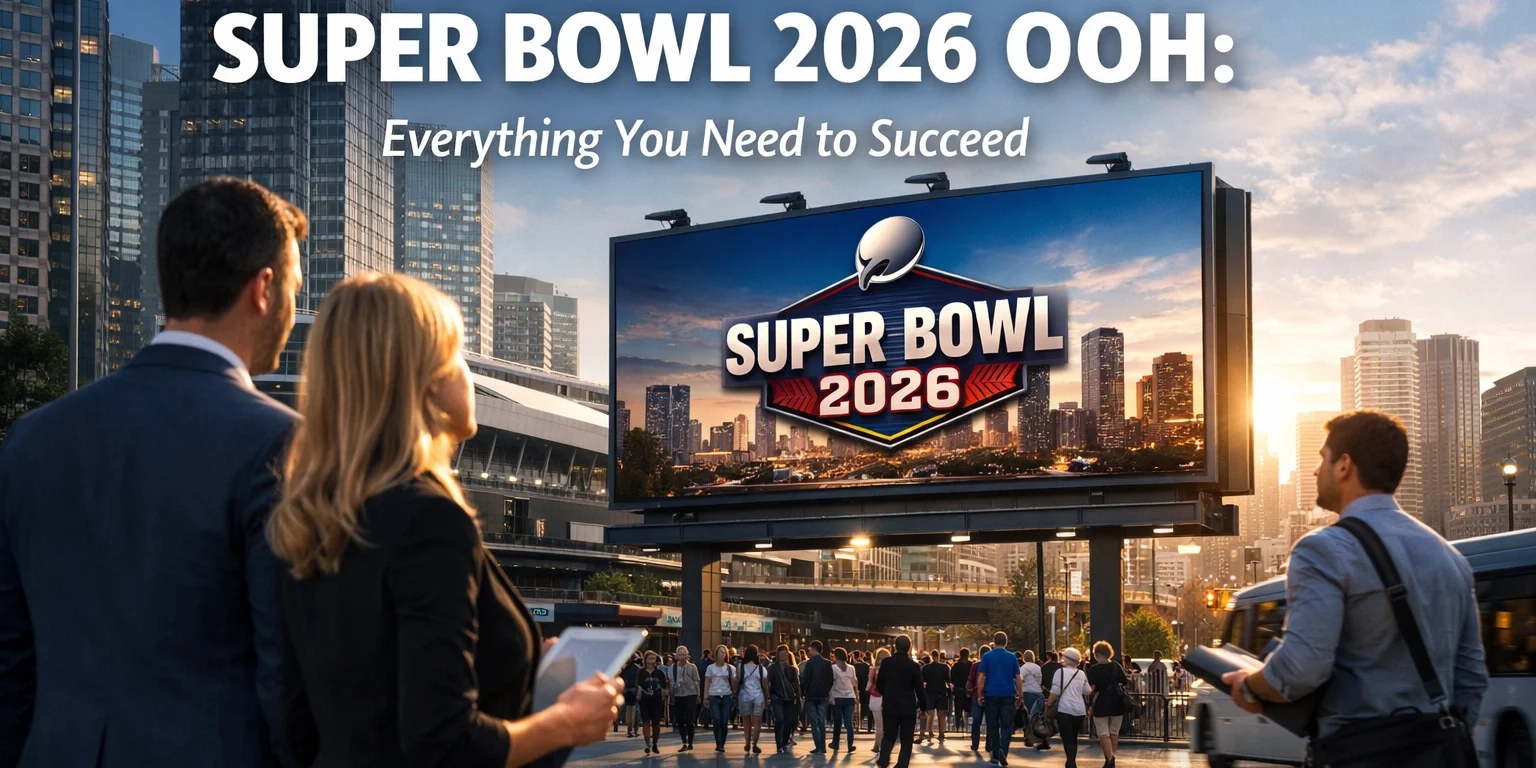
Super Bowl 2026 is not just a broadcast moment: it’s a multi-day, citywide migration of fans, media, brands, and decision-makers. And while TV spots still get headlines, out-of-home (OOH) advertising is where many of the most effective brands own the environment: from airports and rideshares to hotels, fan festivals, and the stadium itself.
OOH works especially well at the Big Game because it’s unavoidable and cumulative. Fans move through repeatable routes and high-dwell spaces for days. Unlike a 30-second TV ad, OOH delivers continuous exposure at the exact moments people are navigating, waiting, buying, and sharing content: prime conditions for recall and action.
This guide breaks down what “winning” with Super Bowl 2026 OOH actually looks like: the strategy, the placements, how to plan, how to measure, and how digital networks (including Sporttron Digital Network) help brands scale and adapt in real time.
What makes Super Bowl OOH different (and more powerful than most people expect)
OOH at the Super Bowl isn’t a single billboard or one flashy stunt. It’s environmental presence: repeated brand contact across the entire event journey. Fans don’t just attend a game; they arrive, check in, explore, eat, queue, celebrate, and post.
Industry analysis regularly highlights three structural advantages of OOH during tentpole events:
- Extended exposure time. The “Super Bowl window” is days long, not minutes long. Fans spend hours in-venue and multiple days in the host market, creating repeated opportunities for brand contact.
- Unskippable media. OOH cannot be muted, blocked, or fast-forwarded. It shows up when attention is naturally available: in transit, in lines, on concourses, and at gathering points.
- Stacking effect. OOH works best when it surrounds the audience. One placement can be memorable; ten coordinated placements create dominance.
As marketing professor Mark Ritson has argued in the broader context of mass media effectiveness, brands grow through reaching more buyers with consistent, repeated cues: not only through narrow targeting. Super Bowl OOH is built for that: high reach, high repetition, high cultural attention.
Owning the environment: why Sporttron-style digital networks matter
The game has shifted from “buy a sign” to “operate a network.” Digital OOH networks give brands the ability to coordinate messaging across venues, rotate creatives by time of day, and adapt based on live conditions (crowds, schedules, or local programming).
Sporttron Digital Network is a strong example of how brands can show up consistently across high-traffic sports and entertainment environments: delivering clean, high-frequency exposure with the flexibility modern campaigns require.
Watch the video below to see the concept of “owning the environment” in action:
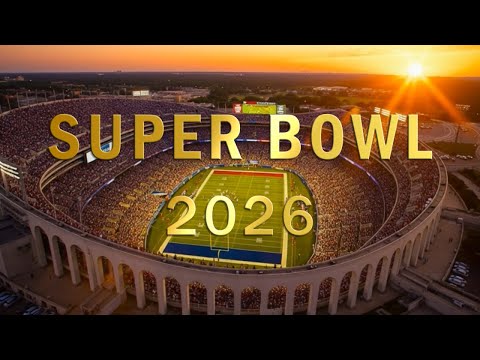
When your messaging can run across multiple screens in multiple locations, you stop thinking in single placements and start thinking in coverage: which is the real goal in Super Bowl OOH.
The Super Bowl 2026 OOH blueprint: plan for the full fan journey
The most reliable way to design a winning OOH program is to map the fan journey and then decide how you’ll show up at each phase. The best campaigns are not random; they’re sequenced.
1) Arrival: airports, major roadways, and rideshare zones
This is where attention is high and distractions are low. People are orienting themselves. They’re also forming first impressions: about the host city, the event, and the brands that “feel official.”
Best formats
- Digital billboards on inbound corridors
- Airport digital signage (baggage claim and arrivals)
- Rideshare pickup zones and transit shelters
Simple rule: if you only buy one stage, buy arrival. It’s the first repeated touchpoint and it anchors brand recall for the rest of the trip.
2) Stay: hotels, entertainment districts, and dining corridors
This stage delivers repetition. Fans loop through the same few areas for days, often on foot. This is where OOH becomes a “frequency engine.”
Best formats
- Street-level digital displays and kiosks
- Wallscapes near major venues
- Digital place-based screens in bars and entertainment zones
3) Build-up: fan festivals, sponsor activations, and media hubs
This is where OOH can directly fuel social sharing and lead capture. People are actively participating and looking for “proof-of-attendance” content.
Best formats
- Directional signage and branded wayfinding
- Photo moments (brandable, well-lit, easy to shoot)
- QR-driven screens tied to giveaways or experiences

4) Game day: stadium perimeter, entry, concourses, and concessions
Game day is where OOH becomes unavoidable. Fans are moving through controlled chokepoints (security, gates, stairs, escalators, concourses). Dwell time is real: especially in food and beverage lines.
Best formats
- Entry and gate takeovers (high volume, compressed time)
- Floor graphics and escalator/stair wraps (close-range impact)
- Concourse digital networks (repeat views across the event)
- Concession screen dominance (high dwell, high recall)
- Perimeter LED (dual audience: in-stadium + broadcast sightlines)
A key point that often gets missed: stadium placements can reach two audiences at once: the fans in the building and the much larger audience watching camera angles that include perimeter signage. Not every unit is broadcast-visible, but when it is, the value multiplier is significant.
5) Post-game: nightlife, transit home, and “next morning” departures
The post-game window is where brands can harvest the emotional peak. Win or lose, fans talk, share, and rewatch. If your brand is present during the celebration (or the commute), you earn association with the moment.
Best formats
- Entertainment district dominance
- Transit and rideshare signage
- Airport departures the following day
Format diversity: why “one big billboard” is rarely enough
A common planning mistake is over-investing in one premium unit and under-investing in coverage. A smarter approach is format diversity: using different surfaces for different distances and behaviors.
Think of OOH formats as roles:
- Billboards and large digital spectaculars = awareness and status
- Street-level and transit = frequency and repeated reinforcement
- Venue networks = captive attention and high dwell
- Floor/entry graphics = “inescapable” close-range branding
- Interactive/QR-enabled screens = action and trackable engagement
In practice, the campaigns that feel biggest aren’t always the ones with the single biggest unit: they’re the ones that show up everywhere you turn.
Creative that works at the Big Game: simple, bold, and built for motion
Super Bowl OOH is consumed in motion: walking, queuing, driving, scanning a crowd. Creative must match that reality.
Creative guidelines that consistently outperform
- One message per unit. If it takes more than two seconds to understand, it’s too complex.
- Big brand cues early. Logo, color, and product shape should be immediate.
- Use location intelligence. “Welcome to [City]” variations, countdowns, or game-week references increase relevance without adding complexity.
- Design to the viewing distance. Floor graphics and massive LED boards are not the same canvas.
- Build for social without relying on it. Make units photo-friendly, but don’t require a selfie to make the message work.
Nielsen has repeatedly noted in its OOH reporting that strong OOH creative tends to be clear, high-contrast, and quickly readable: because the medium is often experienced at speed. Super Bowl week amplifies that condition.

How to integrate OOH with mobile and social (without turning it into a gimmick)
OOH is at its best when it becomes the front door to a larger journey. The goal is not “QR codes everywhere.” The goal is to connect physical presence to measurable action.
High-performing integration patterns
- Hashtag + live content: Encourage posts and display selected fan content on digital screens (moderated and brand-safe).
- Geo-fenced retargeting: Expose fans to OOH, then reinforce with mobile ads during the trip and after they return home.
- Offer-based calls to action: Keep it simple: “Show this screen,” “Scan to enter,” “Tap to claim.”
- Retail tie-ins: If your product is sold locally, coordinate messages with nearby inventory and store locations.
The practical advantage of digital networks is control: creatives can rotate by daypart, audience density, and event timing: keeping the campaign fresh without reinventing it.
Planning timeline: what “early enough” actually means
Super Bowl OOH is inventory-constrained. The most valuable placements: especially those near stadiums, airports, and official fan zones: sell early.
A realistic planning clock
- 12–18 months out: footprint mapping, budget range, early holds, partner selection
- 9–12 months out: inventory lock, measurement plan, creative system planning
- 3–6 months out: final creative production, trafficking specs, contingency planning
- Game month: optimization, creative rotation, on-the-ground verification, reporting setup
If you wait until the last minute, you often get “leftover inventory,” and then you’re forced to make a smaller plan look like a big idea. The better move is to plan for coverage first, then layer premium.
Measurement and ROI: how to prove OOH worked
OOH measurement has matured quickly. Today, strong Super Bowl OOH programs can tie exposure to real outcomes: without pretending attribution is perfect.
Common measurement approaches
- Mobile location analytics (device ID-based): estimates reach, frequency, and visitation lift in defined exposure zones
- Footfall studies: compares exposed vs. non-exposed populations for store visits
- Brand lift surveys: measures awareness and consideration changes pre/post
- Digital lift: traffic spikes, branded search lift, QR or vanity URL engagement
- Sales coordination: retailer-level lift where distribution exists (particularly valuable for CPG)
The most important measurement principle is consistency: decide upfront what success looks like and instrument around it. In other words, don’t run a premium OOH program and then only report “impressions.” Tie it to actions you can defend in a boardroom.
A practical checklist: Super Bowl 2026 OOH that doesn’t miss
Use this as a simple gut-check before you commit budget:
- Coverage: Do you show up in at least 3 stages of the fan journey (arrival, stay, build-up, game day, post-game)?
- Frequency: Will fans see you repeatedly without trying?
- Format mix: Do you have both large-scale status units and close-range high-dwell placements?
- Creative system: Can you rotate creative by daypart or moment without diluting the brand?
- Integration: Do you have a clear path from exposure → engagement → measurable action?
- Measurement: Is there a defined plan for reach/frequency and at least one business KPI (visits, leads, sales, sign-ups)?
If any of these are missing, the campaign may still be visible: but it won’t feel dominant, and it may be harder to defend ROI after the fact.
Bringing it all together: dominance is designed, not bought
Super Bowl 2026 OOH success is rarely about one heroic placement. It is about designing an environment where your audience can’t help but encounter your brand: consistently, clearly, and at the moments that matter.
That’s why digital networks and coordinated venue coverage (the “own the environment” approach showcased by Sporttron Digital Network) keep gaining share: they help brands move from isolated ads to orchestrated presence.
If you’re building your Super Bowl strategy now, focus on the fundamentals: map the fan journey, buy coverage, keep creative simple, and measure what matters. The brands that do those things don’t just appear during Super Bowl week: they feel like part of it.
For more on how we think about event strategy and execution, visit https://usaentertainmentventures.com/about-us.





