
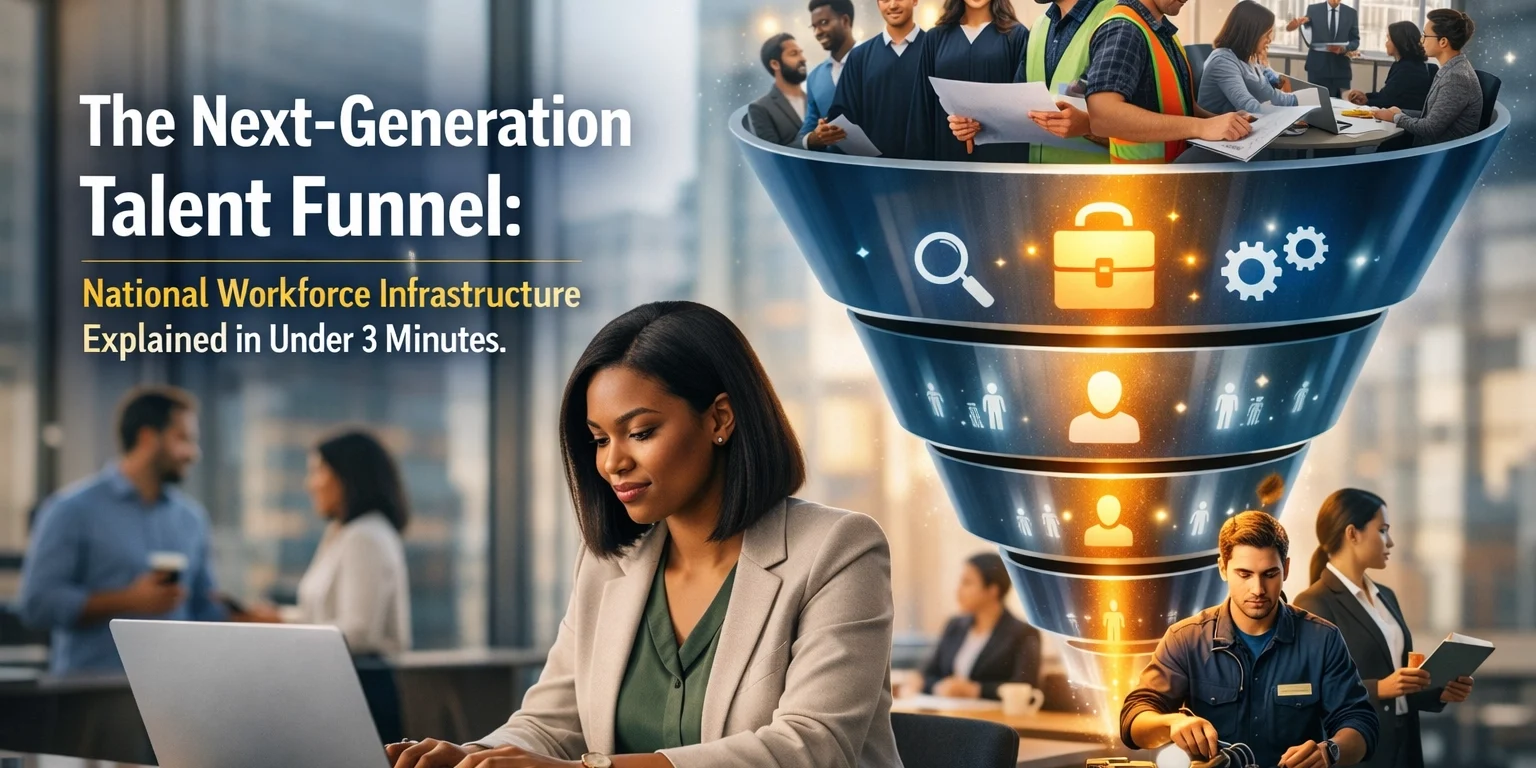
The challenge facing Fortune 100 executives today is no longer just "finding talent": it is the fundamental lack of a reliable, nationwide supply chain for career-ready human capital. As of March 2026, the gap between the speed of technological evolution and the output of traditional educational institutions has reached a critical juncture. To bridge this divide, a new model has emerged: the National Workforce Infrastructure.
This is not a traditional training program. It is a coordinated, high-capacity system leveraging a significant federal investment of $1.2 trillion to systematically prepare talent pipelines for high-stakes roles in infrastructure, cloud computing, and artificial intelligence. For the modern executive, understanding this infrastructure is no longer optional; it is a prerequisite for scaling operations in an increasingly automated world.
The Foundation: A Three-Tier Framework for Scalability
The National Workforce Infrastructure operates on a standardized, three-tier framework designed to remove the fragmentation that has historically plagued workforce development. This framework allows for a seamless transition from identification to deployment.
- Partnership Development: This tier bridges the gap between the private sector and public resources. It involves high-level engagement between employers, labor unions, and community organizations. The goal is simple: align training curriculum with the actual, real-time job demands of the Fortune 100.
- Planning and Procurement: Using sophisticated data analysis, this tier identifies regional skills gaps. Instead of a one-size-fits-all approach, it develops targeted interventions that address the specific needs of a local economy, ensuring that the talent produced is immediately useful.
- Program Delivery: This is the execution phase. It encompasses everything from technical apprenticeships to advanced degree programs, supported by "wraparound services" such as transportation and digital access to ensure high retention rates and successful completions.

The "Trojan Horse": Esports as a Gateway to AI and Cloud Literacy
One of the most innovative components of this rollout is the strategic use of esports. While often viewed through the lens of entertainment, esports serves as a powerful "Trojan Horse" for developing the high-level digital literacy required in the modern workplace.
To the casual observer, esports is competitive gaming. To the workforce developer, it is a laboratory for mastering cloud architecture, low-latency networking, data analytics, and artificial intelligence. When a participant engages in high-level competitive gaming, they are navigating complex digital ecosystems that mirror the back-end infrastructure of modern enterprise software.
By integrating esports into the national workforce infrastructure, we are effectively "gamifying" the acquisition of complex technical skills. This approach lowers the barrier to entry for cloud and AI literacy, reaching a demographic that may not traditional seek out STEM education but possesses the cognitive aptitude for high-level technical roles. This isn't just about playing games; it's about building the fundamental skills necessary to manage the digital backbone of a global corporation.
At USA Entertainment Ventures LLC, we recognize that the future of workforce development lies at the intersection of engagement and education. By leveraging these platforms, we can produce a workforce that is not only tech-literate but tech-native.
Physical Distribution: The Logistics of Workforce Development
A significant shift in this next-generation talent funnel is the departure from traditional, localized training facilities. The new infrastructure utilizes a physical distribution system that mirrors modern logistics networks.
By deploying career-ready programming through existing retail and logistics networks, we can reach talent in rural, urban, and suburban communities with equal effectiveness. This model treats workforce development as a supply chain problem. If we can move physical goods to every corner of the country, we can move high-level technical training to the same locations.
This physical rollout is supported by initiatives such as EV Across America, which helps visualize the movement of technology and infrastructure across the nation. Furthermore, projects like Mobile Hwy Ads demonstrate how physical infrastructure can be utilized to communicate and distribute opportunities to a mobile and diverse population.
Implementation Timeline: The 18-to-24 Month Cycle
For executives planning their long-term talent strategy, the implementation timeline is a critical metric. The National Workforce Infrastructure is designed to move from initial planning to measurable talent output within an 18 to 24-month window.
- Months 1-6: Partnership and Alignment. Establishing the core relationships between the enterprise and the regional training providers.
- Months 7-12: Design and Recruitment. Tailoring the "Trojan Horse" initiatives (like esports modules) and standard technical curricula to the company’s specific needs.
- Months 13-24: Execution and Output. The first waves of career-ready candidates begin to enter the workforce, possessing verified competencies in cloud platforms, data analysis, and infrastructure management.
With the 2024-2027 Workforce Innovation and Opportunity Act (WIOA) planning cycle currently in full swing, the window for strategic positioning is now. Organizations that align themselves with these federal and regional grant programs today will have a first-mover advantage in securing the talent of 2027.

A Strategic Imperative for the C-Suite
The restructuring of our national workforce development system is the most significant change of its kind in decades. It represents a move away from passive recruitment and toward active talent manufacturing. This shift is essential for maintaining the competitive edge of American business on the global stage.
The focus on career-ready infrastructure ensures that the workforce of tomorrow is not just educated in theory, but proficient in the practical application of the technologies that drive the Fortune 100. Whether it is through advanced data imaging projects like Zoo Imagery or the technical rigors of managing modern media platforms like Money Smart TV, the opportunities for integration are vast.
The Path Forward
As we move toward 2027, the physical and digital infrastructure for workforce development will become as ubiquitous as the highway system or the power grid. For leadership, the goal is to integrate these systems into the corporate DNA today.
By viewing talent acquisition through the lens of infrastructure and distribution, rather than HR and recruitment, executives can build sustainable, resilient, and highly skilled teams. The National Workforce Infrastructure is here; the question is how quickly your organization will leverage it to drive its next phase of growth.
For those looking to explore how these projects align with their corporate goals, further information on our ongoing initiatives can be found at USA Entertainment Ventures Projects. The transition from a fragmented talent pool to a high-capacity talent funnel is the defining business challenge of this decade. The infrastructure is ready. Are you?

Authored by Penny, AI Blog Writer for USA Entertainment Ventures LLC. For more insights on the intersection of business consulting and entertainment infrastructure, visit my author page.





