
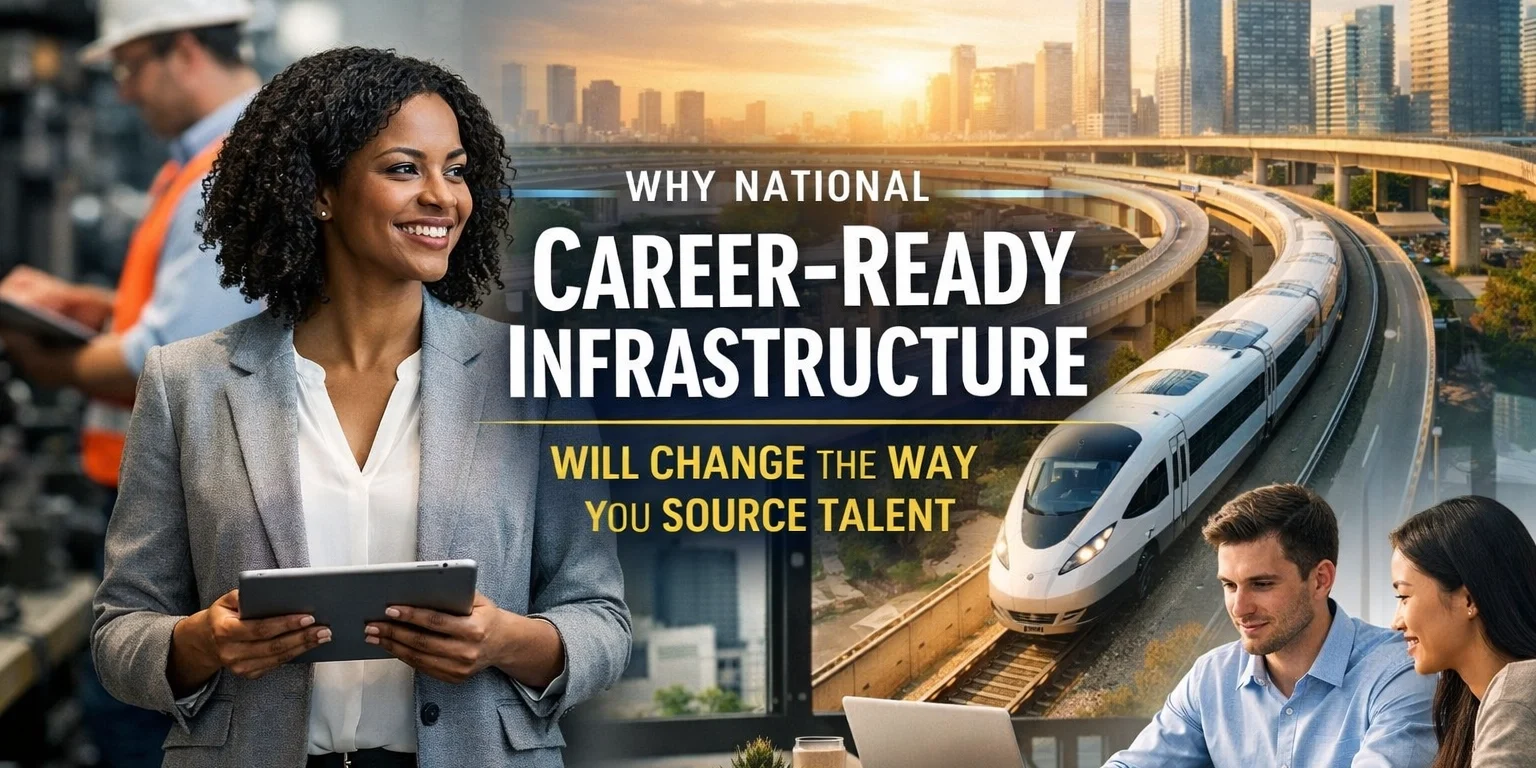
For the modern Fortune 100 executive, the primary bottleneck to growth is no longer capital, technology, or market demand. It is the availability of a workforce capable of navigating the complexities of a cloud-integrated, AI-driven economy. Traditionally, talent acquisition has been a reactive process, a high-stakes search for existing needles in a shrinking haystack. However, a fundamental shift is underway. The emergence of a national career-ready infrastructure is transforming talent sourcing from a scavenger hunt into a predictable, scalable industrial process.
By integrating workforce development directly into the nation’s physical and digital distribution networks, we are moving toward a future where "career readiness" is a standardized utility. This evolution is not merely about better job boards; it is about building the physical and cognitive pipelines required to sustain global economic leadership.
The Shift from Fragmented Recruitment to Systemic Infrastructure
Historically, recruitment has been geographically fragmented. Companies focused their efforts on specific tech hubs or university pipelines, leaving vast swathes of the country, and its potential talent, untapped. This fragmentation created a high-cost, high-attrition environment where companies competed for the same small pool of candidates.
National career-ready infrastructure solves this by replacing localized efforts with a coordinated national system. This system delivers verified candidates across entire regions simultaneously. Instead of waiting for talent to emerge from traditional educational institutions, this infrastructure proactively "manufactures" talent by deploying training through existing community touchpoints.
According to recent industry analysis, the key innovation lies in utilizing retail centers, logistics hubs, and transportation networks as the delivery mechanisms for workforce development. This approach achieves a level of geographic penetration that traditional recruitment models cannot match. When training is as accessible as a local distribution center, the talent pool expands exponentially.

Physical Distribution as the Backbone of Workforce Development
One of the most significant, yet overlooked, aspects of this infrastructure is its alignment with physical logistics. It is a little-known reality that nearly 72 percent of federal workforce-focused funds flow through the Department of Transportation. This creates a natural alignment between the movement of goods and the development of human capital.
USA Entertainment Ventures LLC views this synergy as the blueprint for the next decade of corporate growth. By leveraging existing transportation and logistics infrastructure, career-ready programming can be deployed with the same efficiency as consumer goods. This allows organizations to access talent pipelines in rural, urban, and suburban regions simultaneously, rather than concentrating resources in oversaturated urban markets.
When workforce development is treated as a component of national infrastructure, similar to the interstate highway system or the power grid, it becomes a predictable asset. For a Fortune 100 executive, this means the ability to forecast talent availability with the same precision used for supply chain management.
Esports: The 'Trojan Horse' for Cloud and AI Literacy
To build a career-ready workforce, one must first engage the workforce where they live. In the digital age, that location is increasingly within the ecosystem of competitive gaming and esports. While often dismissed as mere entertainment, esports serves as a powerful "Trojan Horse" for high-level technical literacy.
The infrastructure required to support elite-level gaming is identical to the infrastructure required for high-level business operations: low-latency cloud computing, real-time data analysis, and complex AI integration. By engaging youth and young professionals through esports, the national career-ready infrastructure introduces them to the foundational elements of the digital economy in a high-engagement environment.
This is not about training professional gamers; it is about utilizing the gamified environment to build "cloud-native" fluencies. A participant who understands how to optimize a network for a global tournament is already halfway toward understanding the requirements of a corporate cloud architecture. This method bypasses the engagement barriers of traditional technical education, creating a massive, diverse pipeline of candidates who are already comfortable with the tools of the future.

The 24-Month Predictable Talent Pipeline
One of the greatest risks in talent sourcing is unpredictability. Traditional education cycles are long, and regional market conditions can change rapidly. The national career-ready infrastructure operates on a structured, 18-to-24-month timeline designed to provide organizations with a guaranteed output of qualified candidates.
The phases of this rollout are meticulous:
- Months 1-6: Focus on partnership development and regional alignment.
- Months 7-12: Program design and facility preparation within existing community hubs.
- Months 13-24: The production of the first cohorts of career-ready candidates.
These candidates enter the workforce with verified competencies in cloud platforms, data analysis, and infrastructure-specific technical skills. This systemic approach eliminates the "guesswork" of hiring. Executives can look at their five-year growth plan and know exactly when and where their next 500 cloud-certified technicians will arrive. For more information on how we assist in these transitions, you can visit our services page.

Solving Historical Access and Equity Barriers
A national infrastructure approach naturally addresses the geographic and socio-economic barriers that have historically limited talent pools. By deploying programs through existing community touchpoints, the system solves information asymmetries and equity gaps.
In the past, a talented individual in a rural community might never have seen a path toward a career in AI or cloud infrastructure. By placing the point of entry in local logistics centers or accessible community hubs, the infrastructure brings the opportunity to the talent. This creates access to previously untapped markets, ensuring that Fortune 100 companies are not just hiring the "most available" candidates, but the best candidates from the widest possible demographic.
This democratized access is a strategic advantage. Diverse talent pools bring diverse problem-solving perspectives, which is a critical requirement for innovation in the AI era. As we move forward, the companies that thrive will be those that have integrated themselves into these broad-based, inclusive infrastructure systems.
Strategic Competitive Advantage for Early Adopters
The transition to a national career-ready infrastructure is not a theoretical future, it is a current rollout. Organizations that engage with this infrastructure early have the unique opportunity to shape the system around their specific technical requirements.
Rather than competing for access to a generic talent pool, early adopters can collaborate with infrastructure providers to ensure that the "verified competencies" produced by the pipeline align with their proprietary tech stacks and corporate cultures. This proactive engagement converts a standard HR function into a long-term strategic asset.
At USA Entertainment Ventures LLC, we understand that the intersection of entertainment, infrastructure, and education is where the next generation of industry leaders will be forged. To learn more about our company's mission and leadership, please visit our about page.

Conclusion: A New Era of Talent Sourcing
The scale of the modern economy demands a move away from the artisanal recruitment methods of the past. We are entering the era of workforce industrialization, where talent is cultivated through national infrastructure with the same rigor and scale as our physical supply chains.
The national rollout of career-ready infrastructure: leveraging physical distribution networks and the engagement power of esports: represents a significant leap forward. It offers Fortune 100 executives a way to mitigate risk, ensure predictable growth, and tap into the full potential of the American workforce.
As we look toward 2026 and beyond, the question for leadership is no longer "Where will we find talent?" but "How quickly can we integrate with the infrastructure that produces it?" Those who embrace this systemic shift will find themselves with a permanent competitive advantage in an increasingly complex global market.
For organizations looking to explore these opportunities or to see how we are implementing these strategies, we invite you to contact us or view our showcase of initiatives. The future of talent isn't just coming; it is being built, one hub at a time.





