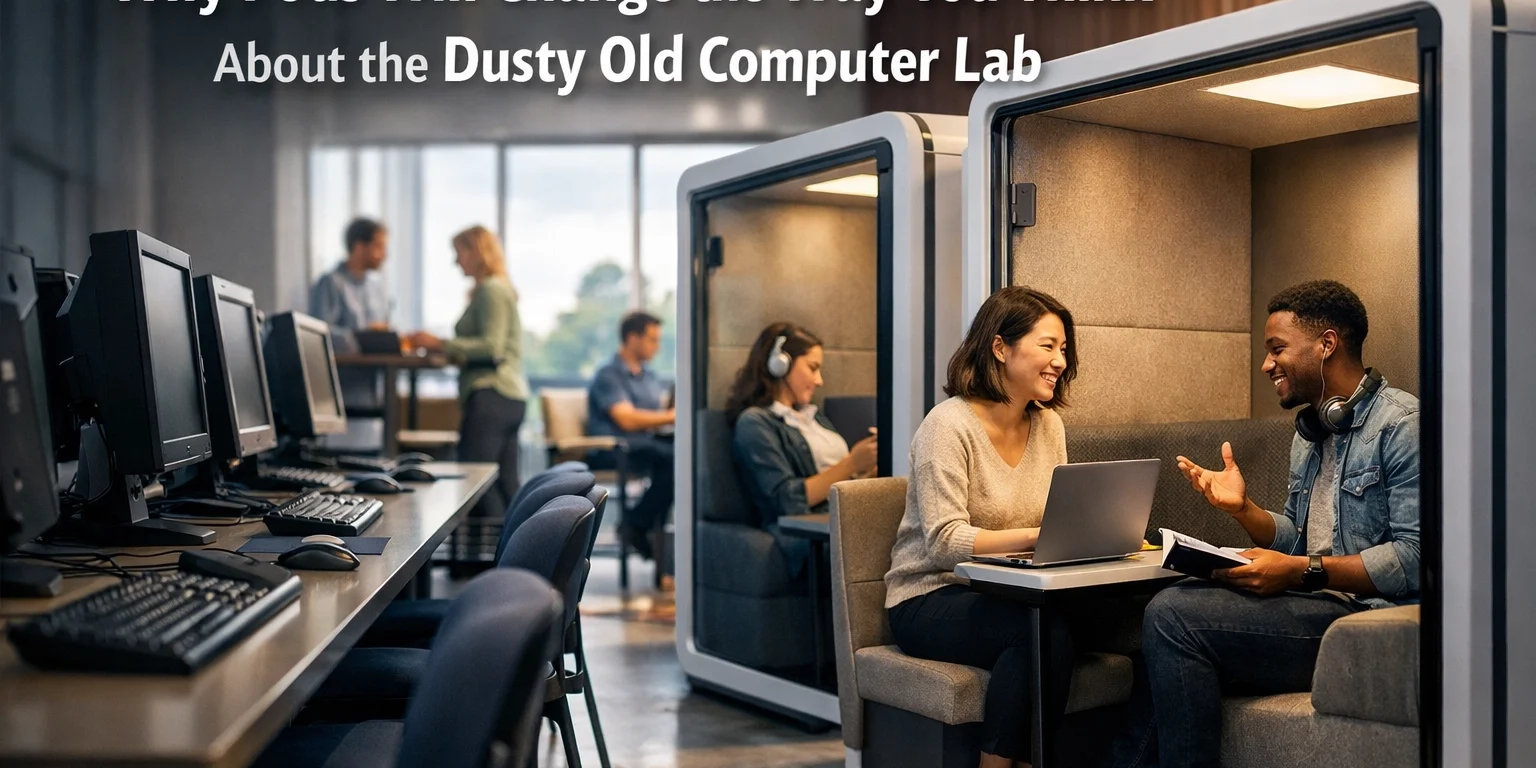
Let’s take a quick trip down memory lane. Close your eyes and imagine the "computer lab" of your youth. You’re probably picturing a windowless room with flickering fluorescent lights, rows of beige towers that hum like a Boeing 747 on takeoff, and those uncomfortable plastic chairs that seem designed to punish your spine. It was a place where you learned how to type "The quick brown fox" and maybe, if you were lucky, played a pixelated game about pioneers dying of dysentery.
Fast forward to 2026. The world has changed, but in many schools and training centers, the computer lab remains a dusty relic of the past. It’s a generic space for generic tasks. But there’s a revolution happening in physical infrastructure that is about to make those old labs look like stone tablets.
Enter the "Pod."
At USA Entertainment Ventures LLC, we spend a lot of time thinking about how environments shape performance. We aren't just talking about a desk with a screen; we’re talking about specialized, modular, and career-focused environments that mirror the modern professional world. Here is why pods are the future of learning and why the "old lab" is finally headed for the recycling bin.
The Death of the Row: Collaboration by Design
The traditional computer lab was built on a linear model: rows of isolated workstations where students stared at the back of each other’s heads. It was designed for a world where people worked in silos.
Modern industry doesn't work that way. Whether you are in software development, marketing, or logistics, you are part of a team. Pods are designed to reflect this. Instead of rows, think of clusters: curated physical spaces that facilitate eye contact, screen sharing, and rapid-fire brainstorming.

These collaborative infrastructures feature configurable work surfaces and multiple display options. This isn’t just about making the room look "cool." It’s about teaching cross-functional skills. According to recent industry observations, employers are increasingly prioritizing the ability to communicate technical concepts to non-technical stakeholders. When you’re sitting in a pod, you aren’t just a drone at a terminal; you’re a professional in a war room.
Cybersecurity: More Than Just Firewalls
Let’s talk about one of the most critical career pathways today: cybersecurity. In a traditional lab, you’re connected to the school’s main network. If a student tries to experiment with a "white hat" penetration test, they might accidentally take down the entire building's Wi-Fi.
A Cybersecurity Pod is a different beast entirely. It provides an isolated network environment. This "sandbox" architecture allows students to conduct real-world simulations: responding to simulated ransomware attacks or practicing incident response protocols: without any risk to the institutional systems.
It’s about "the feel" of the work. Cybersecurity isn’t just lines of code; it’s the high-stakes environment of a Security Operations Center (SOC). By simulating this physical and digital isolation, pods help students decide if they actually enjoy the pressure before they spend four years on a degree.
The Content Creation Studio: The New Front Office
In 2026, every company is a media company. From small businesses to giants like USA Entertainment Ventures LLC, the ability to create high-quality digital content is a core competency.
The "old computer lab" had a webcam and a basic microphone if you were lucky. A Content Creation Pod, however, is a professional-grade production suite. We’re talking:
- Integrated streaming studios.
- Professional audio dampening.
- Video editing workstations configured for 8K rendering.
- Lighting rigs that don't make you look like a ghost.
These pods allow learners to master the entire workflow: from pre-production to distribution. It’s the difference between "playing with a computer" and "learning a trade." If you’re interested in exploring how these specialized setups can transform a business environment, our services page dives deeper into how we consult on these transitions.

Logistics: The Hidden Career Path
We often talk about what happens inside the pod, but there is an entire career pathway built around the pods themselves: Logistics and Operations.
Managing a fleet of modular learning pods requires a sophisticated understanding of supply chains, hardware lifecycle management, and spatial planning. When an organization shifts from a static lab to a modular pod system, they need people who can manage the "physicality" of technology.
This is where logistics meets IT. How do you deploy fifty pods across three different campuses while ensuring they all have the same core computing power and cloud connectivity? It’s a massive puzzle that requires a new generation of logistics professionals. This "infrastructure-as-a-service" model is creating roles that didn't exist a decade ago.
The 75% Rule: Why It Makes Financial Sense
If you’re a CEO or a school administrator, "cool" only goes so far. You need to see the numbers. Here’s the kicker: specialized pod environments are actually more cost-effective than traditional labs.
Research indicates that institutions implementing pod-based models report cost savings between 50 and 75 percent compared to maintaining traditional, generic labs. Why? Because of utilization and standardization.
In a traditional lab, specialized equipment often sits idle in a general-purpose room. In a pod model, the equipment is utilized more efficiently because the space is purpose-built for the program. Furthermore, when multiple facilities use similar pod configurations, they can share resources, training materials, and maintenance protocols. It’s a win for the budget and a win for the student.
Bridging the Digital Divide with Hybrid Architecture
One of the biggest challenges in modern education is the "cloud dependency" trap. If the internet goes down, the learning stops.
Modern pods utilize a hybrid architecture. While they are fully cloud-connected for collaborative projects, they keep core computing resources local. This ensures that even in areas with inconsistent internet access, the work continues. This is a critical consideration for equitable education in underserved areas. At USA Entertainment Ventures LLC, we believe that opportunity should be accessible to everyone, regardless of their zip code’s bandwidth.
Finding Your Path
The ultimate goal of the pod isn't just to teach someone how to use a software program; it's to provide a "career test drive."
A student might think they want to be a video editor until they spend 40 hours in a Content Creation Pod and realize they hate the meticulous nature of the work. Conversely, someone might discover a hidden talent for network architecture while working in a Cybersecurity Pod.
This hands-on experience is invaluable. It prevents the "degree regret" that plagues so many young professionals. By the time a student enters the workforce, they already know the tools, the environment, and: most importantly: themselves.
If you are looking for a career that moves at the speed of technology rather than the speed of a dusty textbook, you might want to check out our career opportunities. We’re always looking for people who understand that the future is being built in these modular spaces.

Final Thoughts: The Future is Modular
The dusty old computer lab had its time. It introduced us to the internet and taught us how to save files on a floppy disk. But the needs of the 2026 workforce have outgrown the "one size fits all" classroom.
Pods represent a shift toward specialized, professional-grade, and collaborative learning. They are the physical manifestation of a world that values agility, specific expertise, and teamwork.
So, the next time you walk past a room full of beige boxes and rows of lonely monitors, remember: there’s a better way. The future is pod-shaped, and it’s a lot more exciting than a typing test.
Whether you're looking to upgrade your institution’s infrastructure or you're a professional looking to pivot into a new field, the move to modular is the smartest play you can make. Let's leave the dust in the past.