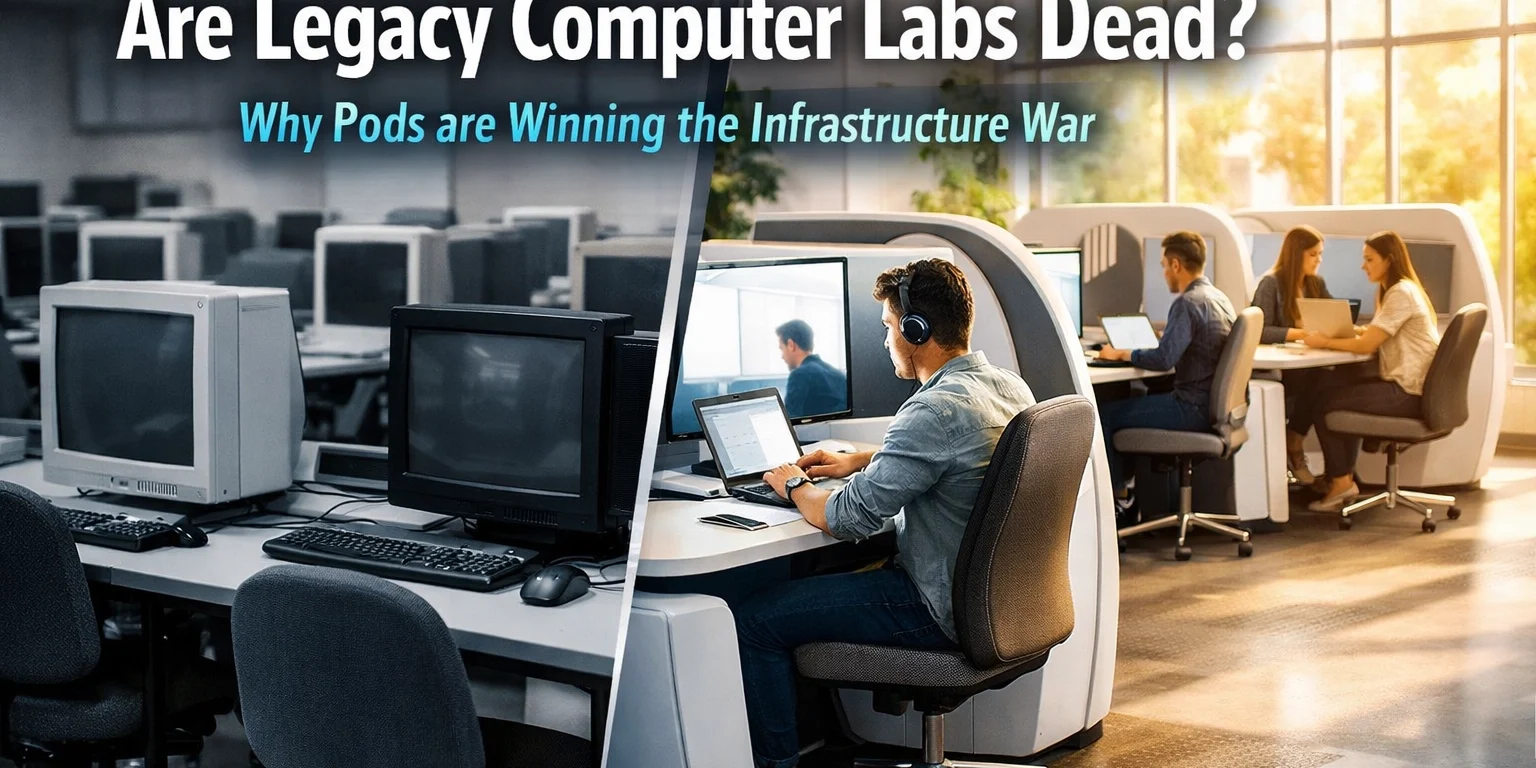
Remember the traditional computer lab? That windowless room smelling of ozone and desperation, filled with rows of beige towers and those "ergonomic" chairs that were anything but? If you haven’t visited one lately, don’t bother bringing flowers to the funeral: because the traditional computer lab isn’t just dying; it’s being replaced by something much sleeker, faster, and infinitely more useful.
Welcome to the era of the Pod.
As we sit here in March 2026, the "Infrastructure War" in education and corporate training is effectively over. The victor? Modular, specialized, and highly portable computing environments. At USA Entertainment Ventures LLC, we’ve been watching this shift closely. It’s not just a change in furniture; it’s a total reimagining of how we prepare people for the workforce.
The Financial Funeral of the Fixed Lab
Let’s talk numbers, because that’s usually where the "old way" starts to fall apart. Traditional computer labs are absolute money pits. To build one, you need premium real estate, a massive budget for HVAC (because 30 PCs generate the heat of a small sun), and a team of contractors to pull miles of Ethernet cable through walls.
Research shows that institutions switching to pod-based models are seeing cost savings between 50 and 75 percent. Why? Because pods are self-contained. You don’t need to renovate a building to install one. You just need a flat surface and a power hookup.
When you factor in the hardware refresh cycle: which happens every three years if you’re lucky: the traditional lab becomes a recurring nightmare for the CFO. Pods, on the other hand, are modular. Need better GPUs for a content creation project? Swap the module. Upgrading to a new server for a cybersecurity workshop? Slide it in. You’re not replacing a room; you’re updating a unit.

Speed: From Months to Minutes
In the modern business world, speed is the only currency that never devalues. If a company realizes it needs to train 50 new logistics coordinators in a new market, waiting six months for a traditional lab to be constructed is a non-starter.
This is where pods take the crown. A pre-configured pod arrives with integrated power distribution, climate control, and security features already baked into the chassis. We are talking about deploying a full-scale high-tech learning environment in a matter of days: sometimes hours: rather than months.
This agility is why pods are winning the infrastructure war. They can be deployed where the people are, rather than forcing the people to travel to where the computers are. For underserved communities or rural areas, this is a game-changer. It’s the difference between "we might build a center here in 2028" and "the training pod arrives on Tuesday."
Purpose-Built for the "What’s Next" Careers
The biggest sin of the legacy computer lab was its generic nature. It was built for "computing," which in 2005 meant Microsoft Word and maybe a flight simulator if the teacher was cool. But in 2026, "computing" is too broad a term to be useful.
Pods are purpose-built. They aren’t generic; they are specialized tools for specific career pathways.
1. The Cybersecurity Sandbox
You can’t teach high-level cybersecurity in a standard public-access lab without risking the rest of the network. Modern cybersecurity pods feature isolated network simulation hardware and secure servers. This allows students to engage in "Red Team vs. Blue Team" exercises in a safe, air-gapped environment. It’s hands-on, it’s messy, and it’s exactly what the industry demands.
2. The Content Creation Studio
The "creator economy" isn’t a hobby anymore; it’s a massive vertical. Pods designed for content creation aren’t just desks with PCs. They are acoustic-treated environments with 4K cameras, high-fidelity microphones, and the processing power required for real-time video rendering. Whether it’s for 360 Sports Media or corporate internal communications, these pods provide a pro-level environment that a generic lab simply can't match.
3. The Logistics Command Center
As global supply chains become more complex, the need for logistics experts has skyrocketed. Logistics pods are designed to simulate real-world command centers, using multi-monitor setups to track global shipments, manage warehouse robotics, and run AI-driven optimization simulations.

The Collaboration Culture
If you look at a traditional lab, the layout is basically a "digital sweatshop": rows of people staring at the back of each other's heads. It’s a design that discourages talking, sharing, and working together.
Pods flip the script. They are designed with "huddle spaces" and shared displays. The physical layout mirrors the contemporary workplace. In 2026, no one works in a vacuum. You’re constantly collaborating via Slack, Zoom, or in-person scrums. Pods facilitate this by creating a circular or clustered environment where looking at your neighbor’s screen isn’t "cheating": it’s peer review.
This shift in physical infrastructure is training students for the soft skills they actually need: communication, teamwork, and collective problem-solving.
Bridging the Digital Divide with Hybrid Architecture
One of the coolest technical aspects of the pod revolution is the use of hybrid architecture. While everyone loves to talk about "the cloud," the reality is that 100% cloud-based learning is a recipe for disaster in areas with spotty internet.
Pods house core computing resources locally while using cloud connectivity for updates and heavy-duty external processing. This means that if the fiber line gets cut by a stray backhoe, the pod keeps running. For rural training initiatives, this reliability is essential. It ensures that the "logistics of learning" don't stop just because the Wi-Fi is acting up.

Career Pathways: Where the Jobs Are
So, if pods are the new infrastructure, what does that mean for your career? It’s creating a whole new set of roles that didn’t exist a decade ago.
- Pod Logistics & Deployment: Someone has to manage the fleet. This is a mix of traditional logistics and high-tech fleet management.
- Modular Infrastructure Techs: These are the people who keep the pods humming. It’s a step up from a standard IT help desk role; it requires knowledge of hardware, networking, and climate control systems.
- Content Architects: As specialized pods become the norm, we need people who can design the "curriculum-in-a-box" that lives inside them.
At USA Entertainment Ventures LLC, we see this as a massive opportunity for business consulting. Organizations shouldn't just be asking "How many computers do we need?" but rather "What kind of pod will drive our specific goals?"
The Verdict: Modular or Bust
The infrastructure war is essentially over because the "fixed" model can't compete with the "fluid" model. Pods offer better economics, faster deployment, specialized training, and a more human-centric design.
Traditional labs might still exist for basic literacy: the "learn how to use a mouse" level of education: but for anything advanced, the pod is the only way forward. They are the mobile, agile, and versatile backbone of 2026’s workforce development.
If your organization is still planning to build a room with 40 fixed desks and 40 desktop towers, take a deep breath and put the blueprints down. The world has moved on to something better, cheaper, and a whole lot cooler.
Want to learn more about how the landscape of business and entertainment is shifting? Check out Zoomedia News for the latest updates on how we're moving the needle.
The future isn't a room; it's a pod. And honestly? The air is much better in here anyway.