
Let’s take a quick trip down memory lane. Do you remember the "Computer Lab" of the early 2000s? It was a windowless room that smelled vaguely of ozone and floor wax, filled with beige towers that roared like jet engines just to load a single page of Encarta. If you were lucky, you got 45 minutes a week to "learn computers," which mostly consisted of playing Oregon Trail until your entire party died of dysentery.
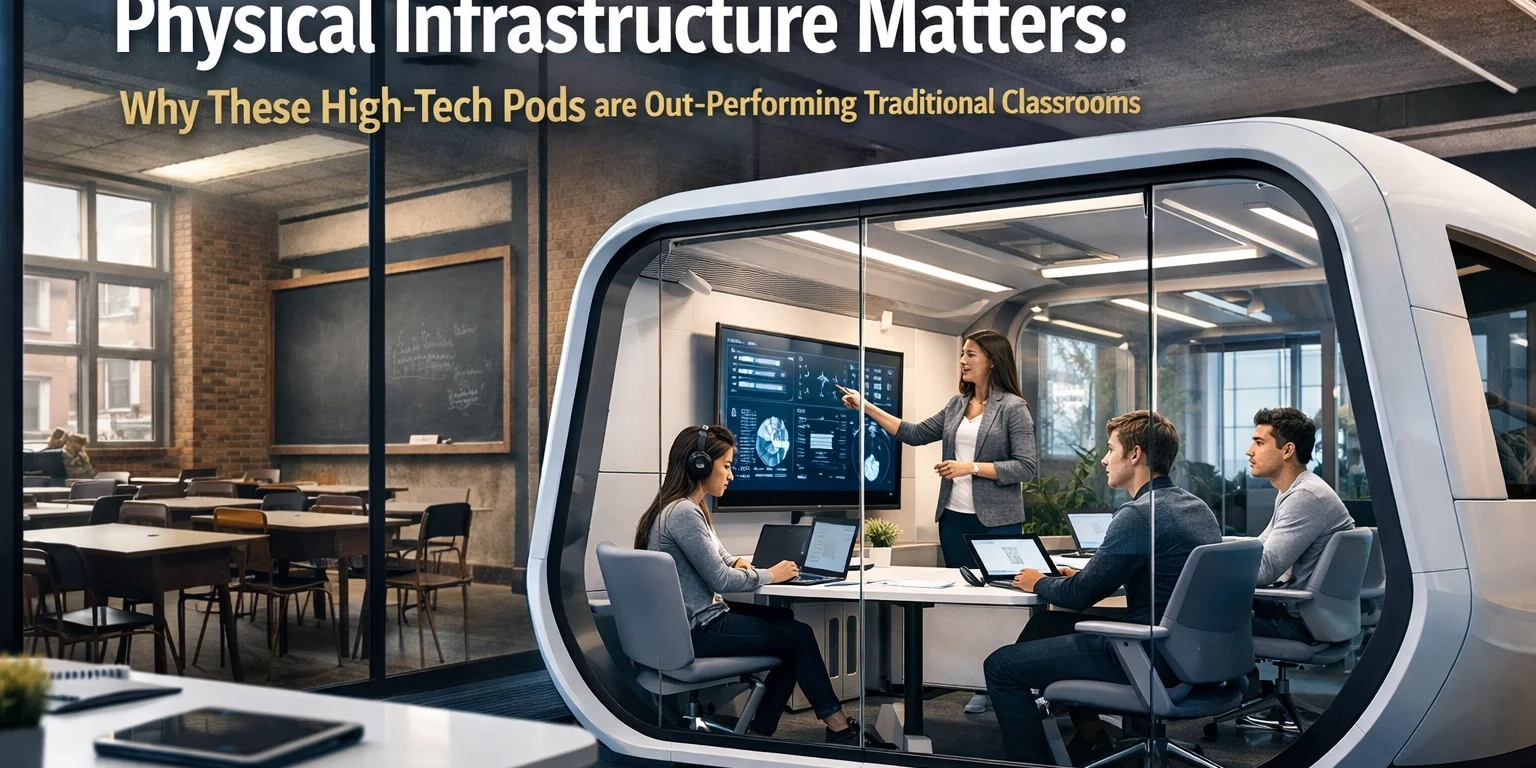
Fast forward to 2026. The world has changed, but a lot of our school buildings haven't. We’re still trying to teach 21st-century skills in 20th-century boxes. This is where the "Pod" comes in. While traditional classrooms are struggling with crumbling drywall and spotty Wi-Fi, high-tech modular pods are quietly revolutionizing how we think about educational infrastructure.
At USA Entertainment Ventures LLC, we spend a lot of time looking at how physical environments impact performance. Whether it's business consulting or career development, the "where" matters just as much as the "what."
The Infrastructure Myth: Bigger Isn’t Always Better
For decades, we’ve been told that a "good school" needs a massive footprint, stadiums, sprawling libraries, and cavernous auditoriums. But in the digital age, physical infrastructure isn't about how many bricks you can stack; it's about the density of the technology inside those bricks.
Traditional classrooms are "generalist" spaces. They have to work for English literature, Algebra, and History. Because they try to do everything, they often do nothing exceptionally well, especially when it comes to high-level tech integration.
High-tech pods, on the other hand, are the specialized surgical tools of education. They are purpose-built environments designed for one thing: high-octane digital immersion. These aren't just "small rooms"; they are self-contained ecosystems with dedicated cooling, fiber-optic hardlines, and ergonomic stations that would make a Silicon Valley engineer weep with joy.

Why Pods are the "New" Computer Labs (On Steroids)
The "computer lab" isn't a room anymore, it's a node. The shift toward learning pods is driven by a simple realization: you don't need a 30,000-square-foot building to access the entire world's knowledge. You just need a stable, high-performance gateway.
In a traditional classroom, a teacher has to manage 30 kids at different levels. In a pod, the physical infrastructure facilitates a "micro-learning" environment. The tech is baked into the walls. We're talking integrated VR arrays for history lessons, localized servers for lag-free coding, and acoustic treatments that allow for professional-grade audio production.
This isn't just about making school "cool." It’s about creating an environment that mirrors the modern workplace. If you want to see what we mean by high-level execution, check out our showcase of modern projects.
Career Pathway #1: Logistics – The Invisible Engine
When people think of "high-tech," they usually think of flashy robots or glowing screens. But some of the most lucrative careers of the future are in the "boring" stuff that keeps the world moving: Logistics.
Modern pods serve as the perfect training ground for logistics professionals. Why? Because a pod is a logistics puzzle. Managing a network of modular pods across a city or state requires a deep understanding of supply chain management, maintenance scheduling, and resource allocation.
Students learning in these environments aren't just reading about logistics; they are living it. They see how modular components are swapped out, how bandwidth is throttled based on demand, and how physical space is optimized. This translates directly into careers in global shipping, warehouse automation, and urban planning.
Career Pathway #2: Cybersecurity – The Digital Shield
You can’t teach cybersecurity effectively on a school network that's still running Windows 10 and a prayer. Traditional school infrastructures are notoriously porous, making them a nightmare for actual security training.
High-tech pods offer a "sandboxed" environment. Because they are modular and can be isolated from the main grid, they allow students to engage in "Red Team vs. Blue Team" exercises, actual live-fire cyber simulations, without the risk of crashing the entire district's payroll system.
The physical isolation of a pod provides a psychological benefit, too. It feels like a "command center." That sense of professional stakes is exactly what students need to prepare for career opportunities in a field that currently has a massive talent deficit. In 2026, the best "defense" is a well-built "offense" in a controlled environment.

Career Pathway #3: Content Creation – The New Literacy
Let’s be honest: in 2026, "content creation" is just the new way of saying "communication." Whether you’re a CEO, a doctor, or a consultant, you need to know how to present ideas through video, audio, and interactive media.
Traditional classrooms are acoustic nightmares. High ceilings and hard floors make for terrible audio. Pods are designed with "studio-first" infrastructure. They provide the soundproofing and lighting rigs necessary for students to produce high-quality podcasts, webinars, and streaming content.
By moving content creation out of the "media center" (which is usually just a corner of the library with a green sheet taped to the wall) and into a dedicated high-tech pod, we’re telling students that their voice has professional value. We’re giving them the tools to build brands before they even graduate.
The Data Speaks: Why Pods Outperform
Research into the 2020-2025 educational shift showed a surprising trend. While traditional schools have more "stuff" (gyms, cafeterias), pods reported higher levels of student engagement and "professional autonomy."
It turns out that when you put a small group of students in a high-density tech environment, they don’t just learn faster, they act more professionally. There’s something about the physical infrastructure of a pod that signals "work" rather than "school." It’s the difference between sitting in a plastic chair at a gum-covered desk and sitting in a cockpit.
For businesses looking to partner with educational initiatives, this is the gold standard. We aren't just looking for "smart" kids; we're looking for kids who are "environmentally literate", those who can step into a high-tech workspace and know exactly how to leverage the infrastructure around them. You can learn more about our philosophy on this at our about us page.

The Cost Factor: A Logic Exercise
Skeptics always point to the cost. "Isn't it cheaper to just use the buildings we already have?"
Actually, no.
Maintaining a massive, aging brick-and-mortar facility is a financial black hole. Between HVAC costs, roof repairs, and the astronomical price of retrofitting old wiring for modern fiber-optics, traditional schools are a "sunken cost" fallacy in action.
Pods are scalable. You can drop a pod into a community center, a parking lot, or an old warehouse. You only pay for the infrastructure you're actually using. It’s "Just-in-Time" education. If a neighborhood grows, you add a pod. If it shrinks, you move the pod to where it’s needed. That’s the kind of agile thinking we advocate for at USA Entertainment Ventures LLC.
Looking Ahead: The Future is Modular
By the end of this decade, the idea of a "school building" might seem as quaint as a "telephone booth." We are moving toward a decentralized, high-tech model where physical infrastructure is as mobile and adaptable as the software we use.
The pods are out-performing classrooms because they aren't trying to be everything to everyone. They are specific, they are high-tech, and they are designed for the world as it exists today: not as it existed in 1950.
If you’re interested in how this shift affects your industry or if you have questions about the logistics of implementing high-tech solutions in your own space, visit our Q&A section or contact us directly.
The beige towers of the old computer lab are gone. The dysentery-prone settlers of Oregon Trail have been replaced by cybersecurity analysts and content strategists. It's time our buildings caught up.

Disclaimer: The views expressed in this blog are focused on the evolving landscape of educational infrastructure and do not constitute specific architectural or financial advice. For more details, see our disclaimer.





