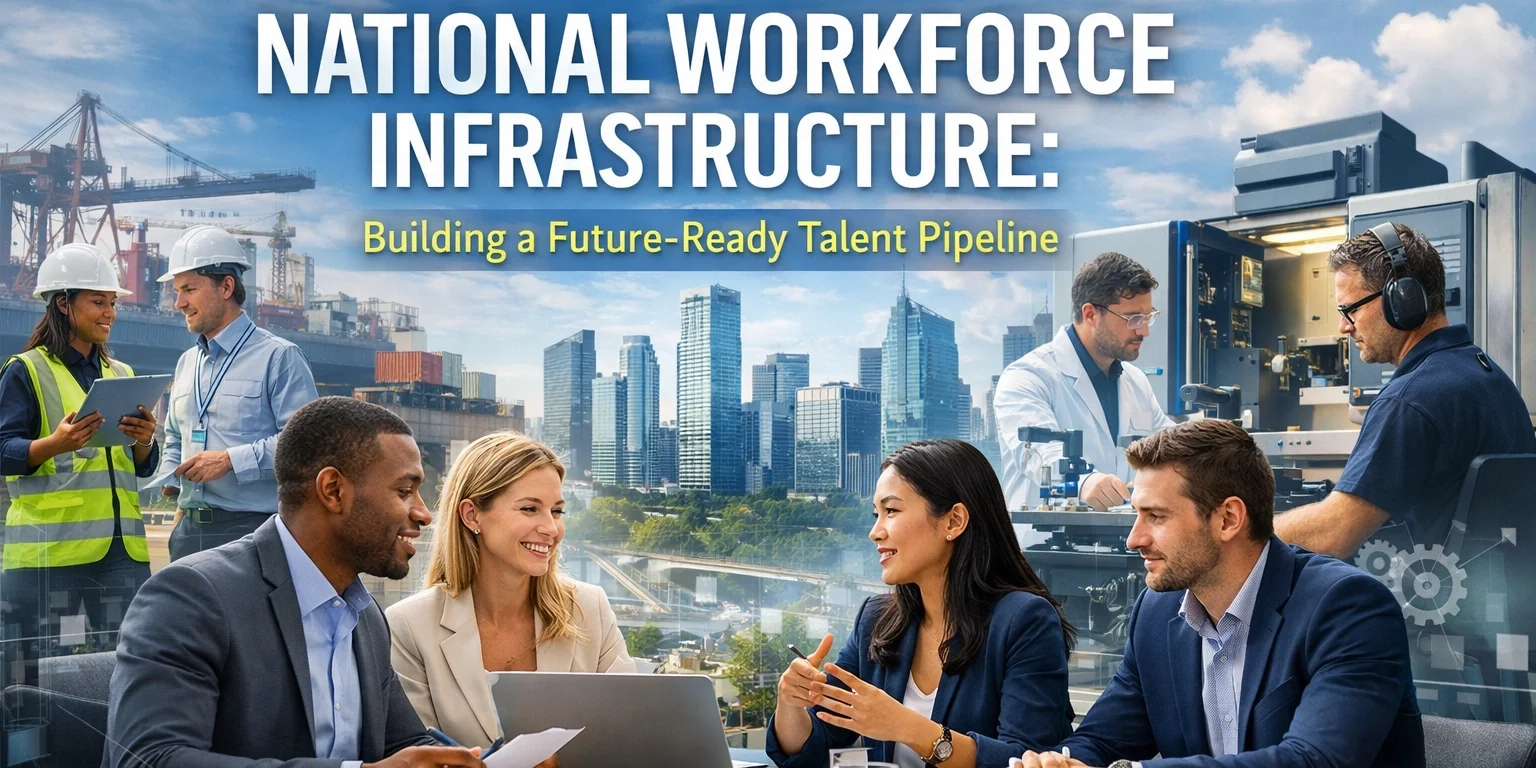
As the global economy transitions into an era defined by artificial intelligence, decentralized cloud computing, and automated logistics, the traditional methods of talent acquisition are proving insufficient. For Fortune 100 executives, the challenge is no longer just finding the right candidates; it is the fundamental lack of a national infrastructure designed to produce them.
The current landscape requires a shift in perspective. Workforce development can no longer be viewed as a secondary human resources function. Instead, it must be treated as a core operational pillar: a national workforce infrastructure that treats talent development with the same rigor and physical presence as the construction of highways or the deployment of 5G networks.
The Shift from HR to Infrastructure
National workforce infrastructure represents a fundamental restructuring of how organizations approach the talent pipeline. It is a physical and digital network that prepares individuals for high-tech employment long before a job requisition is ever posted. This systemic approach is designed to meet the massive demand created by multi-billion dollar investments in national infrastructure projects and the burgeoning AI sector.
To build a future-ready pipeline, organizations must look beyond traditional educational institutions. The goal is to create a seamless distribution system for skills, where training is not a destination but a constant, integrated component of the community environment.

The Esports 'Trojan Horse': A Gateway to Cloud and AI Literacy
One of the most effective strategies for building this infrastructure is the utilization of esports as a "Trojan Horse" for technical literacy. To the casual observer, esports is a competitive gaming phenomenon. To the executive leader, it is a high-engagement environment that requires the exact same technical competencies as modern enterprise operations.
1. Cloud Infrastructure and Low Latency
Competitive gaming at a professional level relies on high-speed data transmission and low-latency cloud environments. By engaging with these platforms, the next generation of workers is inadvertently learning the fundamentals of cloud architecture, server management, and edge computing.
2. AI and Data Analytics
Modern esports platforms utilize complex AI for matchmaking, cheat detection, and performance analytics. Participants who dive deep into these systems develop a natural fluency in prompt engineering and data-driven decision-making: skills that are directly transferable to the boardroom and the data center.
By investing in esports-focused career-ready infrastructure, we are not just supporting a hobby; we are building a workforce that is comfortable navigating the complexities of the digital-first economy. This strategy bypasses the traditional barriers to technical education by wrapping high-level skill acquisition in a high-interest package.
The Physical Distribution System for Talent
A critical insight for modern leaders is that nearly 72 percent of workforce-focused federal funds flow through infrastructure and transportation channels. This reality necessitates a physical distribution strategy. If we want a diverse, skilled workforce, we must place training access points where people already gather.
Rather than expecting potential talent to seek out distant training centers, national workforce infrastructure embeds learning environments within existing commercial and civic hubs. This mirrors modern logistics: just as products reach consumers through optimized distribution networks, career training must reach talent through systematically placed access points.
Strategic Placement in High-Traffic Hubs
By leveraging locations like zoos and aquariums, transportation centers, and mixed-use developments, organizations can create "Career-Ready Zones." These physical sites provide the hardware and connectivity necessary for cloud-based learning while remaining accessible to the broader population.
This approach removes the non-technical barriers to entry: such as transportation and childcare: that often prevent high-potential individuals from completing traditional certification programs. When training is located where people live and play, the pipeline remains full.

The Three-Tier Framework for Executive Implementation
For Fortune 100 organizations, implementing this infrastructure requires a structured model that aligns corporate goals with community capabilities.
Tier 1: Partnership Development
The foundation of a sustainable pipeline is the alignment of employers, educational institutions, and community organizations. At this stage, leaders must define the required competencies. The curriculum should be built backward from the job description. If your firm requires 500 cloud architects by 2028, the infrastructure to train them must be initiated today in collaboration with local workforce boards.
Tier 2: Planning and Procurement
This involves comprehensive workforce assessments to identify regional skill gaps. Executives should utilize business consulting frameworks to determine which geographic areas lack the specific technical infrastructure to support high-level training. This data-driven approach ensures that capital is allocated where the return on human talent is highest.
Tier 3: Program Delivery
The final tier is the execution of training pathways, ranging from digital apprenticeships to project-based learning. Crucially, this tier must include "wraparound services." Research consistently shows that technical training alone fails when participants face logistical challenges. A robust infrastructure provides the support systems necessary to ensure program completion.
The 18 to 24-Month Roadmap
Building a future-ready talent pipeline is not an overnight process. It requires a disciplined timeline from initial planning to measurable talent output.
- Months 1-6: Stakeholder alignment and partnership development. This involves identifying key geographic hubs and defining the technical standards for the technology being deployed.
- Months 7-12: Program design and infrastructure rollout. This is the phase where physical training locations are established and the "Trojan Horse" engagement strategies are launched.
- Months 13-24: The emergence of the first cohort of career-ready candidates. These individuals possess verified competencies in cloud platforms and AI operations, serving as the proof points for the broader national initiative.

Economic Impact and Competitive Advantage
The Infrastructure Investment and Jobs Act (IIJA) has created an unprecedented demand for skilled labor. Estimates suggest that infrastructure investments could create more than 11 million direct and indirect jobs over the next decade. However, nearly half of these roles will require specialized training beyond the high school level.
Organizations that participate in building the national workforce infrastructure gain a significant competitive advantage. They aren't just competing for existing talent; they are creating a proprietary pipeline of workers who are trained on their specific systems and standards. This reduces long-term recruitment costs and increases operational stability.
Furthermore, by expanding diversity in the workforce pipeline, companies foster more inclusive and innovative work environments. A national infrastructure approach ensures that talent is harvested from every corner of the country, not just traditional tech hubs.
Conclusion: The Path Forward
The future of American industry depends on our ability to treat workforce development with the same strategic priority as any other critical infrastructure project. For the executive leadership of the Fortune 100, the directive is clear: move beyond the traditional HR model and embrace a physical, distributed, and tech-forward approach to talent.
By utilizing high-engagement platforms like esports to drive literacy and leveraging physical distribution networks to provide access, we can build a talent pipeline that is not only ready for the challenges of today but resilient enough to lead the innovations of tomorrow.
For more information on how to implement these strategies within your organization, explore our services or reach out to our team at USA Entertainment Ventures LLC. The infrastructure of the future is being built today. It is time to ensure your talent pipeline is part of that foundation.