
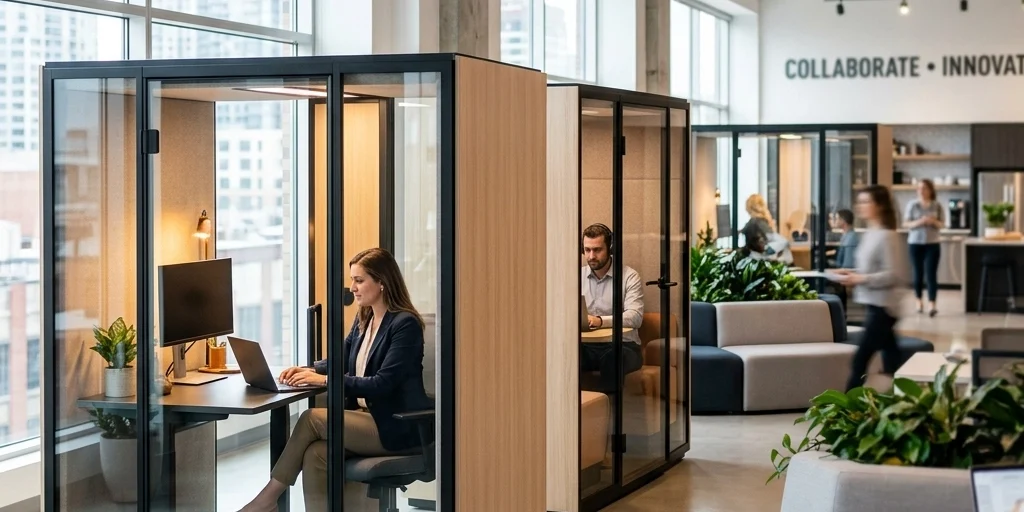
If you walked into a computer lab or an office back in the early 2000s, you knew exactly what to expect: endless rows of beige towers, a chaotic bird’s nest of gray Ethernet cables under every desk, and a cooling system that sounded like a jet engine taking off. Fast forward to 2026, and that "row-based" layout is officially a dinosaur. It was built for a different era, an era before AI, before decentralized content creation, and before cybersecurity became a physical necessity.
At USA Entertainment Ventures LLC, we’re seeing a massive shift. People aren’t just upgrading their software; they are ripping out the floorboards and rethinking their physical infrastructure. We are trading the "long row" for the "modern pod." And no, these aren't the things you sleep in at a Japanese transit hotel. We’re talking about modular, high-performance infrastructure units that are changing how we work, learn, and grow careers.
The Problem with the Row (And Why It’s Dying)
Let’s be honest: the traditional computer lab setup was never really that great. It was just the only thing we knew how to do. You put twenty desks in a line, ran a power strip along the wall, and hoped the circuit breaker didn't trip when everyone turned their monitors on at once.
But modern tech has outgrown the power strip. Research shows that traditional enterprise data centers and labs are often ill-equipped to handle the thermal and power requirements of today’s workloads. While a standard rack from ten years ago might have pulled 5kW of power, today’s AI-driven setups are hungry for 12kW to 40kW per rack. If you try to shove that kind of power into a traditional row-based setup, you’re basically building a very expensive space heater.
Beyond the heat, there’s the flexibility issue. If you need to expand a traditional lab, you’re looking at months of construction, permit hunting, and rewiring. In a world that moves at the speed of a viral TikTok, who has time for that?

Enter the Pod: Modular, Mobile, and Mighty
So, what exactly is a "Pod"? Think of it as a self-contained ecosystem. It’s a modular unit that integrates power, cooling, networking, and security into a single, standardized package. Instead of building a room around your computers, you drop a pod into the room.
The stats don't lie: while building a traditional data center or high-tech lab can take months: or even years: modular pods can be deployed in a matter of weeks. They are pre-fabricated and engineered for high reliability. This isn't just about convenience; it’s about survival. Currently, about 97% of organizations feel an urgent need to deploy AI-powered technologies, yet only about 13% actually have the physical infrastructure ready to handle it. The pod is the bridge over that gap.
Career Pathway #1: The Logistics of the Future
When we talk about infrastructure, most people think of IT guys in hoodies. But the shift toward pods is opening up a massive career pathway in logistics. We aren't just moving boxes anymore; we are orchestrating the deployment of complex, high-value modular environments.
Logistics in 2026 is about precision. It involves the coordination of specialized transport, on-site assembly, and the integration of these pods into existing power grids. For those looking for a career that combines physical problem-solving with high-tech implementation, the pod revolution is a goldmine. Organizations need experts who understand "Career-Ready Infrastructure." If you can manage the physical distribution of these units, you’re not just a mover; you’re an architect of the modern workforce.
You can learn more about why this matters on our Career Ready Infrastructure page.

Career Pathway #2: Physical Cybersecurity
We often talk about cybersecurity as if it’s some invisible force field made of code. But as any pro will tell you, if I can walk up to your server and unplug it, your firewall doesn't matter.
Modern pods provide a level of physical security that "rows of desks" simply can’t match. Because they are self-contained units, they are easier to monitor, lock down, and shield. This has created a surge in demand for cybersecurity professionals who specialize in the physical-to-digital interface.
In a pod-based environment, you’re not just guarding a network; you’re guarding a specific, modular asset. This makes it easier to implement "Zero Trust" architectures on a physical level. If you’re interested in a career where you get to play both digital detective and physical security specialist, the pod-based computer lab is your new playground. Check out our services to see how we’re helping companies secure their assets.
Career Pathway #3: The Content Creation Hub
Let’s talk about the creators. The old-school computer lab was a place where you wrote essays or looked at spreadsheets. The modern pod is a content studio.
Content creation: whether it’s high-end video editing, 3D rendering, or AI-generated media: requires massive computing power and specific acoustic/lighting environments. Modern pods are being designed specifically for this. They offer the isolation needed for recording and the cooling needed for high-end GPUs.
We’re seeing a shift where "Content Creation Specialist" is no longer just a title for YouTubers; it’s a core business function. Companies need people who can walk into a pod, fire up the localized infrastructure, and produce high-quality media without the latency issues of the cloud. The pod makes the hardware local, which makes the creative process seamless. It’s about having the right tools in the right box.

Why "Brand-Neutral" is the Best Approach
You might notice we aren't shouting about one specific manufacturer. That’s because the beauty of the pod movement is its modularity. You aren't locked into one "behemoth" provider for thirty years. You can mix and match components that suit your specific needs: whether you're focusing on AI, logistics, or education.
At USA Entertainment Ventures LLC, we believe in the power of choice. Our goal is to help businesses and individuals find the infrastructure that actually fits their goals, rather than trying to fit their goals into an outdated, rigid row of desks.
The Societal Impact: Democratizing Tech
Perhaps the most exciting thing about the swap from desktop rows to pods is what it does for workforce development. Because these pods are modular and relatively easy to deploy, they can be placed in areas that traditionally lacked high-tech infrastructure.
Imagine a small town or a rural community center. They might not have the budget to build a multi-million dollar data center, but they can afford a pod. That pod immediately gives the local community access to the same tools found in Silicon Valley. It levels the playing field for the next generation of logistics experts, cyber defenders, and creative minds. It’s not just a box; it’s an opportunity.

Final Thoughts: Don't Get Left in the Row
The transition is happening whether we like it or not. The "long row" of computers is becoming a relic of the past, right alongside the floppy disk and the dial-up modem. The future is modular, it’s powerful, and it’s contained in a pod.
Whether you are an employer looking to modernize your office, an educator trying to prepare students for the real world, or an individual looking for a fresh career path in logistics or tech, pay attention to the physical infrastructure. It’s the foundation everything else is built on.
If you have questions about how to make the switch or what this means for your specific industry, don't be a stranger. Head over to our Q&A section or check out our Showcase to see the kind of impact modern infrastructure can have.
The rows are closing. The pods are opening. It’s time to decide which one you’re going to be standing in.
Want to learn more about the future of work and entertainment? Visit USA Entertainment Ventures LLC to see how we’re driving innovation across the industry.





