Remember the classic high school computer lab? That beige-on-beige sanctuary where the hum of 30 cooling fans created a white noise machine that could put a caffeinated squirrel to sleep? If you close your eyes, you can probably still smell the faint scent of ozone and floor wax. For decades, this was the gold standard for technical training: rows of identical towers, tangled cords, and a teacher at the front of the room trying to explain Excel while half the class was secretly playing Minesweeper.
Fast forward to 2026, and those "laboratories" are looking more like museums. In the high-stakes worlds of cybersecurity, global logistics, and professional content creation, the traditional lab isn't just outdated: it’s actively holding us back.
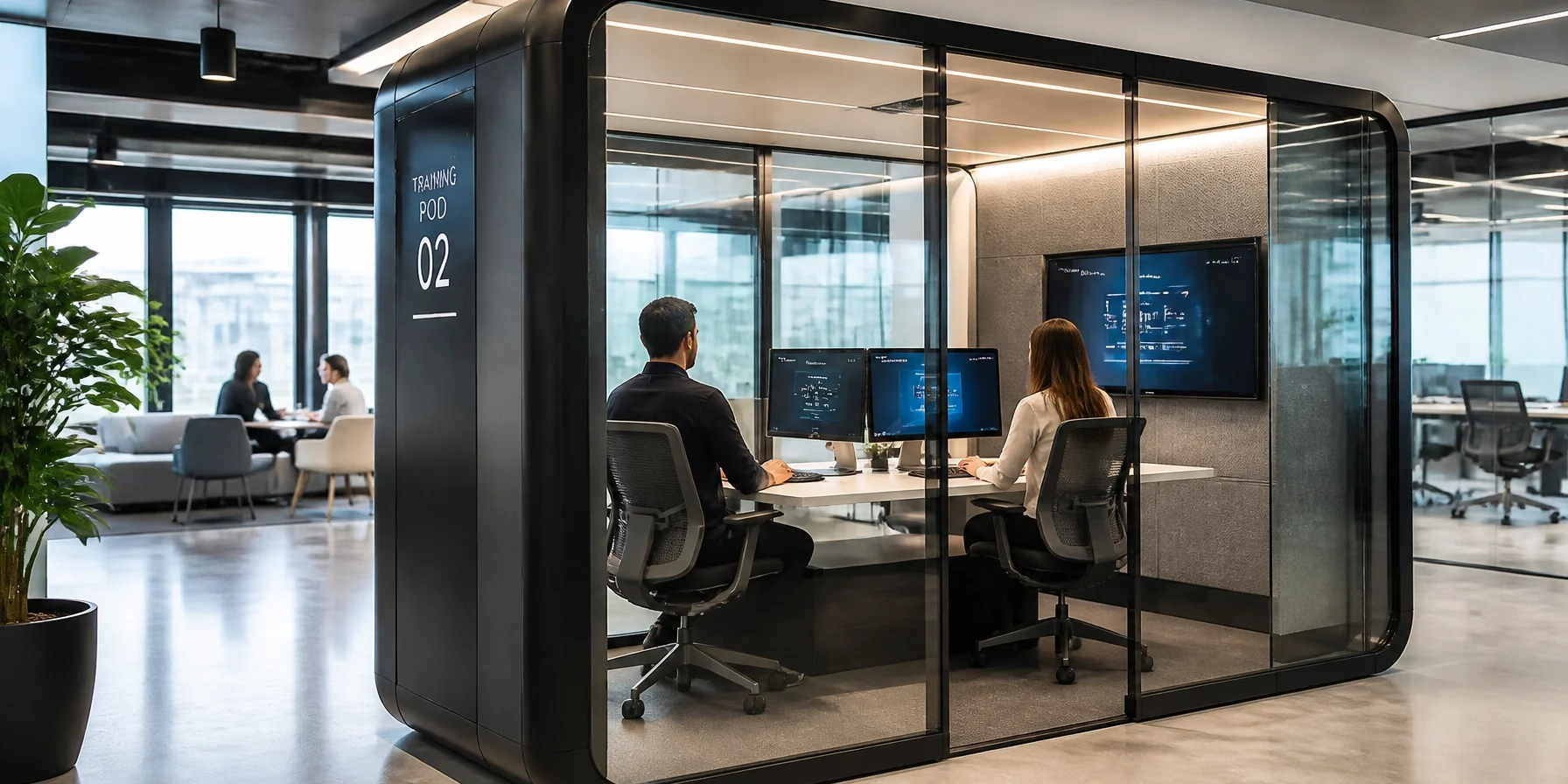
At USA Entertainment Ventures LLC, we’re seeing a massive shift in how businesses and government agencies approach workforce development. The era of the "row-and-file" lab is dead. In its place, the "Pod" has emerged as the secret weapon for career training.
Here are 10 reasons why the old-school lab is failing and why modular Pods are the inevitable future of career training.
1. The "Prisoner of the Rows" Problem
Traditional labs are built for lecture-style instruction, not the agile, project-based work that defines modern industries. In a logistics or cybersecurity role, you aren’t just following a PowerPoint; you’re reacting to real-time data. Traditional labs force a linear hierarchy where everyone stares at the back of someone else's head.
Pods, however, are modular by design. They can be configured for individual deep work or grouped together for team-based "war rooms." This flexibility mirrors the modern workspace. When you’re training through programs like DOD SkillBridge, you need an environment that feels like the mission-driven sectors you’re entering, not a 1990s typing class.
2. Acoustic Chaos vs. Deep Focus
Have you ever tried to conduct a penetration test or edit a high-fidelity video in a room with 20 other people talking? It’s a nightmare. Traditional labs offer zero acoustic privacy. They are echo chambers where every keyboard click and whispered question becomes a distraction.

Modern training Pods are sound-treated environments. For a cybersecurity trainee, this means the ability to focus entirely on the "cyber range" simulation without the auditory clutter of the outside world. Statistics from recent industry surveys suggest that 85% of instructors believe hands-on, focused environments are critical for students to successfully apply what they’ve learned in real-world scenarios.
3. The One-Size-Fits-None Hardware Trap
In a traditional lab, every machine is usually identical. This is great for the IT guy managing the updates, but it’s terrible for specialized training. A student learning advanced video content creation needs a massive GPU and high-refresh-rate monitors. A student learning logistics management might need a multi-screen dashboard setup to track global shipping lanes.
Pods allow for "Role-Specific Environments." You can outfit one Pod as a Security Operations Center (SOC) and the one next to it as a high-end media suite. This targeted investment ensures that trainees are working on the exact hardware they will encounter in their new careers.
4. Cybersecurity Requires Real Isolation
If you’re training someone to handle ransomware or conduct malware analysis, the last thing you want is that training happening on a shared, open network in a generic lab.
Pods are the physical manifestation of a "sandbox." They provide the isolated, secure infrastructure needed to run high-stakes simulations safely. With cloud intrusions increasing by 75% in 2024 alone, the demand for realistic, isolated training environments has never been higher. A Pod can be its own segmented network node, allowing students to break things, fix them, and learn the stakes of a $4.88 million data breach (the current average cost of a breach) without actually endangering the facility's main server.
5. Logistics Demands Proximity
Logistics training shouldn't happen in a basement three miles away from the warehouse. Traditional labs are fixed assets: they are where the building says they are.
Pods are modular and, in many cases, mobile. You can drop a logistics training Pod directly onto a distribution center floor or near a port. This allows for "Just-in-Time" training. Trainees can move from the theoretical simulation in the Pod directly to the operational floor in minutes. This proximity reduces travel costs and keeps the training grounded in the reality of the supply chain.

6. Content Creation and the "Studio" Standard
The creator economy is no longer a hobby; it’s a billion-dollar business sector. You can't teach professional content creation in a room where the lighting is "fluorescent flickering" and the background noise is "someone eating a bag of chips three rows back."
Modern Pods are essentially mini-studios. They come equipped with:
- Acoustic foam for crystal-clear audio recording.
- Controlled, adjustable lighting for video production.
- Ergonomic setups for long editing sessions.
This turns training from a "class" into a "production," giving students the portfolio-ready experience they need to jump into the workforce.
7. The Psychological Shift: From "Student" to "Professional"
Environment dictates behavior. When you sit in a dusty, old-school lab, your brain defaults to "student mode": passive, bored, and waiting for the bell to ring.
Stepping into a sleek, high-tech Pod triggers a psychological shift. It feels like a "cockpit." It signals to the trainee that the work they are doing is high-value and professional. This is especially vital for veterans transitioning through recruitment programs. They aren't looking to go back to school; they are looking to move into a new mission. Pods provide that professional atmosphere from day one.
8. Scalability: The "Lego" Model of Infrastructure
If a college or corporation wants to expand a traditional lab, they usually need a construction crew, new permits, and six months of downtime.
Pods are the "Legos" of infrastructure. Need five more training stations? You don't need a new wing of the building; you just need five more Pods. They can be added, moved, or repurposed as career trends change. Today’s logistics Pod can be tomorrow’s AI development hub with just a software swap and a monitor upgrade. This scalability makes them a much more "future-proof" investment for business development.

9. Power and Cooling Efficiency
Traditional labs are energy hogs. Keeping 40 high-powered towers cool in a single room requires massive HVAC systems working overtime.
Pods are designed with localized cooling and power management. Because they are self-contained, they are significantly more energy-efficient. You only cool the space being used. In an era where sustainability is a corporate mandate, the Pod model isn't just cooler (literally); it’s greener.
10. Future-Proofing for 2026 and Beyond
The workforce is changing faster than our buildings can keep up with. We are seeing a massive rise in demand for "hybrid" training: where virtual IT labs are accessed via physical hardware.
Pods are the perfect bridge. They provide the physical "home base" for immersive virtual environments. Whether it's VR-based warehouse management or AR-assisted cybersecurity defense, the Pod provides the controlled environment necessary for these technologies to shine. At USA Entertainment Ventures LLC, we focus on managing these transitions, ensuring that the infrastructure of today doesn't become the bottleneck of tomorrow.
The Actionable Takeaway: It’s Time to Un-Plug the Old Lab
If your organization is still relying on the "classroom of 1998" to train the "workforce of 2026," you’re already behind. The transition to Pods isn't just an aesthetic choice; it’s a strategic one.
For business leaders and recruitment officers:
- Audit your current space: Is it quiet? Is it role-specific? Is it scalable?
- Identify high-impact roles: Start with your cybersecurity and content creation teams. These are the areas where Pods offer the highest ROI.
- Invest in modularity: When looking at new facilities or training centers, prioritize modular infrastructure that can grow with your needs.

The future of career training isn't found in rows of desks. It’s found in specialized, focused, and modular spaces that respect the complexity of modern work. The traditional lab had a good run, but it’s time to move into the Pod.