
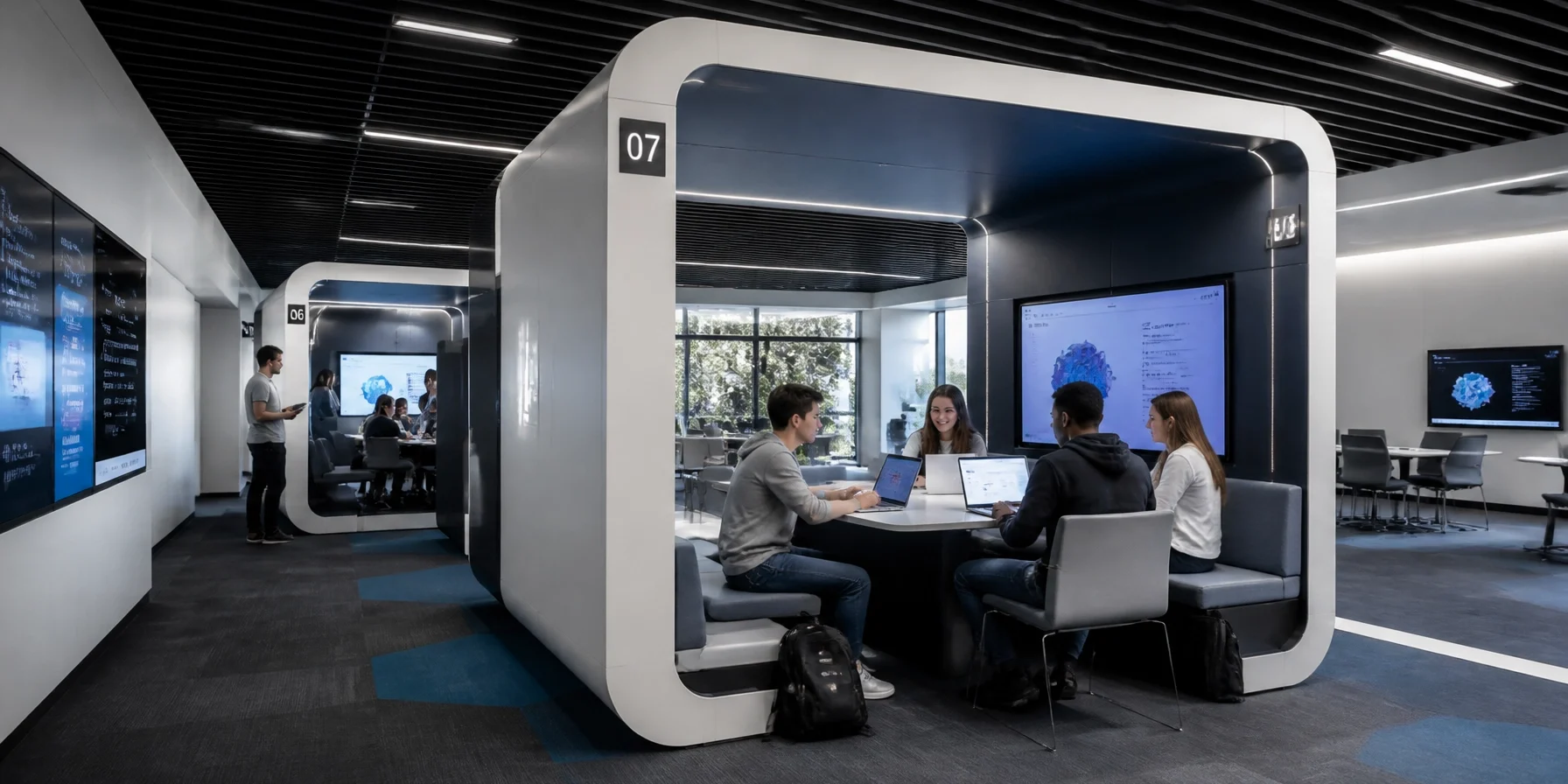
Remember the scent of a 1998 computer lab? A delightful cocktail of overheated CRT monitors, ozone, industrial carpet, and the quiet despair of thirty teenagers waiting for Windows 95 to boot from a floppy disk. Rows upon rows of identical grey boxes, bolted down like church pews, enforcing a strict posture of solitary confinement in the digital age.
Thankfully, the era of the monolithic computer lab is heading the way of the dial-up modem.
Today’s educational institutions and forward-thinking training centers are ditching the rigid classroom rows in favor of something much sleeker, smarter, and infinitely more flexible: technology pods. Whether you call them modular tech hubs, micro-labs, or collaborative pods, these self-contained powerhouses are quietly revolutionizing how we train the next generation of tech talent. And no, they don't smell like warm plastic.
The Great Lab Makeover: Why Rows of PCs Are Out
Let’s be honest: traditional computer labs were built for an era when having a computer in the room was a novelty. They were designed around the concept of centralized control: everyone facing forward, working in isolation, doing exactly the same thing at exactly the same speed.
The problem? Real-world tech work doesn’t happen in solitary confinement.
Modern careers require collaboration, quick pivoting, and access to specialized environments that mimic actual workplaces. When schools rely on static labs, upgrading hardware is an absolute nightmare involving massive renovation bills and weeks of downtime.
Pod-based infrastructure flips the script. Instead of one giant room that takes three months and a small fortune to overhaul, institutions can deploy modular pods. These micro-environments can be scaled, rearranged, or upgraded independently. Need a high-performance rendering hub this semester and a secure networking sandbox the next? Swap out a pod, not the entire building wing.
To learn more about how modern workspace and physical infrastructure strategies are evolving, check out USA Entertainment Ventures.
Cybersecurity Pods: Practicing Defense Without Breaking the Internet

Let’s look at how this plays out in high-stakes fields like cybersecurity. In an old-school computer lab, teaching ethical hacking or threat detection was like trying to conduct a chemistry experiment in a crowded library: one wrong move and someone brings down the entire network (or worse, gets a sternly worded email from the university sysadmin).
Enter the cybersecurity pod.
These are isolated, sandboxed micro-environments equipped with dedicated local servers, custom switches, and multi-monitor setups. Students in a cybersecurity pod aren’t just reading textbook chapters on threat mitigation; they are actively spinning up virtual machines, simulating live DDoS attacks, and running digital forensics in a controlled, high-intensity setting.
It’s the difference between reading about a fire extinguisher and actually putting out a grease fire in your own kitchen (though, thankfully, with a lot less smoke). By providing realistic, isolated network infrastructure, pods allow learners to make mistakes, learn from them, and build muscle memory for the modern SOC (Security Operations Center).
Content Creation Pods: Where Broadcasters and Creators Are Born

If you think media production is just pointing a smartphone at a ring light, the trillion-dollar creator economy would like a word. Today’s content creation goes far beyond basic video editing: it encompasses live broadcasting, multi-camera switching, audio engineering, spatial audio mixing, and rapid motion graphics.
Trying to teach professional-grade media production in a generic computer lab with standard desktop mice and tinny headphones is an uphill battle.
Modern content creation pods solve this by functioning as mini broadcast studios. Packed with high-end GPUs, professional-grade microphones, acoustic treatment, and stream decks, these pods immerse students in an authentic production workflow. Learners transition seamlessly from scripting and recording to live-streaming and post-production editing.
When a student steps out of a media pod and into an actual production house or digital agency, the learning curve is practically flat. They’ve already been using the gear, managing the codecs, and hitting deadlines in a professional environment.
Logistics and Supply Chain Pods: Simulating the Global Grid

We rarely associate logistics with high-tech physical spaces, but modern supply chain management is essentially a high-speed exercise in data analytics, automation, and predictive modeling. From autonomous warehouse robotics to global freight tracking, logistics is deeply digital.
Logistics and supply chain training pods bring the complexity of the global shipping grid directly into the learning space. Equipped with interactive simulation screens, supply chain visualization software, and IoT integration tools, these pods let students test routing algorithms, manage inventory bottlenecks, and simulate warehouse automation workflows in real time.
Instead of staring at static spreadsheets in a traditional classroom, learners interact with live data streams and scenario-based simulations. It bridges the gap between abstract supply chain theory and the fast-paced realities of modern fulfillment centers.
The Future of Physical Infrastructure is Modular
The shift from monolithic computer labs to agile, specialized pods isn’t just an aesthetic upgrade: it’s a pedagogical evolution. By replacing one-size-fits-all rooms with targeted, high-performance environments, educational institutions and training facilities are building direct bridges to modern careers.
Whether it’s defending networks in a cybersecurity pod, producing broadcast-quality media in a content studio, or optimizing global supply chains through interactive simulation, pods prove that the physical spaces where we learn matter just as much as the curriculum itself.
So, raise a glass to the old computer labs of yesteryear. They served us well, but it’s time to step into the pod.





