
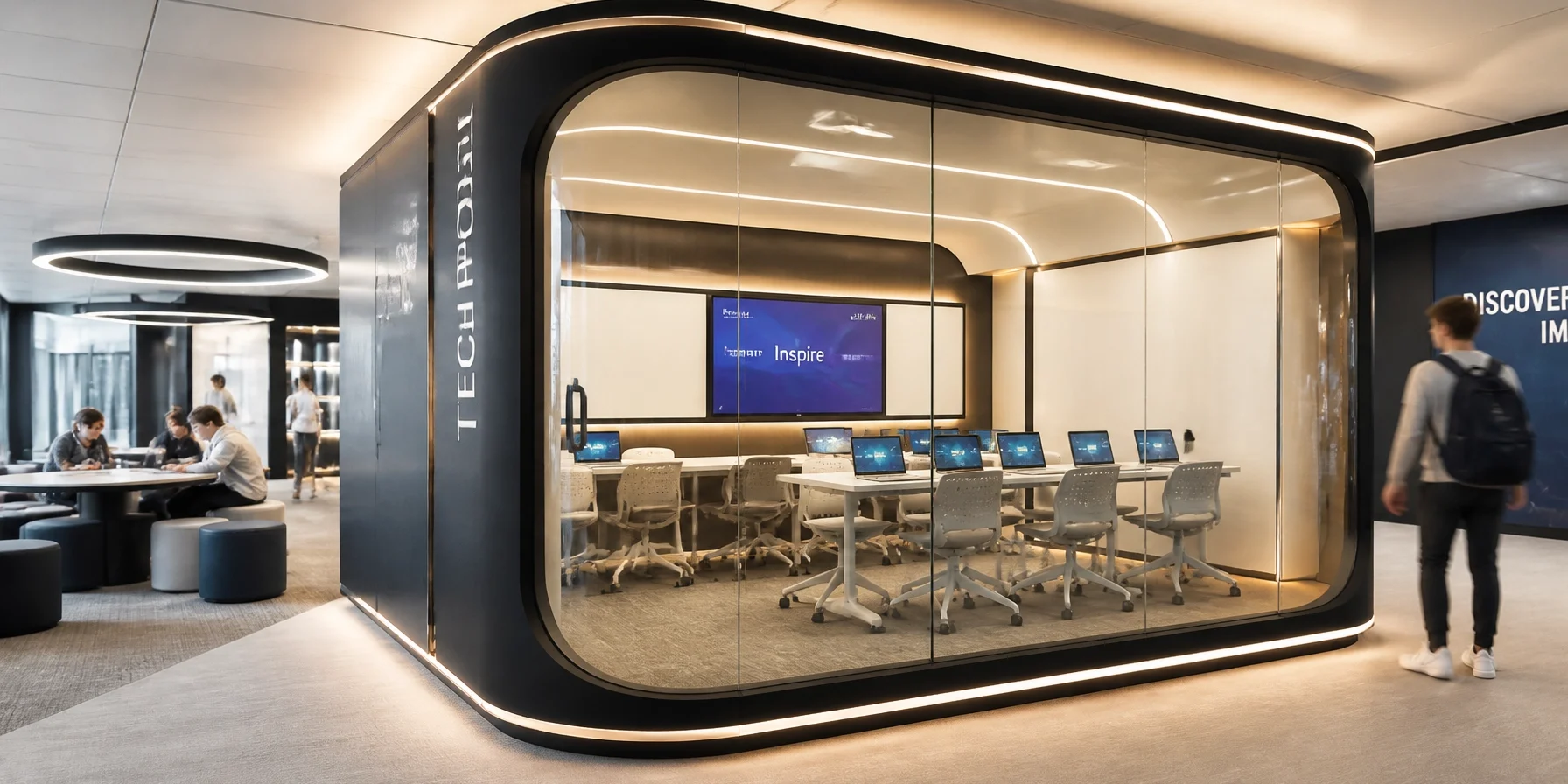
Remember the classic school computer lab? The cavernous room lined with fifty desktop towers, the symphony of clicking plastic keyboards, the hum of overworked cooling fans, and the unmistakable nostalgia of IT administrators trying to reboot Windows XP. It was a staple of tech education for decades. But let’s be honest: static, rows-upon-rows computer labs are about as modern as a dial-up modem.
Today, institutions and forward-thinking organizations are rethinking physical infrastructure entirely. Instead of anchoring students to rigid, permanent rooms, the gold standard has shifted to modular, pre-fabricated units known simply as pods. These self-contained mini data centers and specialized workstations are transforming tech education, making hands-on learning faster, smarter, and infinitely more flexible.
If you are curious how these micro-environments are reshaping everything from supply chains to digital defense, let’s take a look at why pods are officially the new computer labs.
What Exactly Is a Tech Pod?
Before we get ahead of ourselves, what are we talking about when we say "pods"? Think of a pod as a plug-and-play technological ecosystem. Unlike traditional rooms that require months of drywall, electrical rewiring, and custom HVAC installation, a pod is a pre-engineered unit that integrates compute power, cooling, networking, and physical security into a single deployable asset.
As explored in our look at physical infrastructure in a digital world, modularity is winning the day. Instead of gutting an entire campus building to upgrade hardware, administrators can simply drop in a new pod, plug it into power and internet, and instantly unlock high-performance computing power.
Why Pods Leave Old-School Computer Labs in the Dust
Traditional computer labs suffer from a major flaw: inflexibility. If your curriculum shifts from graphic design to artificial intelligence, your old lab's hardware is suddenly obsolete, and retrofitting the room costs a fortune.
Pods solve this problem through sheer adaptability:
- Rapid Deployment: You don't need a construction crew; you need a delivery truck and a connection cable.
- Isolation and Customization: Each pod can be custom-tuned for a specific workflow without interfering with adjacent spaces.
- Standardized Environments: Whether deployed in a rural training center or a bustling metropolitan campus, a pod delivers the exact same physical and digital performance profile.
By modernizing physical infrastructure, institutions can pivot their training programs at the speed of industry: without blowing their entire budget on remodeling.
Powering Emerging Careers: Logistics, Cybersecurity, and Content Creation
The true magic of pod-based tech education isn't just that they look cool: it’s how effectively they bridge the gap between classroom theory and real-world careers. Let’s look at three major industries where pods are making an immediate impact.

1. Logistics: Steering Global Supply Chains
Modern supply chain management is high-stakes and heavily digital. Logistics training pods are equipped with triple-monitor arrays, live global shipping dashboards, and warehouse performance metrics that mirror real corporate logistics centers. Trainees learn how to manage bottlenecks, track cargo in real-time, and optimize transport routes using actual industry software. Because these pods can be deployed directly near distribution hubs or manufacturing plants, students transition seamlessly from learning the ropes to managing live operational environments.
2. Cybersecurity: The Ultimate "Sandbox-in-a-Box"
Teaching cybersecurity in a standard computer lab is like teaching explosives handling in a crowded coffee shop: one wrong move and someone gets hurt. Cybersecurity pods offer total physical and logical isolation. They act as mini Security Operations Centers (SOCs) complete with acoustic privacy and segmented networks. Students can run aggressive red-team and blue-team attack simulations without risking corporate networks or university servers. It’s a controlled sandbox where future incident responders learn how to triage threats, analyze malware, and fortify digital defenses under pressure.

3. Content Creation: Turnkey Studios on Demand
Gone are the days of booking a massive, expensive university media suite to shoot a basic video. Content creation pods are self-contained production powerhouses. Featuring integrated acoustic treatment, professional lighting rigs, and high-performance workstations optimized for 4K video editing and live streaming, these pods give aspiring creators a professional-grade studio environment. Students master everything from live switching and audio mastering to post-production color grading, building portfolios that stand out in today’s competitive media landscape.

The Future of Learning Infrastructure
The transition from static computer labs to dynamic pods represents a fundamental shift in how we approach education and workforce development. By embracing modular physical infrastructure, organizations can scale training programs faster, adapt to emerging technologies on the fly, and give learners hands-on access to the exact tools they’ll use on the job.
Whether you're training the next generation of supply chain wizards, ethical hackers, or digital media moguls, pods prove that sometimes the best way to move forward is to think inside the box.





