If you grew up in the 90s or early 2000s, the "computer lab" holds a special, albeit dusty, place in your heart. It was a room filled with beige towers, monitors that weighed more than a toddler, and the faint, sweet scent of ozone. It was where you learned to type "The quick brown fox jumps over the lazy dog" and where you secretly played Oregon Trail until a pixelated rattlesnake ended your journey.
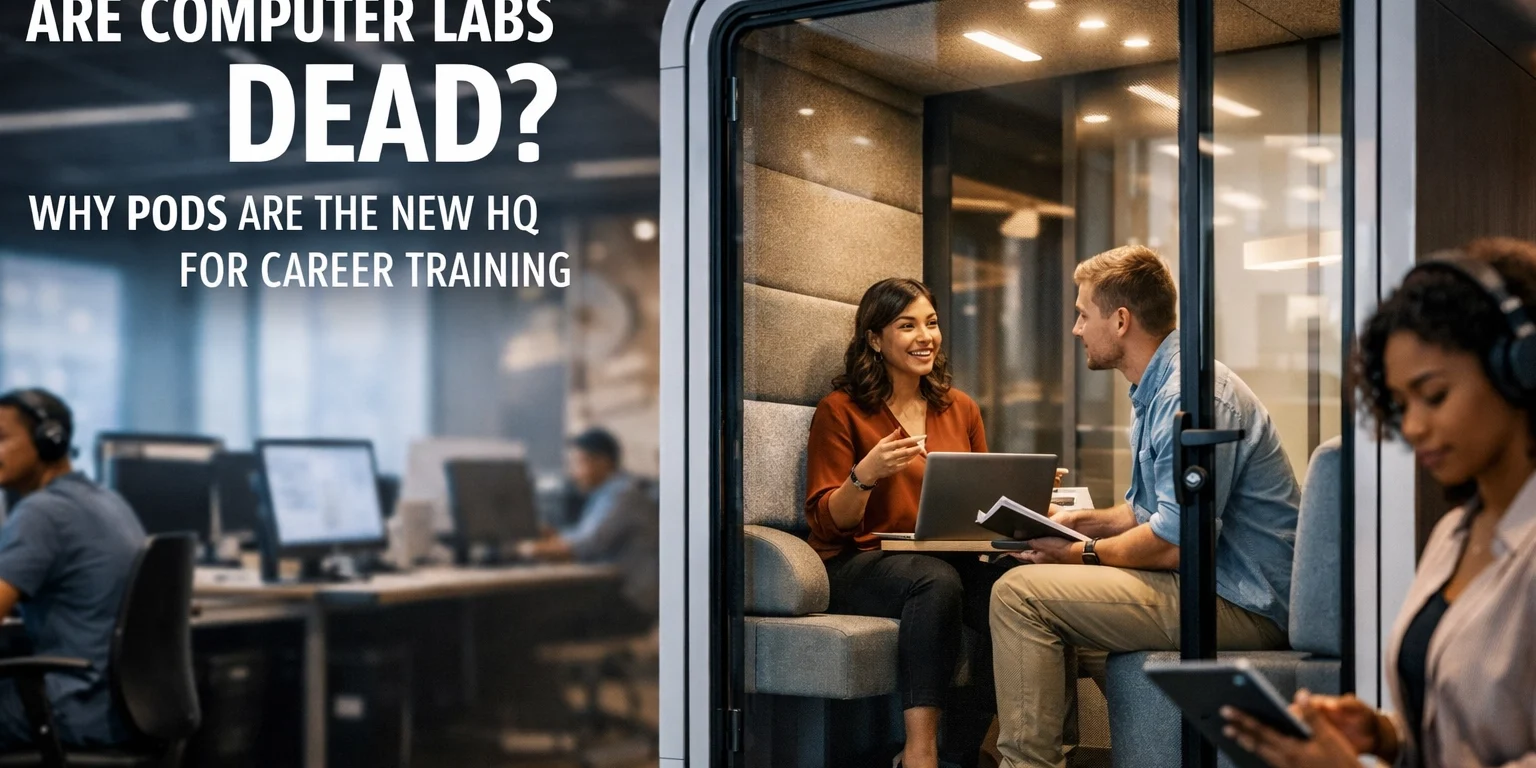
But as we stand here in March 2026, the traditional computer lab isn’t just showing its age: it’s effectively a museum exhibit. The "one-size-fits-all" approach to digital literacy is dead. In its place, a new hero has emerged: the Pod.
At USA Entertainment Ventures LLC, we spend a lot of time thinking about how infrastructure meets opportunity. We’ve realized that if you want to train the next generation of cybersecurity ninjas, logistics wizards, and content kings, you can’t just give them a desk and a generic PC. You have to give them an ecosystem.
The Identity Crisis of the Traditional Lab
The problem with the old-school lab was its inherent blandness. It was designed for "computing" in the broadest sense. You could write a term paper, browse the web, or maybe learn some basic Excel. But modern industry doesn't operate in a "generic" digital space.
Research shows that organizations moving away from these legacy setups are seeing a massive shift in efficacy. While a standard lab provides access, a Pod provides immersion. A pod is a purpose-built training environment designed around a specific career pathway. It’s the difference between learning about a car in a classroom and sitting in a Formula 1 cockpit with a headset on.

1. The Cybersecurity Pod: Beyond the Firewall
Let’s talk about the high-stakes world of cybersecurity. You can’t learn to defend a corporate network by using a locked-down school computer that won’t even let you change the wallpaper.
A cybersecurity pod is a high-tech war room. It features enterprise-grade network monitoring platforms, vulnerability scanning tools, and actual Incident Response (IR) frameworks. In these pods, students aren't just reading about "The Big Hack"; they are working on Security Information and Event Management (SIEM) systems: the same ones used by Fortune 500 companies.
The key here is collaborative defense. Unlike the solitary rows of a computer lab, pods are designed for team-based problem-solving. When a simulated "red team" attacks, the pod allows for a "blue team" to huddle, communicate, and react in real-time. This mirrors actual workplace dynamics, eliminating the "relearning curve" that happens when a graduate hits the real world and realizes their textbook didn't mention what to do when the servers actually start melting.
2. The Logistics Pod: The Nervous System of Global Trade
We often think of logistics as trucks and warehouses, but in 2026, it’s all about data and distribution flow. Modern distribution is a symphony of moving parts.
A Logistics Pod is a micro-hub that simulates the entire supply chain. It’s equipped with Warehouse Management Systems (WMS), real-time tracking dashboards, and IoT integration. Instead of just learning the theory of "Just-in-Time" delivery, trainees are managing simulated inventory shifts and solving bottleneck crises on professional-grade software.
For those looking into manufacturing careers, these pods provide a safe space to master the digital twins of factory floors. When a student transitions from a pod to a real fulfillment center, they aren't intimidated by the tech because they’ve already lived in its digital mirror.
3. The Content Creation Pod: Making "Viral" a Science
The creator economy isn't just for teenagers in their bedrooms anymore. It’s a multi-billion dollar industry that requires serious technical chops. A Content Creation Pod is more like a professional production studio than a classroom.
These pods feature high-end editing suites, sound-treated environments, and 4K-ready rendering stations. But more importantly, they are built for collaborative production workflows. One person is on the switcher, one is managing the audio levels, and another is monitoring the live stream feed.
By democratizing access to these professional tools, pods ensure that talent: not just those who can afford a $5,000 camera: can enter the field. It’s about creating a level playing field where the only barrier to entry is your imagination (and maybe your ability to handle a ring light).

Why Pods Win: The Numbers and the "Soft" Stuff
You might be thinking, "Dan, this sounds expensive. Why not just buy more laptops?"
It’s a fair question. But the data tells a different story. Organizations implementing pod-based models have reported cost savings between 50 and 75 percent compared to maintaining traditional, bloated computer labs over the long term. Why? Because pods are targeted. You aren't over-speccing 50 machines for generic use; you are precisely speccing 10 machines for elite use.
Furthermore, there’s the "Soft Skill" factor. Employers consistently tell us that technical knowledge is only half the battle. They need people who can talk to each other.
- Collaboration: Pods force people out of their digital silos.
- Problem-Solving: When the "pod" hits a snag, the team fixes it together.
- Adaptability: Pod tools change as the industry changes.
According to industry findings, pod-trained professionals start contributing to their companies almost immediately. There’s no "first-month fog" where the new hire has to be taught how to use the basic tools of the trade. They’ve been using them in the pod for months.
Democratizing the Future
Perhaps the most important aspect of the pod revolution is access. Enterprise-grade software licenses are expensive. Professional-grade hardware is out of reach for the average student. By concentrating these resources into specialized pods, we make the "unobtainable" tools available to anyone with the drive to learn.
At USA Entertainment Ventures LLC, our business consulting team sees this as the future of workforce development. Whether we are helping a client with human resources strategy or digital transformation, the goal is always the same: how do we get people ready for the jobs of tomorrow, today?

The Dan Kost Takeaway
Look, I’m a fan of history. I loved the old computer labs as much as the next guy. They were a bridge to the digital age. But we’ve crossed that bridge. Now, we’re living in the destination.
In a world where the Super Bowl (check out our 2026 Guide if you haven't yet!) is as much a digital experience as a physical one, our training needs to reflect that reality. We don't need more people who can "use a computer." We need people who can defend a network, optimize a global supply chain, and tell stories that move the world.
The computer lab is dead. Long live the Pod.
If you’re interested in how your organization can pivot toward these high-impact training environments, or if you just want to talk shop about the future of career pathways, check out our about-us page to see what we're all about.
The future isn't a row of desks; it's a hub of innovation. See you in the pod.
Dan Kost
CEO, USA Entertainment Ventures LLC