
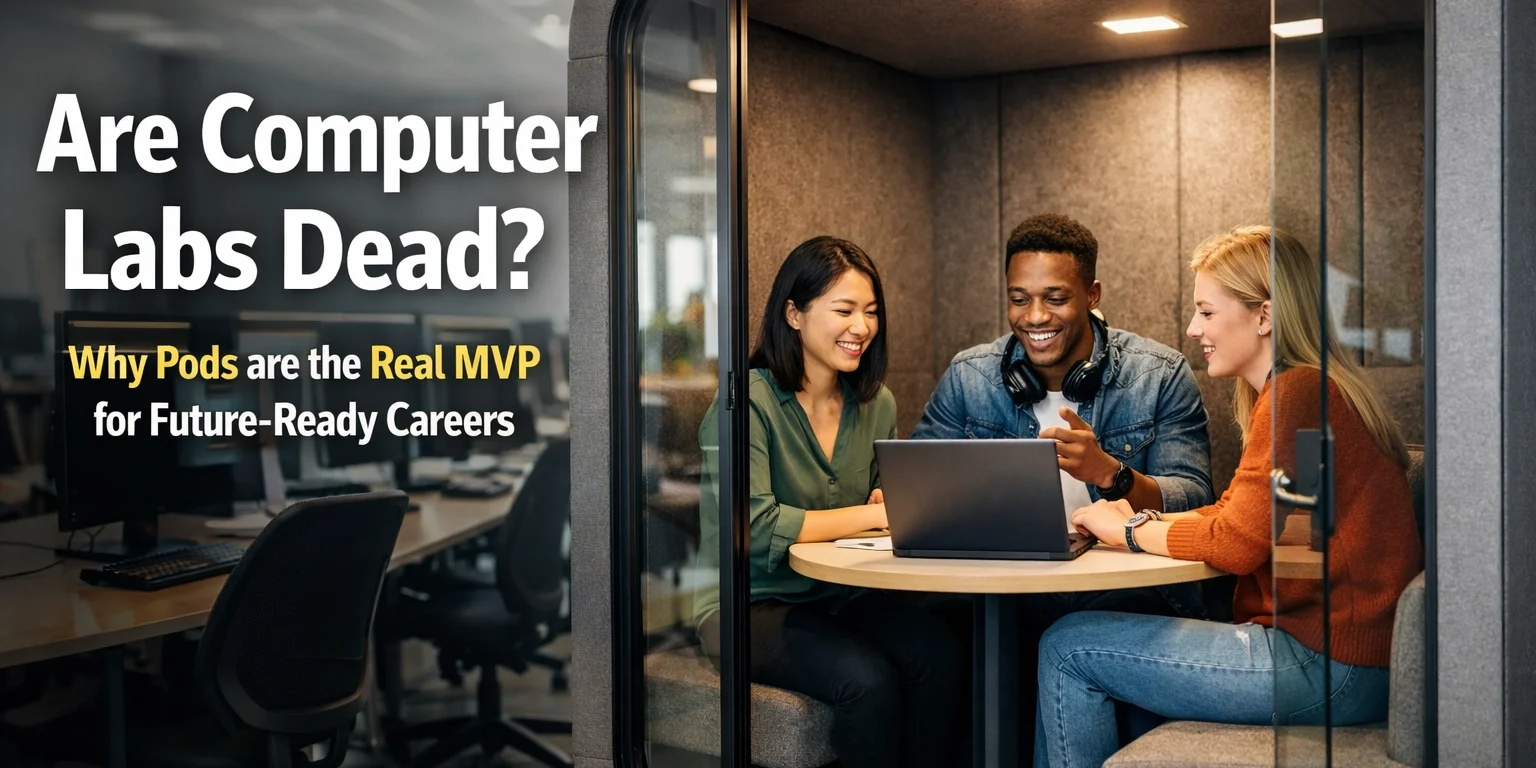
Walk into any high school or university today, and you might witness a strange architectural ghost: the traditional computer lab. You know the one: rows of beige desks, tangled wires, and desktop towers that haven’t been relevant since the early 2010s. For years, these rooms were the "tech hubs" of our institutions. Today? They are largely expensive storage units for dust.
As we sit here in March 2026, the data is undeniable. According to recent research, about 95% of students now carry their own powerful laptops or tablets. The original mission of the computer lab: to provide basic access to computing power: is officially "Mission Accomplished." But here’s the kicker: while the need for basic labs has died, the need for specialized, physical infrastructure has never been higher.
At USA Entertainment Ventures LLC, we spend a lot of time thinking about how physical spaces drive economic opportunity. The reality is that we aren't moving away from labs; we are evolving into Pods. And if you want to understand where the next generation of high-paying careers is coming from, you need to look at these specialized hubs.
The Death of the Generic Workspace
The problem with the old-school computer lab wasn't the technology; it was the "genericness." A lab was a room where you did everything: wrote an essay, checked email, maybe played some Minesweeper. But in a world where everyone has a "lab" in their backpack, the physical space needs a new job description.
Universities and vocational centers are reporting that students are avoiding traditional labs in droves. However, they are flocking to collaborative spaces. The "Pod" model replaces rows of cubicles with purpose-built environments. Think of it as moving from a cafeteria (where everyone gets the same mystery meat) to a high-end kitchen (where you have the specific tools to create a masterpiece).

Cybersecurity Pods: The Digital War Room
Let’s talk about one of the fastest-growing career paths: Cybersecurity. You cannot learn high-level penetration testing or network defense in a generic computer lab. Why? Because if a student accidentally releases a piece of malware or triggers a massive data sweep on a standard school network, the IT department is going to have a very bad day.
Cybersecurity Pods are the solution. These are isolated network environments: digital sandboxes: where students can safely conduct "red team versus blue team" exercises.
- The Setup: Instead of facing a wall, students sit in clusters (pods) with shared monitors and real-time analytics dashboards.
- The Skill: This mirrors how real-world Security Operations Centers (SOCs) work. It’s collaborative, high-pressure, and highly technical.
- The Career: Students graduating from these pod-based programs aren't just "good with computers"; they are battle-tested defenders ready for six-figure roles in national security and corporate defense.
Content Creation Pods: From Consumption to Production
We’ve moved past the era where "making videos" was a hobby. In 2026, content creation is a pillar of the global economy. From corporate marketing to independent streaming, the demand for professional-grade media is insatiable.
Traditional labs were never built for this. A content creation pod, however, is a different beast. These spaces integrate professional-grade audio gear, 4K streaming capabilities, and high-end post-production workstations.
When you look at major events: like we see in the ultimate guide to Super Bowl 2026 fan engagement: the infrastructure behind the scenes is massive. Content pods allow students to learn the entire workflow of production, from the first frame to the final upload. It’s about creating "tangible connections" through digital media, and that requires a space that supports creativity rather than stifling it.
Logistics and Supply Chain Pods: The New Backbone
If the last few years have taught us anything, it’s that the world stops moving if the supply chain breaks. Logistics is no longer just about driving trucks; it’s about massive data sets, real-time tracking, and predictive AI.
Modern logistics pods feature industry-standard software and simulation tools. Students can visualize how physical goods move through a complex global network. This isn't just "learning a program"; it’s understanding the physical-to-digital bridge that keeps our economy afloat.
At USA Entertainment Ventures LLC, we are heavily invested in the idea that infrastructure is the foundation of opportunity. You can see this reflected in our national infrastructure rollout, where we emphasize that the future of work isn't just "remote": it’s integrated into specialized hubs that connect people to real-world systems.
Why Pods are the "Real MVP" for ROI
Let’s get into the business side of things, because at the end of the day, someone has to pay for these upgrades. You might think that building specialized pods is more expensive than a generic lab. Surprisingly, the data says otherwise.
Institutions that have transitioned to pod-based infrastructure report cost savings between 50 and 75 percent.
How?
- Efficiency: Instead of maintaining 100 generic PCs that are barely used, an institution can maintain 25 high-end, specialized pods that are used 24/7.
- Longevity: Specialized gear is often higher quality and has a longer professional shelf life than "off-the-shelf" consumer desktops.
- Engagement: Student retention and placement rates skyrocket. When a student learns in an environment that looks exactly like their future office, they are more likely to finish the program and get hired.

Collaborative vs. Isolated Learning
The most significant change isn't just the hardware; it’s the human element. The old computer lab was a place of isolation. You sat down, put your headphones on, and stared at a wall.
Pods are designed for teamwork. They feature movable furniture, shared screens, and open floor plans. This mimics the modern workplace. Whether you’re in cybersecurity, logistics, or media, you are rarely working alone. You’re working in a team. By changing the physical infrastructure, we are teaching students the "soft skills" of collaboration and communication: skills that AI can't easily replace.
Building for 2030, Not 1999
The "death" of the computer lab is really just a metamorphosis. We are shedding the skin of a generic, outdated model and replacing it with something lean, specialized, and career-focused.
As we continue to roll out our vision at USA Entertainment Ventures LLC, we remain committed to the idea that the right infrastructure can change the trajectory of a community. Whether it's through our work with Mobile Hwy Ads or our broader consulting initiatives, we see the shift toward Pods as a win-win for students, educators, and the economy.
The message for educational leaders and business consultants is clear: Stop trying to save the generic computer lab. It’s gone, and it’s not coming back. Instead, start building the Pods that will house the next generation of cybersecurity experts, content moguls, and logistics wizards.
The future isn't a row of computers; it's a pod of possibilities.

Want to learn more about our vision for the future of infrastructure?
Check out our latest updates and projects at USA Entertainment Ventures to see how we’re helping build the pipeline for a future-ready workforce.





