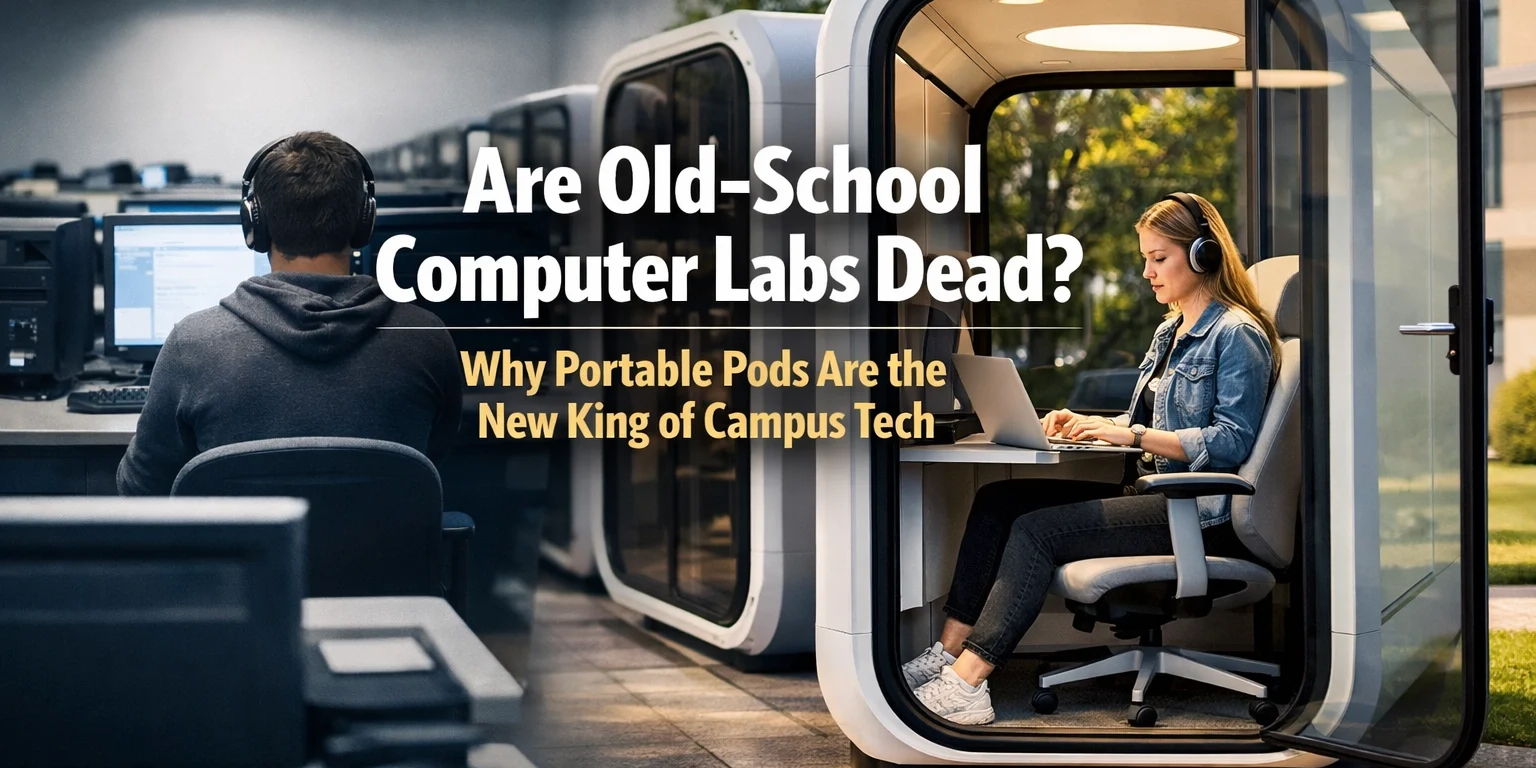
If you close your eyes and think of a "computer lab," you probably see a dimly lit room filled with rows of beige (or maybe slate gray) towers, a tangle of dusty Ethernet cables, and that unmistakable hum of forty cooling fans struggling to stay alive. For decades, this was the epicenter of campus technology: a sacred space where students went to write term papers, print out syllabus PDFs, and occasionally play a sneaky game of Minesweeper.
But it’s 2026, and the "room with rows of desks" model is looking more like a museum exhibit than a modern learning environment. The traditional computer lab isn’t just aging; it’s being replaced by something faster, smarter, and infinitely more flexible: the Portable Pod.
At USA Entertainment Ventures LLC, we spend a lot of time looking at how physical infrastructure meets digital demand. Whether it’s future-ready pipelines or the way media is consumed on the go, the shift toward mobility is undeniable. Let’s dive into why these high-tech pods are dethroning the old guard and how they are carving out new career pathways for the next generation.
The Financial Death Spiral of Traditional Labs
The math simply doesn’t add up for traditional labs anymore. Educational institutions are finding that maintaining a fixed room full of hardware is a black hole for budgets.
First, there’s the "hardware refresh" cycle. Technology moves so fast that a top-of-the-line workstation bought today is essentially a paperweight in four years. For a university with ten labs, that’s hundreds of machines requiring constant maintenance, software updates, and eventual replacement.
Secondly, there is the real estate problem. Physical space on campus is at a premium. Keeping a 2,000-square-foot room locked into a single purpose: especially when it sits empty for half the day: is an enormous waste of resources. Modern campuses need spaces that can pivot.
Traditional labs often fail because they are designed for "generic computing." In an age where every student has a laptop or a powerful smartphone, nobody needs to go to a lab just to use Microsoft Word. They need specialized tools that can’t fit in a backpack.
Enter the Pod: Specialized, Scalable, and Swift
So, what is a "Pod"? Think of it as a purpose-built, self-contained environment. Instead of a generic room for everyone, pods are specialized hubs designed for specific career paths. They are modular, often portable, and can be deployed exactly where they are needed.
Recent data suggests that institutions switching to pod-based models can see cost savings between 50 and 75 percent. By ditching the massive overhead of permanent rooms and shifting to a hybrid architecture: where local high-performance hardware is supplemented by cloud connectivity: schools are getting more bang for their buck.

Career Pathway #1: The Cybersecurity Frontline
One of the most significant advantages of the pod model is the ability to create "sandboxed" environments. In the world of cybersecurity, you can’t exactly let students practice penetration testing or malware analysis on the main campus network. That’s a recipe for a very bad day for the IT department.
Cybersecurity pods act as isolated tactical units. They come equipped with network simulation hardware, secure servers, and the specific toolsets needed for ethical hacking and defense. This physical infrastructure allows students to work in a "live" environment that mirrors a real-world Security Operations Center (SOC).
By training in these pods, students aren't just learning theory; they are getting hands-on experience with the physical and digital realities of the job. It’s a direct pipeline into a high-demand industry that desperately needs people who know how to handle hardware, not just click buttons on a screen.
Career Pathway #2: Content Creation and the "Creator Economy"
If you’ve looked at the media landscape lately, you know that content creation is no longer just a hobby; it’s a multi-billion dollar industry. But a standard classroom isn't equipped for high-end production.
Content creation pods are essentially "studios in a box." We’re talking professional-grade lighting, soundproofing, 4K streaming setups, and workstations capable of rendering complex 3D environments in real-time. This is where projects like ZooMedia and other digital ventures find their footing.
When a student enters a content pod, they are entering a professional workspace. They learn how to manage a broadcast, edit high-resolution video, and handle the logistics of a live production. This hands-on experience is what separates a graduate with a degree from a graduate with a portfolio.
Career Pathway #3: Logistics and Infrastructure Management
Here is the part people often forget: someone has to move, maintain, and manage these pods. The shift from "fixed" to "portable" tech has created a massive new career path in technical logistics.
Managing a fleet of portable tech pods across a campus or a city requires a deep understanding of:
- Physical Deployment: How to safely move and secure high-value tech.
- Network Integration: Ensuring that a portable unit can "plug and play" with existing infrastructure.
- Preventative Maintenance: Keeping specialized hardware running at peak performance without the luxury of a central IT office nearby.
At USA Entertainment Ventures LLC, we see this as the backbone of the new economy. It’s about more than just the "cloud"; it’s about the physical reality of where technology meets the person using it.

Why Collaboration is the "Secret Sauce"
The old-school computer lab was a lonely place. You sat in a carrel, put your headphones on, and stared at a CRT monitor until your eyes watered. Modern work isn’t like that. Whether you’re in a startup or a Fortune 500 company, work is collaborative.
Pods are designed with this in mind. They feature "huddle" spaces, shared displays, and layouts that encourage cross-functional teamwork. A cybersecurity student might be working in one pod while a content creator works in the next, and the logistics of their shared infrastructure might be managed by a third student. This mimics the contemporary workplace, where silos are being broken down in favor of agile, collaborative teams.
Bridging the Equity Gap
One of the biggest arguments for keeping traditional labs was "equity": ensuring that students who couldn't afford a high-end computer had access to one. While well-intentioned, the traditional lab actually failed many students because it was only accessible during certain hours and in certain buildings.
Portable pods can be placed in community centers, dorm lobbies, or even mobile units that travel to underserved areas. Because they utilize hybrid cloud architecture, they can provide high-end computing power to students who might only have a basic tablet at home. It’s about taking the tech to the people, rather than making the people come to the tech.
Looking Ahead: The Campus of 2030
As we look toward the future, the idea of a "fixed" computer lab will likely seem as quaint as a chalkboard. We are moving toward an era of "just-in-time" infrastructure. Need a high-end VR lab for a three-week architecture project? Roll in a pod. Need extra cybersecurity training for a weekend boot camp? Deploy the pod.
This flexibility allows educational institutions to be responsive to the market. They no longer have to wait for a ten-year capital improvement project to update their technology. They can swap out pods as industry needs change, ensuring that their students are always training on the "King of Campus Tech."
The death of the old-school computer lab isn’t something to mourn. It’s an evolution. It’s a move away from static, expensive, and isolated learning toward a future that is mobile, specialized, and deeply connected to the real-world careers of tomorrow.
Whether you're interested in the infrastructure of tomorrow or just looking for a better way to get students ready for the workforce, one thing is clear: the pods have arrived, and they’re here to stay.
Want to learn more about how we’re shaping the future of infrastructure and media? Check out our latest projects at USA Entertainment Ventures and see how we're turning big ideas into reality.