
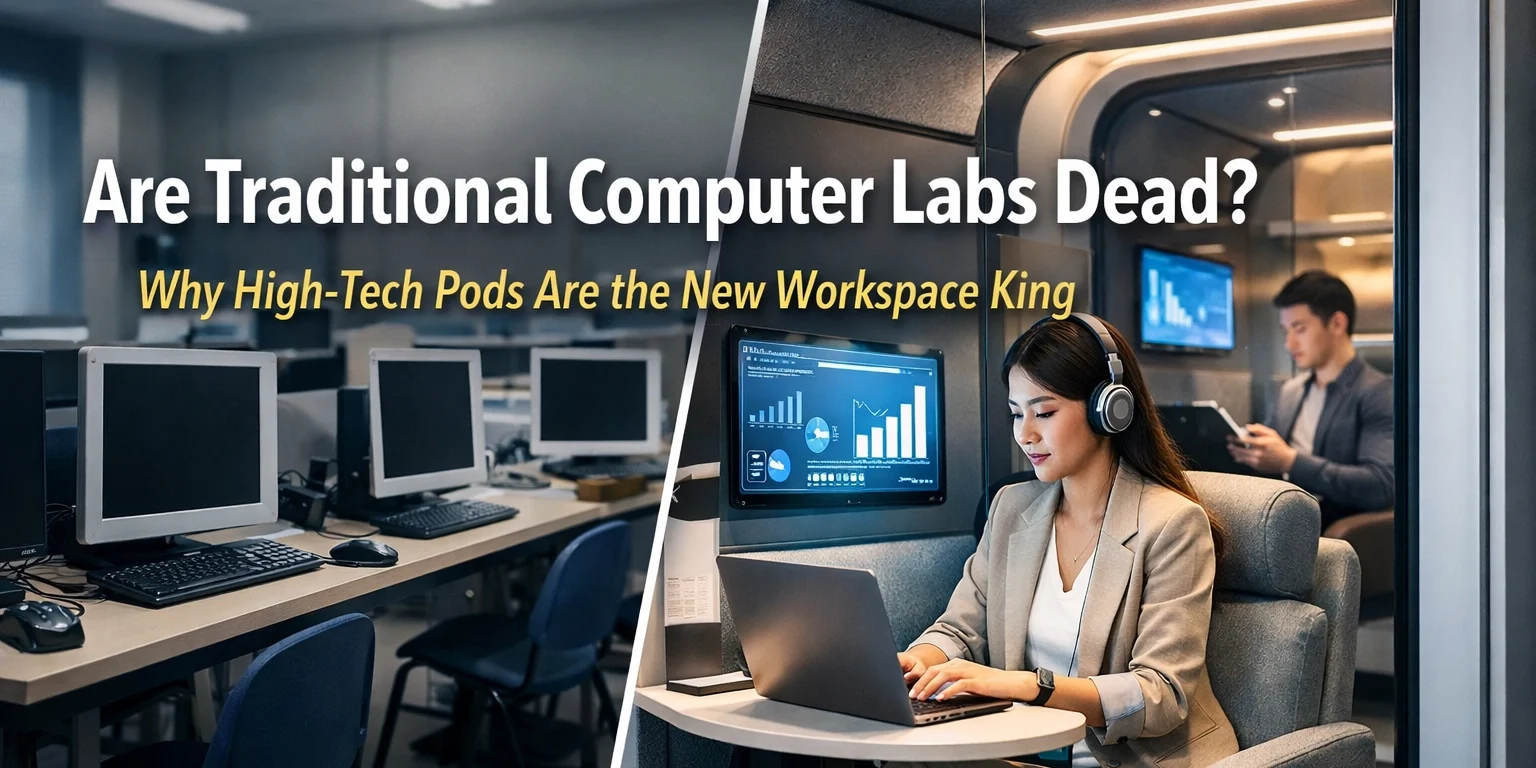
If you grew up anytime between 1990 and 2015, the "computer lab" holds a very specific place in your memory. It was likely a windowless room smelling faintly of ozone and floor wax, filled with rows of beige (and later, sleek black) towers that were perpetually out of date. You went there to type a paper, play Oregon Trail, or, if you were feeling particularly rebellious, bypass the school’s firewall to look at memes.
Fast forward to Monday, March 9, 2026, and that image is looking more like a museum exhibit than a modern workplace. In the fast-paced world of Business Consulting, we are seeing a massive shift in how physical space is used to facilitate digital work. The traditional, static computer lab isn't just getting a facelift; it’s being replaced by something far more agile, efficient, and frankly, much cooler: The High-Tech Pod.
The Evolution of the "Work-Center"
For decades, the computer lab was a necessity because the hardware was too expensive and too heavy to be anywhere else. But today, most of us carry a device in our pockets that has more processing power than the entire lab of 1998. So, why do we still need dedicated physical infrastructure?
The answer lies in specialization. While a laptop is great for checking emails or drafting a memo, it falls short when you’re diving into high-level cybersecurity, 4K content creation, or complex logistics management.
Traditional labs are failing because they are rigid. They take up massive amounts of real estate, require permanent HVAC cooling for dozens of machines, and are a nightmare to upgrade. Enter the "Pod." These modular, purpose-built environments are designed for specific tasks. Instead of a room full of general-purpose PCs, a Pod is a hyper-focused workspace equipped with exactly what a professional needs for a specific career pathway.
Why Pods are Winning (By the Numbers)
According to recent industry research, institutions and businesses switching to pod-based models are reporting cost savings between 50 and 75 percent. How is that possible?
- Reduced Overhead: You aren't paying to heat, cool, and light a 2,000-square-foot room when you only need four 50-square-foot pods.
- Flexibility: Pods can be moved. If your office layout changes or your school needs more space for a theater production, you don't need a sledgehammer; you just need a pallet jack.
- Targeted Upgrades: Instead of replacing 100 desktops, you upgrade the specific hardware in the "Cyber Pod" or the "Editing Pod."
At USA Entertainment Ventures LLC, we see this as a logical step in the digital evolution of the American workspace. It’s about working smarter, not just harder.
Career Pathway #1: The Cybersecurity Fortress
Cybersecurity isn't just about sitting in a dark room with green text scrolling down a screen (despite what movies tell you). It requires specialized hardware, multiple monitors for real-time monitoring, and isolated networks to test vulnerabilities without crashing the main office Wi-Fi.
A High-Tech Pod dedicated to cybersecurity acts as a "mini-SOC" (Security Operations Center). For those looking into career opportunities in this field, practicing in an environment that mimics a real-world command center is invaluable. You aren't just learning code; you’re learning the physical and mental workflow of a high-stakes industry.

Career Pathway #2: The Content Creation Engine
If you’ve ever tried to render a 10-minute 4K video on a standard office laptop, you know the sound of a computer fan trying to reach escape velocity. You also know the frustration of waiting three hours for a file to export.
Content creation pods are the new "gold standard" for the creator economy. These pods are acoustically treated (no one wants to hear the coffee machine in the background of their podcast) and equipped with high-end GPUs and color-calibrated monitors. Whether you are working on a project for our showcase or building your own brand, having a space that is literally "plug and play" for creativity is a game-changer.
Career Pathway #3: Logistics and Real-Time Ops
We don't often think of logistics as a "high-tech" field, but in 2026, it’s all about data. Managing a supply chain or a fleet of autonomous delivery vehicles requires a "mission control" mindset.
Logistics pods allow operators to manage complex data streams, satellite tracking, and communication hubs in a focused environment. It’s about taking the chaos of global trade and condensing it into an actionable dashboard. This is the new front line of business consulting and infrastructure management.

Are Traditional Labs Truly Dead?
To be fair, "dead" might be a strong word. Let’s say they are "evolving." Traditional labs still have a place for collaborative, large-group learning where everyone needs to be looking at the same screen at the same time. Modernized labs are shifting toward a "Bring Your Own Device" (BYOD) model, where the room provides the high-speed connection and the collaborative atmosphere, but the "brains" of the operation come in the students' backpacks.
However, for specialized, high-intensity work, the Pod is the undisputed king. It provides a level of immersion that a row of desks simply cannot match. It’s the difference between driving a minivan and sitting in a cockpit.
The Social Factor: Collaboration in a Pod World
One of the biggest criticisms of the "Pod" movement is the fear of isolation. Won't everyone just be locked in their own little boxes?
In reality, the opposite is happening. Because pods are efficient and save space, they allow for larger "common areas" where people can gather once their deep-work session is over. Think of it as the "Library Model": you go to the stacks (the pods) for intense focus, and you go to the lounge for the brainstorm. This balance is crucial for maintaining a healthy company culture and fostering the kind of fan experience or client satisfaction that we strive for.
Actionable Takeaway: How to Adapt
If you are a business owner, educator, or just someone looking to future-proof your career, here is how you can jump on the Pod trend:
- Audit Your Space: Do you have a "storage room" that’s just collecting dust? That’s not a closet; it’s a potential three-person cybersecurity hub.
- Identify Your Specialized Needs: Don't build a general lab. Identify the one thing your team needs most, be it video editing, data analysis, or a quiet space for client calls, and build a pod for that.
- Invest in Modular Infrastructure: When buying furniture or tech, ask yourself: "Can I move this in twenty minutes?" If the answer is no, you might be building a dinosaur.
Looking Forward
The shift from labs to pods is more than just a change in furniture; it’s a shift in how we value our time and our focus. In an era where distractions are everywhere, a dedicated physical space that says "this is where the real work happens" is the ultimate luxury.
Whether you're curious about our services or looking to join our team, the future of work is about precision. The days of one-size-fits-all computing are over. Long live the Pod.

Want to learn more about the intersection of tech, entertainment, and business? Check out our Q&A section or reach out to us directly through our contact page. We’re always looking for the next big thing in workspace innovation.





