
The Enterprise Skills Gap Requires Infrastructure, Not Just Programs
Fortune 100 companies are facing a persistent challenge: the gap between available talent and the specialized skills required for cloud computing, artificial intelligence, and data-driven operations continues to widen. According to the World Economic Forum, 50% of all employees will need reskilling by 2025 as adoption of technology increases. Traditional educational pathways are not producing career-ready candidates at the velocity or scale enterprises require.
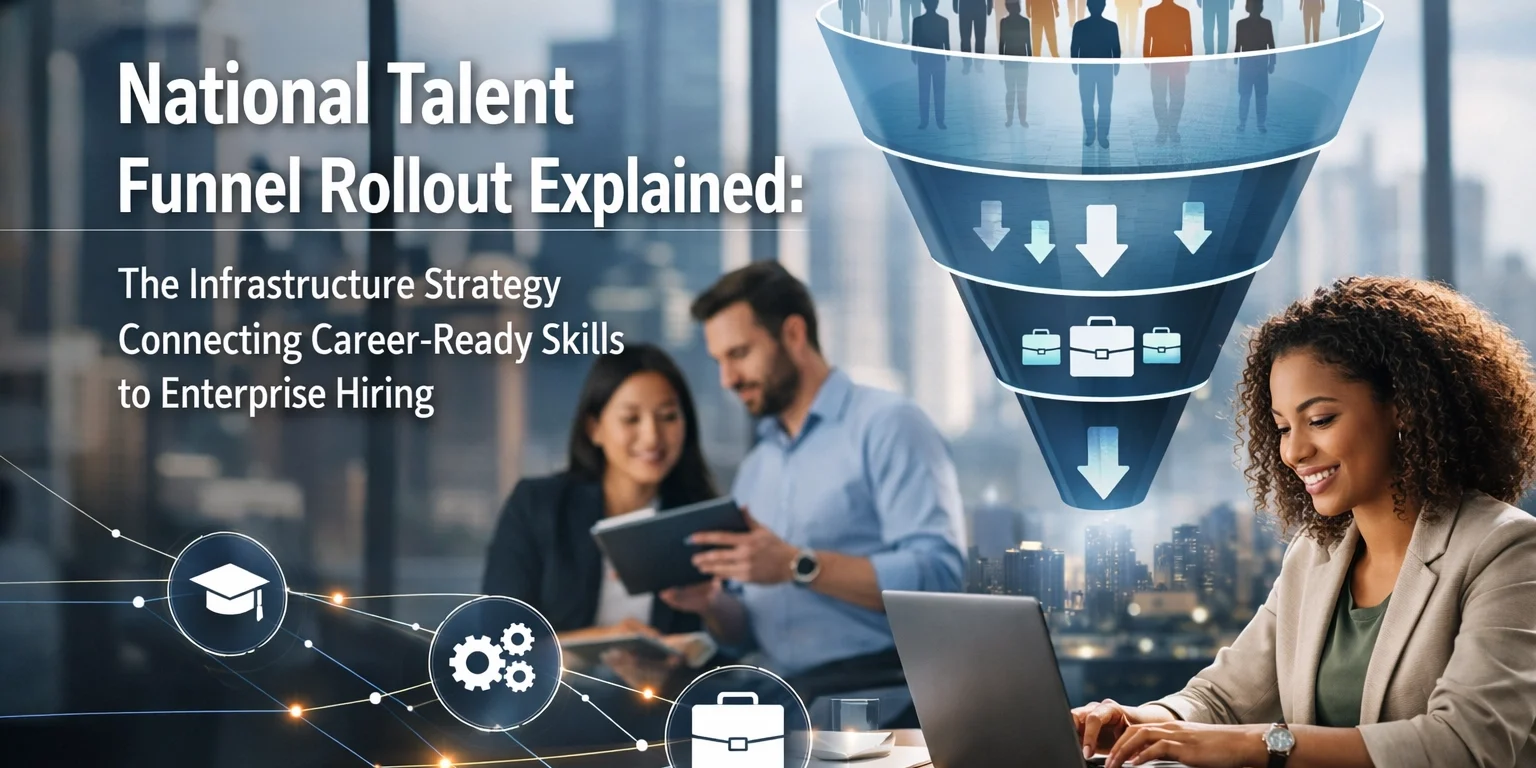
The National Talent Funnel Rollout represents a fundamental shift in how workforce development infrastructure can be deployed: not as isolated training programs, but as an interconnected system that identifies, develops, and channels technical talent directly to enterprise hiring pipelines. This strategy leverages physical distribution networks, engagement platforms, and career pathways to create what is essentially a national pipeline for technical literacy.

Understanding the Infrastructure Model
Unlike conventional workforce development initiatives that rely on fragmented community programs or academic institutions working in isolation, the National Talent Funnel operates as an integrated infrastructure play. The model has three core components:
Physical Distribution Networks: Utilizing existing logistics and distribution infrastructure to create accessible points of engagement across diverse geographic regions. These locations serve as nodes in a nationwide system where career-ready skill development can occur at scale, reaching communities that traditional tech education has bypassed.
Engagement Platform Architecture: The infrastructure leverages high-interest activities: particularly competitive gaming and esports: as the entry point for technical skill development. This approach recognizes that engagement precedes education, and that sustainable workforce pipelines require intrinsic motivation rather than compliance-based participation.
Enterprise Integration Layer: Rather than producing generically "trained" individuals, the system incorporates enterprise-defined competencies and credentials directly into the development pathway, ensuring that graduates emerge with immediately applicable, market-validated skills.
The infrastructure approach is deliberate. Just as highway systems or electrical grids require coordinated rollout and interconnected nodes to function, effective workforce development at national scale requires similar architectural thinking. Isolated training centers cannot create the network effects necessary to shift labor market dynamics at the enterprise level.
Esports as the Gateway to Cloud and AI Literacy
The strategic use of esports and competitive gaming within this infrastructure deserves particular attention. This is not about training professional gamers: it is about leveraging an engagement mechanism that naturally introduces participants to the technical stack enterprises require.
Modern competitive gaming environments operate on cloud infrastructure, utilize real-time data analytics, employ machine learning for matchmaking and performance optimization, and require participants to develop systems thinking, rapid decision-making under uncertainty, and collaborative problem-solving. These are precisely the cognitive frameworks and technical exposures that create foundational literacy for enterprise technology roles.

By positioning esports as the entry point: what industry strategists term the "Trojan Horse" approach: the infrastructure attracts participants who might not initially seek technical training but who develop affinity for technology through high-engagement activities. Once engaged, participants can be systematically introduced to underlying technologies: cloud computing architecture, data pipeline management, AI-assisted analytics, and infrastructure automation.
Research from MIT's Computer Science and Artificial Intelligence Laboratory demonstrates that engagement-first learning pathways produce significantly higher retention and skill mastery than traditional instruction-first methodologies. The National Talent Funnel applies this insight at infrastructure scale.
The progression is intentional: participants enter through competitive gaming, gain exposure to technical systems, receive guidance toward career-relevant applications of those systems, and transition into formal credentialing pathways aligned with enterprise requirements. This creates a funnel that begins with millions of potential participants and systematically channels motivated individuals toward career-ready outcomes.
The Physical Distribution Strategy
Perhaps the most innovative aspect of the National Talent Funnel is its approach to physical infrastructure. Rather than building new facilities from scratch: a capital-intensive and time-prohibitive approach: the strategy leverages existing distribution networks that already reach diverse communities nationwide.
Logistics and distribution centers exist in virtually every metropolitan area and many rural regions, creating an existing footprint that can be activated for workforce development purposes. These facilities possess several advantages: they are already located near transportation hubs, they serve diverse demographic populations, they operate with established management structures, and they have existing relationships with local communities.

By integrating workforce development activities into these distribution nodes, the infrastructure achieves several objectives simultaneously. It provides accessible entry points for participants who may not have nearby colleges or technical training centers. It creates natural connections between skill development and employment opportunities, as logistics and distribution operations increasingly require technical competencies in automation, data management, and systems optimization. And it enables rapid national rollout without the decade-long timelines typically associated with building educational infrastructure.
The physical presence matters for several reasons. First, it addresses the digital divide by providing equipment, connectivity, and technical environments that participants may not have in their homes. Second, it creates community and peer learning effects that purely online programs cannot replicate. Third, it establishes legitimacy and institutional credibility that improves participation rates, particularly in communities where online-only programs have historically underperformed.
Connecting Career-Ready Skills to Enterprise Hiring
The ultimate measure of the National Talent Funnel's effectiveness is whether it produces candidates enterprises actually hire. This requires careful alignment between skill development pathways and enterprise requirements: an alignment that many traditional education systems struggle to achieve due to slow curriculum adaptation and disconnection from current market demands.
The infrastructure addresses this through several mechanisms. First, it incorporates industry-standard certifications and credentials directly into the development pathway, ensuring participants emerge with market-recognized qualifications. Cloud computing certifications, data analytics credentials, and technical project management qualifications are embedded throughout the progression, not added as afterthoughts.
Second, the system utilizes competency-based assessment rather than time-based completion. Participants advance by demonstrating mastery of specific technical skills, not by accumulating credit hours. This creates more reliable signals for enterprise hiring teams and allows accelerated progression for high-aptitude individuals.
Third, the infrastructure includes direct enterprise integration points where companies can define specific competency requirements, participate in assessment validation, and access candidate pipelines for roles they need to fill. This transforms workforce development from a supply-side activity into a demand-driven system responsive to actual labor market needs.
Implementation Considerations for Enterprise Leaders
For Fortune 100 executives evaluating this infrastructure strategy, several implementation factors warrant consideration. The National Talent Funnel represents a multi-year buildout that will scale progressively rather than appearing fully formed. Early adoption by enterprises creates competitive advantage in talent access, but requires willingness to engage with an evolving system rather than a finished product.
Geographic rollout will likely follow a hub-and-spoke pattern, with initial concentration in regions where distribution infrastructure density is highest, followed by expansion into secondary markets. Enterprises with operations in multiple regions should anticipate variable access to the talent pipeline depending on local infrastructure maturity.

Integration with existing enterprise hiring systems requires technical and procedural adaptation. Companies will need to incorporate new credential types into applicant tracking systems, train hiring managers on competency-based assessment interpretation, and potentially modify job descriptions to align with the skills candidates actually possess rather than traditional degree requirements.
The infrastructure also presents opportunities for enterprise participation beyond hiring. Companies can contribute to curriculum development, provide technical mentorship, offer apprenticeship pathways, and establish preferred hiring partnerships. These engagements strengthen the talent pipeline while building employer brand awareness among emerging technical professionals.
The Strategic Imperative
The National Talent Funnel Rollout addresses a fundamental challenge facing American enterprise: the technical skills required for competitive advantage are not being developed at sufficient scale or velocity through traditional educational pathways. By approaching workforce development as infrastructure rather than programming, the strategy creates a systemic solution capable of operating at the scale enterprises require.
The esports engagement mechanism, physical distribution network, and enterprise integration layer represent a coordinated system designed to identify technical aptitude, develop career-ready competencies, and channel qualified candidates toward enterprise hiring pipelines. For Fortune 100 executives facing persistent talent shortages in cloud computing, artificial intelligence, and technical operations, this infrastructure represents a material development in talent supply chains.
As the rollout progresses over the coming years, enterprises that engage early with the infrastructure will establish preferred access to emerging talent pools and influence the development of competencies most critical to their operations. The strategic question is not whether workforce development infrastructure is needed: the skills gap makes that case clearly: but rather which companies will position themselves advantageously within the emerging system.
For more insights on workforce infrastructure strategies and enterprise talent development, visit USA Entertainment Ventures LLC.