
For decades, the traditional computer lab followed a familiar recipe: rows of identical desktops, fluorescent lighting, tangled cables, and at least one keyboard that had clearly survived several administrations.
That model served its purpose. But technology careers have changed. Today’s learners are not preparing only to type documents or practice basic coding. They are learning to manage supply chains, investigate cyber threats, produce professional video, analyze data, and collaborate across digital platforms.
The physical spaces used for training need to change, too.
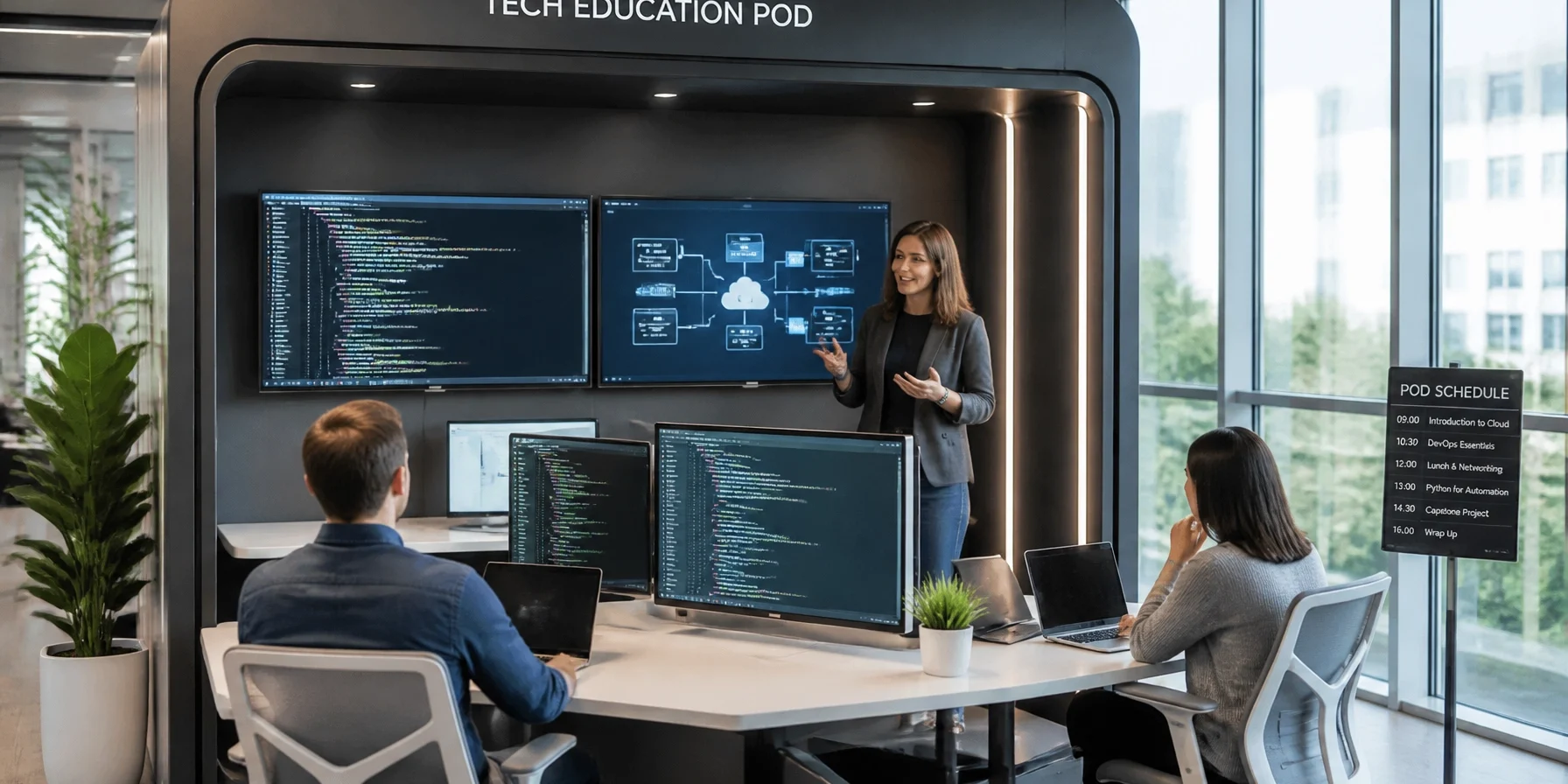
Enter the pod: a modular, purpose-built learning environment designed around a specific activity, team, or career pathway. Instead of placing dozens of generic computers in one large room, pods create smaller, more focused spaces that resemble the workplaces learners may soon enter.
What Is a Technology Pod?
A technology pod is essentially a compact, specialized lab. It may be an enclosed room, modular workspace, or carefully designed cluster of workstations equipped for a particular workflow.
A logistics pod might include large displays, multiple monitors, and supply-chain simulation software. A cybersecurity pod may contain isolated networks and threat-monitoring tools. A content creation pod can function as a small media studio with professional microphones, lighting, cameras, and editing systems.
The important distinction is that a pod is not simply a computer in a smaller room. It is a physical environment designed to support a real-world task.
That matters because modern careers are organized around workflows, not isolated software applications. A security analyst does not simply “use a computer.” A logistics coordinator monitors data, communicates with multiple teams, and makes decisions under changing conditions. A content producer plans, records, edits, publishes, and reviews audience performance.
Pods are built to reflect that reality.
Why Traditional Computer Labs Are Losing Ground
Old-school labs tend to be fixed, generic, and difficult to update. When technology changes, the room may require new wiring, new furniture, new hardware, or a complete renovation. That can make a lab expensive to maintain and awkward to adapt.
Pods offer a more flexible alternative. Institutions can begin with a small number of specialized units and add more as enrollment, funding, or program priorities change. A space once used for introductory computing can become a media studio, a simulation center, or a collaborative project room without rebuilding the entire facility.
Pods also support different learning styles. Some learners need quiet concentration. Others learn best through teamwork, discussion, and hands-on experimentation. A large room full of identical desks does not easily accommodate both groups. A collection of pods can.
The shift is not about making education look futuristic for its own sake. It is about creating spaces that support the skills employers actually need.
The World Economic Forum’s Future of Jobs Report 2025 projects that 39% of workers’ core skills will change by 2030. The report identifies artificial intelligence and big data, networks and cybersecurity, and technological literacy among the fastest-growing skill areas. In other words, learners need regular practice with changing tools and realistic problems: not just a chair facing a monitor.
Logistics Pods: Turning Supply Chains Into Simulations
Logistics is a strong example of why specialized infrastructure matters. The U.S. Bureau of Labor Statistics projects 17% employment growth for logisticians from 2024 to 2034, with approximately 26,400 openings per year.
The BLS describes logisticians as professionals who “analyze and coordinate an organization’s supply chain.” That supply chain may involve suppliers, warehouses, transportation providers, customers, weather events, inventory constraints, and the occasional surprise that arrives precisely five minutes before a deadline.
A logistics pod can turn those pressures into a practical learning exercise. Learners might track shipments on shared dashboards, reroute freight around a weather disruption, compare transportation costs, or manage inventory across multiple locations.
This kind of practice develops more than software familiarity. It builds judgment, communication, prioritization, and resource-management skills. Learners begin to understand how decisions affect an entire operation.
They also gain a better sense of the work itself. A career pathway becomes easier to imagine when the training environment looks and feels connected to the workplace.

Cybersecurity Pods: Safe Places to Practice Risky Skills
Cybersecurity training presents a different challenge. Learners need to practice detecting threats, investigating incidents, and defending networks. However, experimenting with malicious code or offensive techniques on a live institutional network is not an especially popular idea with the IT department.
Cybersecurity pods help solve that problem through isolation. A pod can be configured as a controlled environment, sometimes called a sandbox, where learners can test security tools without putting production systems at unnecessary risk.
Teams can conduct Red Team and Blue Team exercises. One group simulates an attack while another detects and responds to it. Learners can review logs, identify suspicious activity, follow incident-response procedures, and explain their decisions.
The experience is valuable because cybersecurity is collaborative. Professionals must communicate clearly while the situation is unfolding. A pod supports that teamwork with shared screens, dedicated workstations, and a physical layout that resembles a small Security Operations Center.
The WEF report also anticipates major workforce movement through 2030, including 170 million new roles and 92 million displaced roles. That does not mean every learner must become a cybersecurity specialist. It does mean adaptable technical skills will matter across industries.

Content Creation Pods: From Classroom Assignment to Portfolio
Content creation is another career area where the room itself affects the quality of the work.
A standard computer lab may provide editing software, but it rarely provides good acoustics, controlled lighting, recording equipment, or enough processing power for complex video projects. The result is often a presentation recorded beside a humming air conditioner. The air conditioner may have excellent work ethic, but it is not a great co-host.
Content creation pods bring the basic elements of a professional studio into a compact space. Learners can record podcasts, produce interviews, edit video, create social media campaigns, build training materials, or stream live presentations.
The benefit is practical. Students and trainees finish with work they can show to employers, clients, or partners. They also learn the complete production process: planning, scripting, recording, editing, publishing, and measuring audience response.
That combination supports pathways into digital marketing, media production, communications, instructional design, and independent creative work.

The Bigger Advantage: Career-Aligned Infrastructure
Pods do not eliminate the need for classrooms, libraries, or general-purpose computer access. They add something those spaces often cannot provide: focused environments built around real work.
For schools, workforce programs, businesses, and community training centers, the practical advantages include:
- Flexibility: Add or reconfigure spaces as programs evolve.
- Focus: Reduce distractions through smaller, purpose-built environments.
- Collaboration: Give teams shared screens and work areas.
- Security: Create controlled spaces for cyber and network simulations.
- Career alignment: Help learners practice the workflows used in actual jobs.
- Portfolio development: Produce tangible projects instead of completing assignments that disappear into a grading system.
Organizations considering new workforce strategies can explore business services, case studies, and related guidance on building the next-generation talent funnel.
The Next Computer Lab May Not Look Like a Computer Lab
The future of technology education will require more than updated devices. It will require environments that connect learning to employment.
Pods provide that connection. They turn physical infrastructure into part of the curriculum, whether the goal is managing a supply chain, defending a network, or producing a polished media project.
The traditional computer lab is not disappearing overnight. But its role is changing. As technology careers become more specialized and interdisciplinary, modular pods offer a practical way to keep training spaces flexible, relevant, and connected to the future of work.
The next generation of learners may not remember the old rows of identical computers. If the pod model succeeds, they may remember something more useful: the first place where a career started to feel real.





