
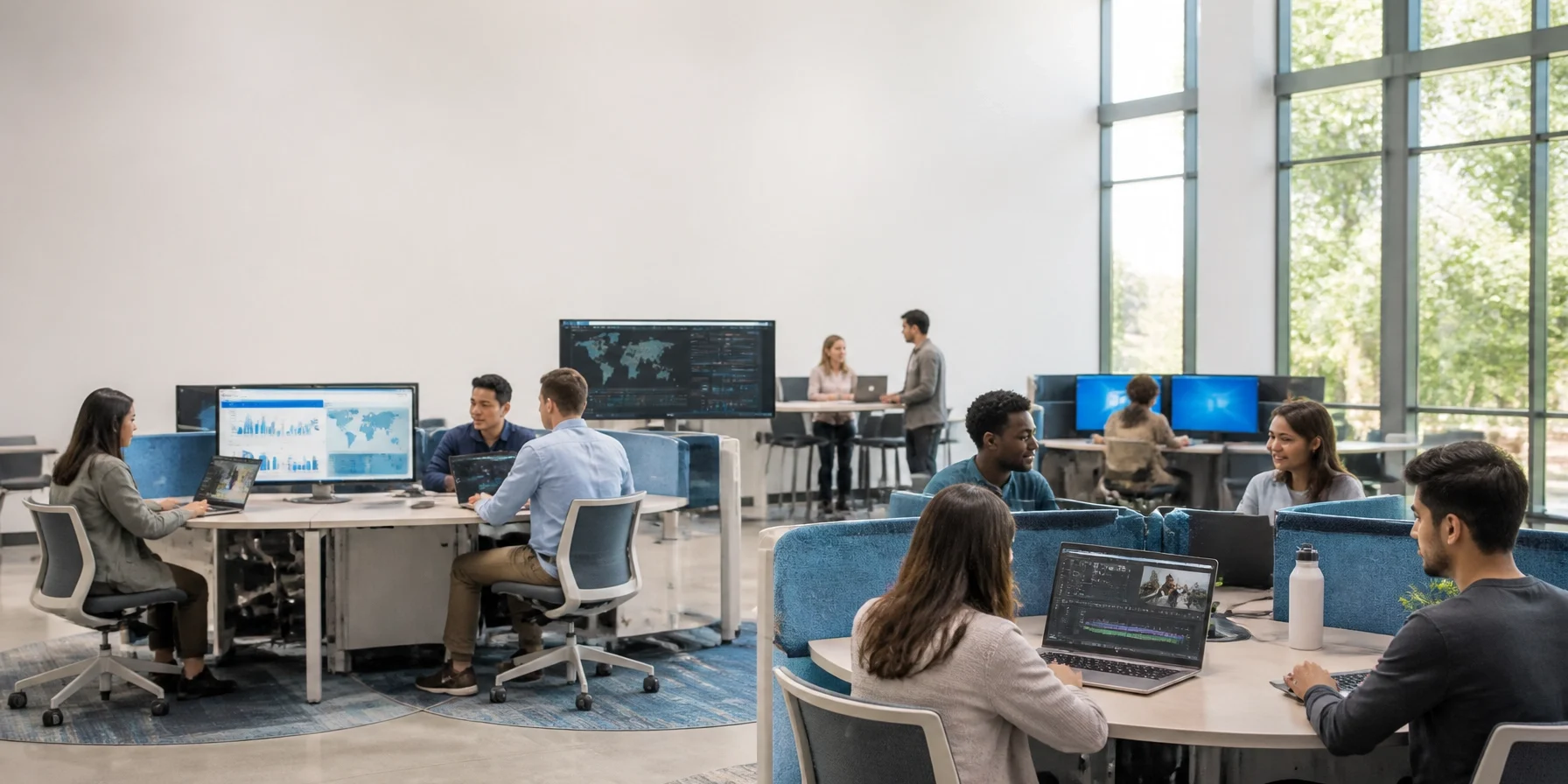
Walk into an old-school computer lab and you may see rows of identical desktops, tangled cables, and enough fluorescent lighting to make everyone look like they are being questioned in a spy movie.
That model served education well for decades. But modern Tech Education is changing. Students are no longer preparing only to type documents or complete software tutorials. They are learning how to manage digital supply chains, investigate cyber threats, build media projects, and collaborate across complex systems.
That is where Pods come in.
Pod-based spaces are becoming a practical alternative to traditional Computer Labs because they combine technology, teamwork, flexibility, and career-focused learning in one physical environment. They do not simply provide more computers. They create workspaces that look and feel more like the workplaces students may enter after graduation.
What Are Pods?
A pod is a small, modular work area designed for focused individual or group activity. Depending on the setting, a pod may include:
- Networked computers or laptop docking stations
- Shared displays and presentation screens
- Power and high-speed internet connections
- Whiteboards or digital collaboration tools
- Sound-dampening materials
- Specialized equipment for a particular career pathway
Some pods are open clusters that seat four to six learners. Others are semi-enclosed booths designed for quiet work, recording, or secure technical exercises.
The basic idea is simple: instead of putting students in rows facing the front of the room, pods organize them around a task. The room becomes less “everyone stare at the same screen” and more “let’s solve this problem together.”
A 2012 pilot study of a university “Pod Room” found that students and instructors reported stronger interaction, collaboration, and problem-based learning opportunities. The researchers also noted an important limitation: the technology worked best when instructors redesigned lessons around active participation rather than simply moving lectures into a new room. In other words, a pod is helpful, but it is not educational magic furniture.
Why Pods Improve on Traditional Computer Labs
Traditional labs are often fixed, single-purpose spaces. Every station may have the same hardware, the same layout, and the same function. That creates consistency, but not much adaptability.
Pods offer several advantages:
1. More collaboration
Modern careers rarely involve working alone at one computer all day. A logistics analyst may coordinate with operations teams. A cybersecurity professional may work in a group investigating an incident. A content producer may collaborate with writers, editors, designers, and clients.
Pods support these working patterns naturally. Students can share screens, compare ideas, divide responsibilities, and present progress without rearranging an entire classroom.
Research reinforces the value of this approach. In a meta-analysis of 225 studies, Freeman and colleagues reported that active learning improved student examination performance and that failure rates were significantly higher in traditional lecture-based courses. Their conclusion was straightforward: students tend to learn more when they actively participate.
2. Greater flexibility
A traditional lab can be difficult and expensive to reconfigure. Pods are more adaptable. A single room can support different courses during the same day:
- A logistics simulation in the morning
- A cybersecurity exercise after lunch
- A video editing or podcast project in the afternoon
That flexibility matters to schools, workforce programs, and community learning centers managing limited space. Physical Infrastructure becomes an asset that can evolve as technology and employer needs change.
3. Better focus and privacy
Not every technical task benefits from an open room full of competing conversations. Cybersecurity investigations, audio recording, software development, and detailed data analysis all require concentration.
Sound-dampened or semi-enclosed pods can reduce distractions while still preserving access to shared instruction. Students get a quieter place to focus without being completely isolated from their teams.
4. More realistic workplace preparation
Rows of computers teach computer use. Purpose-built pods can teach professional workflows.
A pod can be designed to resemble a control room, security operations center, production studio, or collaborative office. That realism helps students understand not only what tools do, but also how people use them together under real-world conditions.
Three Career Pathways Enabled by Pods

Logistics: Turning Data Into Decisions
A logistics pod might include multiple displays showing shipment routes, inventory levels, warehouse activity, or delivery schedules. Students can work through scenarios such as a delayed shipment, a fuel-price change, or a sudden inventory shortage.
One student may monitor transportation data while another evaluates warehouse capacity. A third can recommend a revised route, and a fourth presents the decision to the group.
This is more engaging than memorizing supply-chain terms from a textbook. It also reflects a growing field. The U.S. Bureau of Labor Statistics projects 16.7% employment growth for logisticians from 2024 to 2034.

Cybersecurity: Practicing Without Breaking the Network
Cybersecurity education requires hands-on practice, but experimenting on a live institutional network is a poor plan. It is difficult to explain a network outage with the phrase, “The students were learning.”
A cybersecurity pod can use segmented networks, dedicated firewalls, and sandboxed systems. A sandbox is an isolated environment where learners can safely test tools and respond to simulated threats without affecting production systems.
Students can practice:
- Red Team and Blue Team exercises
- Incident response
- Log analysis
- Vulnerability assessment
- Malware investigation using controlled samples
The employment outlook also demonstrates why this pathway matters. BLS projects 28.5% growth for information security analysts between 2024 and 2034.
Content Creation: Building a Production Workflow
Content creation pods can function as compact studios. They may include microphones, cameras, acoustic treatment, headphones, lighting, and editing workstations.
A group could produce a short training video, podcast, livestream, or marketing campaign. One learner manages audio, another edits video, and another organizes the project’s visual assets. The result is not just a finished assignment. It is a portfolio piece and a lesson in deadlines, review cycles, and teamwork.

The BLS projects film and video editor employment to grow about as fast as average through 2034, with continued demand across digital media, advertising, education, and online communications. The pathway may begin with a modest editing project, but the skills can travel widely.
How to Start Replacing a Computer Lab With Pods
A successful transition does not require removing every desktop on day one. Organizations can begin with a pilot area and measure:
- Utilization: Which pods are used, and for what activities?
- Learning outcomes: Are students completing more practical projects?
- Technical reliability: Are networking, displays, and equipment easy to maintain?
- Accessibility: Can all learners use the space comfortably?
- Career alignment: Do projects reflect real employer needs?
Most importantly, curriculum should change along with the room. A pod-based classroom filled with lecture-only lessons is still a traditional lab wearing a nicer jacket.
Organizations developing talent pipelines can also connect pod-based learning with internships, career and technical education, and programs such as DOD SkillBridge recruitment. As discussed in building the next-generation talent funnel, early exposure to real tools and workflows can help learners make more informed career choices.
The Next Phase of Tech Education
Pods are not a cure-all, and traditional classrooms still have a role. However, they offer a stronger physical foundation for collaborative, career-focused learning.
The future of Physical Infrastructure in education will likely be less about one large room full of identical machines and more about flexible spaces built around specific outcomes. Logistics learners will manage moving goods. Cybersecurity learners will investigate threats. Content creators will produce work for real audiences.
That is why Pods are becoming the new Computer Labs: they turn technology access into practical experience. For schools, training organizations, and employers, the opportunity is to build spaces that do more than house equipment. They can help people see: and practice: the careers they are preparing to enter.





