
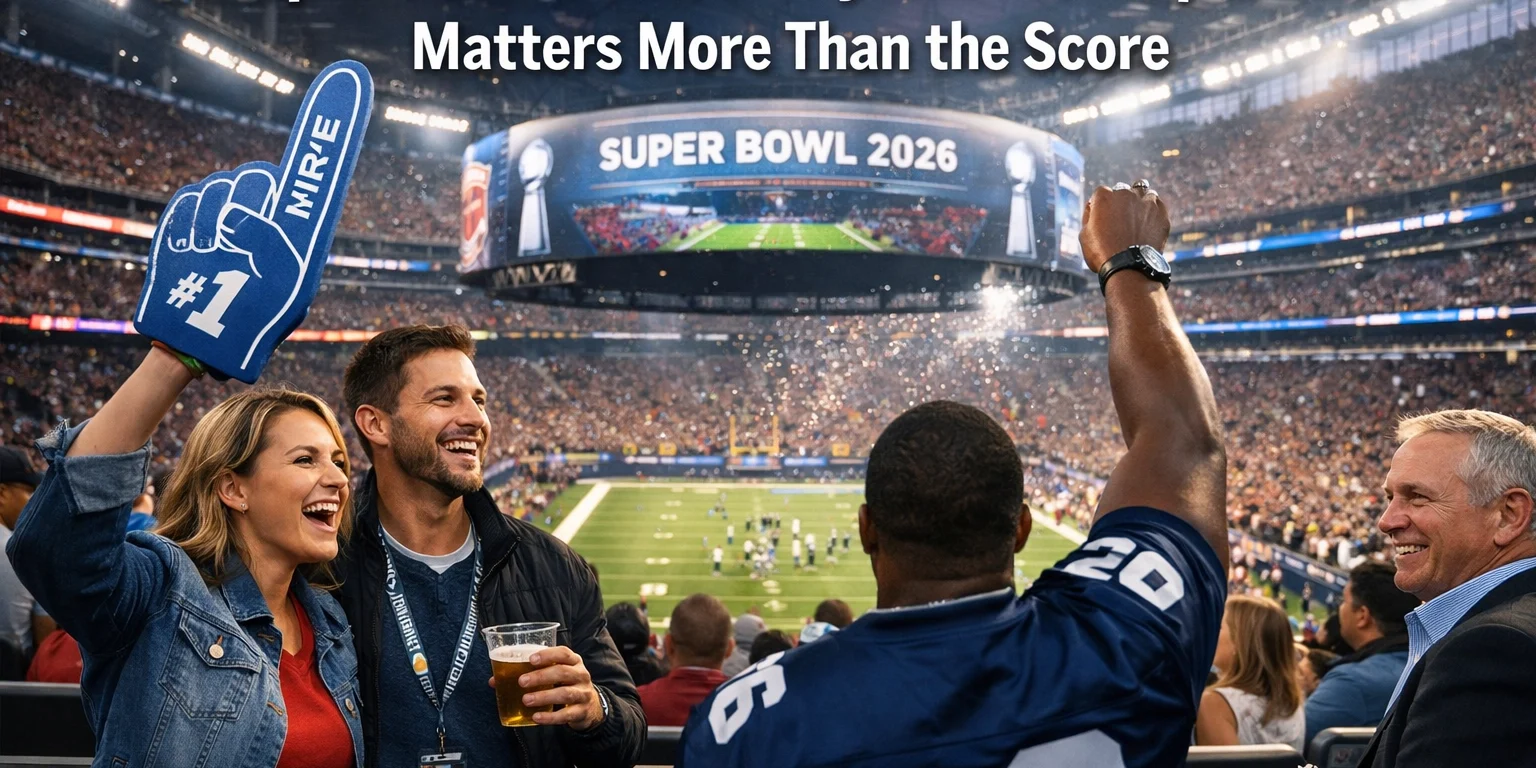
The final whistle blows, confetti falls, and one team hoists the Vince Lombardi Trophy. For decades, that singular moment defined success at the Super Bowl. But in 2026, something fundamental has shifted. The game itself: those four quarters of action: represents just one piece of a much larger puzzle.
Super Bowl LX has demonstrated that the true victor isn't necessarily the team that wins on the field, but rather the ecosystem of brands, venues, and organizers that create meaningful connections with fans before, during, and after kickoff. This transformation reflects a broader evolution in how major sporting events generate value, moving beyond broadcast ratings to encompass tangible experiences that resonate long after the game ends.
The End of the Single-Moment Strategy
The traditional approach to the Super Bowl treated it as a discrete media event. Brands invested millions in a 30-second commercial slot, hoping that brief moment would drive awareness and sales. The NFL focused on game day logistics. Fans watched from home or fought crowds for a few hours at the stadium.
That model no longer delivers maximum impact. Super Bowl 2026 proved that successful activation requires treating the event as a cultural ecosystem, not just a media buy. The brands that generated the most significant returns started their engagement weeks before kickoff, maintained momentum across social and earned media during the game, and extended their presence well beyond the final score. This sustained approach yielded coverage across mainstream outlets and created conversations that lasted far longer than any commercial break.

The structural shift reflects changing consumer expectations. Modern audiences don't want to be talked at through advertising: they want to participate, engage, and become part of the story themselves. This fundamental change in how people consume entertainment has forced stakeholders to rethink every aspect of event planning and brand activation.
Building the Multi-Week Cultural Platform
Super Bowl 2026 expanded from a single Sunday into a multi-week cultural platform where conversation begins well before the event and extends beyond the final whistle. This evolution redefines what "winning" the Super Bowl means for every stakeholder involved.
For the NFL, success now encompasses the entire fan experience journey. That journey includes the Super Bowl Experience: an interactive showcase featuring games where fans can test their skills, meet current and former players for autographs, take photos with the Vince Lombardi Trophy and all 59 Super Bowl rings, run a 40-yard dash against virtual NFL players, and shop exclusive merchandise. These tangible, in-person connections transform passive viewership into active participation.
The physical footprint of the event has grown accordingly. What once concentrated in a single stadium now sprawls across entire cities, creating opportunities for fans who may never set foot in the actual game venue to still feel connected to the experience. This expansion serves both commercial and cultural purposes, democratizing access while generating economic activity across broader geographic areas.

Technology as the Invisible Enabler
None of this extended engagement would function without sophisticated technical infrastructure operating seamlessly in the background. Levi's Stadium deployed Wi-Fi 7 technology with hyper-directional capabilities to service fans securely and effectively, addressing the massive bandwidth demands created when tens of thousands of people simultaneously take pictures and share content in real time.
This technical backbone makes participation feel frictionless. Fans don't think about how their phones connect or how their social media posts upload instantly: they simply expect it to work. Meeting those expectations requires substantial investment in infrastructure that most attendees will never notice or appreciate directly, yet which fundamentally enables the entire fan experience ecosystem.
The technology extends beyond connectivity. Advanced camera systems capture personalized moments, augmented reality applications overlay interactive content on the physical environment, and mobile platforms coordinate logistics for everything from parking to concessions. Each component contributes to an environment where fans can focus on enjoyment rather than friction.
Why Physical Experiences Matter in a Digital Age
The emphasis on tangible, in-person connections might seem counterintuitive in an increasingly digital world. Yet the opposite proves true: as screens dominate daily life, physical experiences gain value precisely because of their scarcity and memorability.
Consider the impact of touching an actual Super Bowl ring versus viewing an image of one online. The physical encounter creates a visceral memory that photographs cannot replicate. Meeting a player in person, feeling the weight of the Lombardi Trophy, or competing in a physical challenge on an NFL-themed field all generate emotional responses that passive media consumption rarely achieves.

These experiential moments also drive the social media engagement that brands and the NFL seek. Fans who participate in hands-on activities become content creators themselves, sharing their experiences with their own networks and amplifying reach far beyond what traditional advertising could accomplish. The physical experience and digital amplification work synergistically rather than in opposition.
Competitive Advantage Through Connection
For organizations in the business of major events, fan experience has evolved from a nice-to-have amenity into a genuine competitive advantage. Venues, brands, and leagues that excel at creating meaningful connections will command premium value and sustained engagement. Those that treat events as isolated media moments will find themselves increasingly irrelevant.
This competitive dynamic extends beyond sports. Any organization managing large-scale events: from music festivals to corporate conferences: must recognize that participants now expect sophisticated, multi-layered experiences. The bar continues rising as technology improves and audience expectations evolve accordingly.
The investment required to meet these expectations is substantial but justified. Infrastructure upgrades, experiential activations, and extended engagement campaigns all carry significant costs. However, the return manifests not just in immediate revenue but in long-term brand affinity and customer lifetime value that compounds over years.
Practical Implications for Event Strategy
What does this shift mean for organizations planning major events? Several actionable principles emerge from Super Bowl 2026's approach:
First, extend your timeline. Don't plan for a single day: design a multi-week ecosystem that builds anticipation, delivers the core experience, and maintains momentum afterward. Second, invest in infrastructure that enables rather than inhibits participation. Technology should be invisible to users but robust enough to handle peak demand without failure.
Third, create physical touchpoints that generate emotional resonance and social sharing. Interactive experiences that put fans at the center of the action consistently outperform passive observation. Fourth, recognize that success metrics extend beyond attendance numbers to encompass engagement depth, content generation, and sustained conversation.
Looking Forward
Super Bowl 2026 marks a turning point in how major sporting events create value. The lesson extends far beyond football or even sports generally: any organization managing large-scale events must recognize that the experience surrounding the core moment now matters as much as the moment itself.
This evolution benefits everyone involved. Fans gain richer, more memorable experiences. Brands achieve deeper engagement than traditional advertising could provide. Venues and cities see extended economic activity. The organizations managing these events build stronger relationships with their audiences.
The score still matters, of course. Sports remain fundamentally competitive, and fans will always care who wins. But in 2026, we've learned that the game represents just one element of a much larger story: and sometimes, the connections made in the stadium concourse matter more than what happens on the field.
For more insights on creating meaningful experiences at major events, visit USA Entertainment Ventures LLC.





