
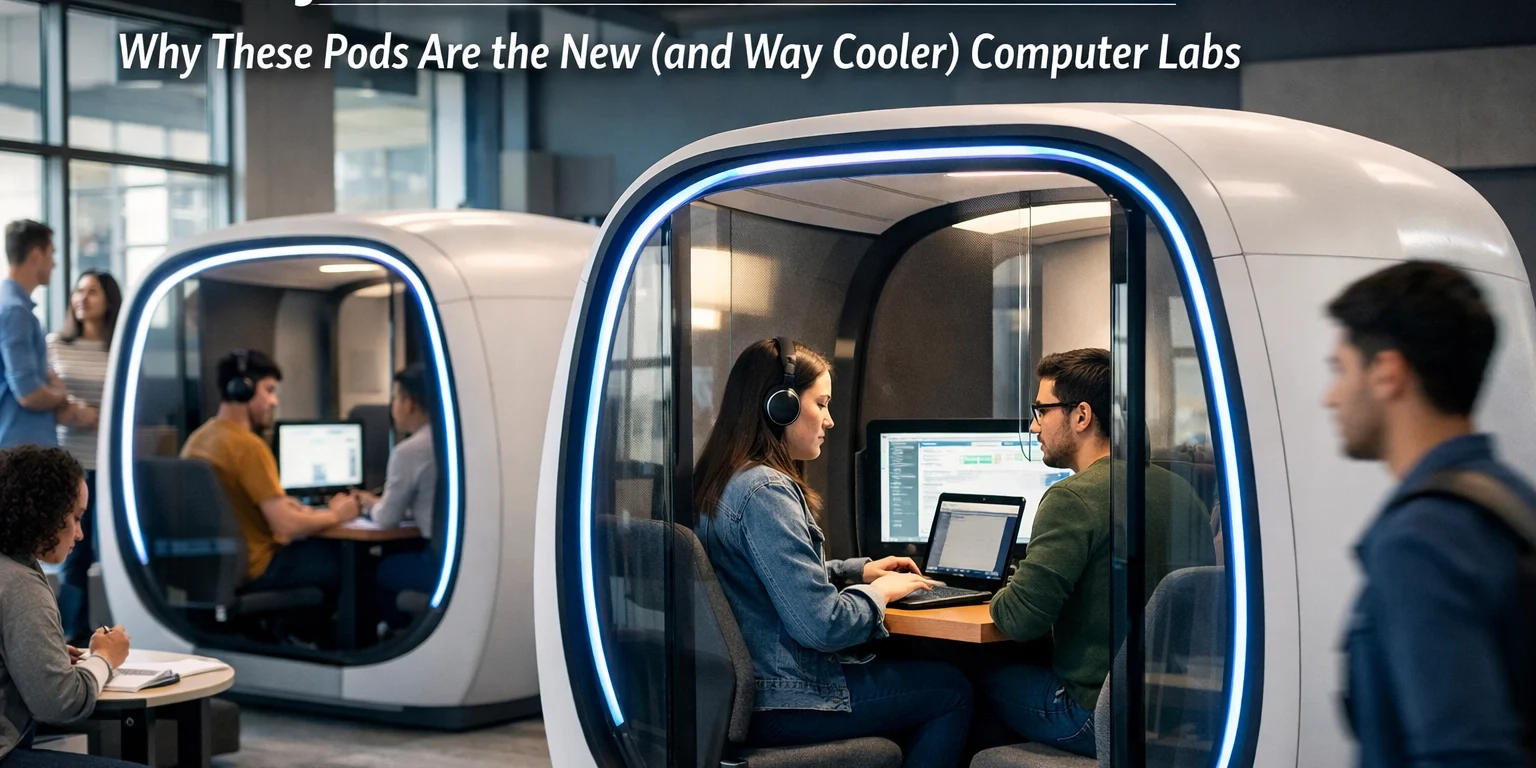
Let’s be honest: the traditional computer lab was a vibe, but not a good one. If you’re of a certain age, the phrase "computer lab" probably triggers a very specific sensory memory. It’s the smell of floor wax and ozone, the hum of fifty beige towers struggling to run Oregon Trail, and the sight of rows upon rows of students staring at the backs of each other's heads. It was a place designed for isolation, built on a foundation of rigid infrastructure that assumed everyone needed to do the exact same thing at the exact same time.
Fast forward to 2026, and that model is as dead as the floppy disk. At USA Entertainment Ventures LLC, we’re seeing a massive shift in how organizations think about physical space. The "Pod" has arrived, and it isn't just a fancy desk. It is a complete reimagining of what a learning and working environment should look like. These pods are the new nerve centers for the modern workforce, and they’re way cooler than anything we had in high school.
The Infrastructure Pivot: From Rows to Clusters
The physical differences between a 1998 computer lab and a 2026 pod-based environment are striking. Traditional labs sacrificed everything at the altar of consistency. Everyone had the same monitor, the same keyboard, and the same uncomfortable chair. But in the world of business consulting, we know that consistency is often the enemy of innovation.
Pods represent a fundamental shift toward collaborative clusters. Instead of facing a wall or the back of a classmate’s head, learners and workers are grouped in pods that feature shared screens, movable furniture, and open floor plans. This mirrors the real-world team dynamics found in modern tech hubs and creative agencies.

When the physical infrastructure supports mixed hardware: laptops, tablets, and high-end desktops: all connected via a robust cloud-based system, the possibilities explode. This shift allows for a level of flexibility that traditional labs could never dream of. You aren't tethered to a specific "station." You’re part of a mobile, agile environment that can pivot from a cybersecurity "war room" to a content creation studio in a matter of minutes.
Why Pods Win the Numbers Game
If you’re a CFO or a school administrator, the "cool factor" probably isn't enough to get you to sign a check. You want data. Here’s a statistic that usually ends the argument: institutions that transition to pod-based infrastructure report cost savings between 50 and 75 percent.
That seems counterintuitive, right? Higher-end gear and cooler furniture should cost more. But the magic is in the utilization. Traditional labs are often ghost towns for 16 hours a day. Pods, however, are designed for high-density, 24/7 usage. Instead of maintaining 100 underutilized, generic PCs that need to be replaced every three years, organizations can maintain fewer, high-end specialized pods that are used continuously.
The hardware in these pods has significantly more longevity than the consumer-grade junk found in old-school labs. By investing in quality physical infrastructure, you’re actually spending less over the long haul. Plus, the physical arrangement drives behavioral change. Research shows that students in pod-arranged settings demonstrate significantly more interaction with peers and mentors. Improved engagement leads to better knowledge retention, which leads to better job placement. That’s a ROI everyone can get behind.
Career Pathway: The Cybersecurity War Room
One of the most exciting applications for these pods is in the world of cybersecurity. You can't learn how to defend a network while sitting in a row of desks like you’re taking a 1950s typing class. Cybersecurity is a team sport. It requires communication, rapid-fire collaboration, and the ability to see multiple data streams at once.
Pod-based infrastructure allows for the creation of simulated SOCs (Security Operations Centers). In these pods, one group can act as the "Red Team" (the attackers) while the other acts as the "Blue Team" (the defenders). The physical proximity allows them to shout across the cluster, huddle over a shared screen to analyze a breach, and pivot their strategy in real-time. It’s high-pressure, it’s collaborative, and it’s exactly what a career in cybersecurity looks like. When a student moves from a training pod to a professional SOC, the transition is seamless because the physical environment is identical.

Career Pathway: Logistics and the Modern Supply Chain
We often think of logistics as guys in warehouses moving boxes, but in 2026, logistics is a high-tech game of chess played with real-time data. At Mobile Hwy Ads, we see how important data-driven infrastructure is to the movement of goods and information.
Training for a career in logistics now happens in pods where participants can monitor global supply chains, track fleet movements, and optimize routes using AI-driven software. The collaborative nature of the pod is essential here. In the real world, if a shipment is delayed in the Port of Long Beach, it affects a dozen different departments. Pods allow trainees to simulate these cascading effects, working together to solve problems that are too complex for a single person at a single desk. It’s about building the "soft skills" of communication alongside the "hard skills" of data analysis.

Career Pathway: Content Creation and Media
The "influencer economy" has matured into a multi-billion dollar content creation industry. But to make it today, you need more than just a smartphone and a dream. You need to understand production, post-production, and digital distribution.
Pods are the perfect infrastructure for this. Think of a pod as a "studio-in-a-box." One pod might be optimized for video editing, while another is set up for podcasting or livestreaming through platforms like Zoomedia. By providing high-end physical infrastructure: soundproofing, specialized lighting, and professional-grade processing power: pods give creators the tools they need to compete in a crowded marketplace.
At 360 Sports Media, the emphasis is on the quality of the output. Pods allow creators to work asynchronously, jumping into a high-performance environment whenever inspiration strikes, rather than being limited by the "9-to-5" hours of a traditional lab.
The Scalability Factor: Taking the Show on the Road
The old computer lab model was geographically fixed. If you wanted to train 50 people in a new city, you had to find a building, wire it, buy 50 desks, and hope the AC could handle the heat. It was a massive capital expenditure.
Pod-based systems scale across locations without those proportional costs. Because these pods are often modular and rely on virtualized or cloud-based environments, they can be deployed in community centers, satellite offices, or even repurposed retail spaces. This is the future of workforce development: bringing the training to the people, rather than forcing the people to commute to a central "hub."

The Human Element
At the end of the day, the reason pods are "cooler" than computer labs isn't just about the tech: it's about the people. We are social creatures. We learn better when we can talk to each other. We work better when we feel like part of a team.
Traditional labs were isolating. They were places where you went to put your head down and grind. Pods are inviting. They are places where you go to build, to break things, and to create something new. They represent a shift in the way we value human interaction in the digital age.
As we look toward the future of USA Entertainment Ventures LLC, we’re committed to the idea that physical infrastructure matters. Whether we’re talking about Sports Media or business consulting, the environment we create dictates the results we achieve.
So, let's leave the beige boxes in the graveyard of history. The future is modular, it’s collaborative, and it’s happening in a pod near you. It’s time to embrace the new (and way cooler) way of doing things. After all, why just work at a desk when you can operate from a nerve center?





