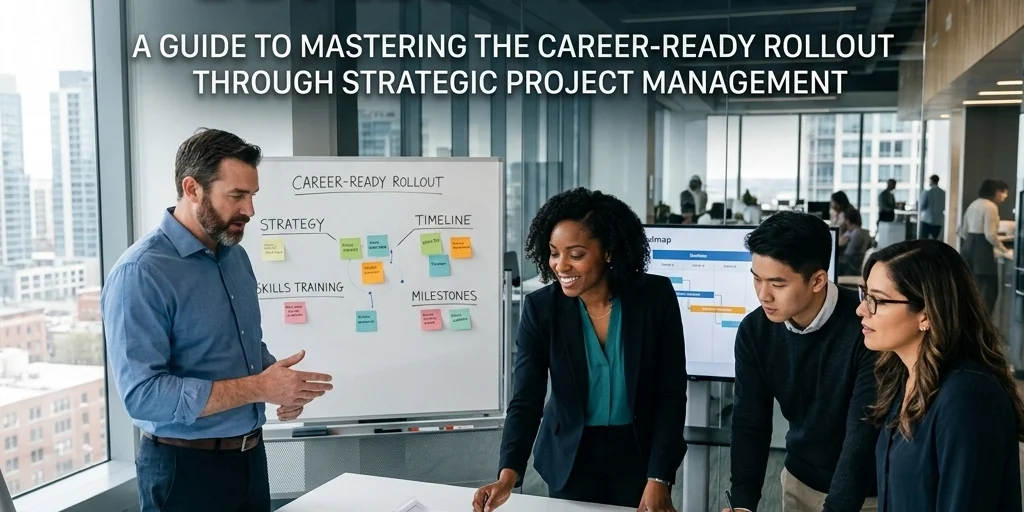
The global economic landscape of 2026 has reached a critical juncture where the traditional educational pipeline no longer keeps pace with the velocity of technological advancement. For Fortune 100 executives, the challenge is no longer just "hiring talent": it is the strategic orchestration of a national workforce infrastructure that can adapt in real-time. As we navigate the complexities of a post-digital-transformation era, the focus has shifted toward a "career-ready" rollout: a comprehensive, scalable model that integrates technical literacy with physical logistics and strategic project management.
To maintain a competitive edge, leadership must view workforce development not as a human resources function, but as a core operational deployment. This guide explores the mechanics of a national rollout, the innovative use of digital subcultures to drive AI literacy, and the physical distribution systems required to sustain a high-performing labor force.
The Paradigm Shift: Competency Over Credentials
The reliance on four-year degrees as a primary filter for talent is rapidly diminishing in favor of verified competency. In the current fiscal year, data suggests that companies prioritizing skill-based hiring see a 25% increase in retention and a significant reduction in the time-to-productivity for new hires. However, moving from a degree-centric model to a competency-centric one requires a robust national infrastructure.
Strategic project management serves as the foundation of this transition. A national rollout of career-ready programs demands a level of coordination akin to a major product launch or infrastructure project. It involves aligning state workforce development boards, local investment areas, and private sector requirements into a unified delivery system.

Esports: The 'Trojan Horse' for Cloud and AI Literacy
One of the most effective, yet frequently misunderstood, vehicles for workforce development is the strategic integration of esports. To the uninitiated, esports is mere entertainment; to the visionary executive, it is a "Trojan Horse" for developing the high-level digital literacy required in the modern economy.
The infrastructure required to run a professional-grade esports ecosystem is a microcosm of the modern enterprise cloud environment. Participants are not just playing games; they are interacting with low-latency networking, cloud-based data processing, and AI-driven analytics. By embedding workforce development modules within these ecosystems, organizations can cultivate a generation of workers who are inherently comfortable with complex technical architectures.
"Esports provides a unique sandbox for technical mastery," notes one industry consultant specializing in digital transition. "When a young professional understands how to optimize a server for a global tournament, they are essentially learning the fundamentals of cloud architecture and real-time data management. It’s about meeting the talent where they already live."
This approach addresses the "literacy gap" without the friction of traditional retraining programs. It transforms passive consumption into active, career-ready skill acquisition.
The Physical Distribution of Workforce Development
While digital literacy is paramount, the rollout of a national workforce strategy requires a tangible, physical presence. We often discuss the "cloud" as if it exists in a vacuum, but the reality is that workforce development requires a physical distribution system. This includes regional innovation hubs, mobile training units, and hardware-rich environments where hands-on learning can occur.
At USA Entertainment Ventures LLC, we understand that visibility and accessibility are key to any national campaign. Just as our projects like EV Across America and Mobile Hwy Ads focus on high-impact physical presence, workforce development must be integrated into the physical infrastructure of our cities and logistics corridors.
The "Career-Ready Rollout" involves deploying specialized "Pure Box" style environments: modular, rapidly deployable learning centers: to regions where the talent gap is most acute. These centers serve as the physical nodes of a national network, providing the hardware necessary for AI training, robotics maintenance, and high-level technical certifications.
Mastering the Rollout: A Strategic Project Management Framework
Executing a national workforce initiative requires a disciplined project management approach. Fortune 100 companies should view this through the lens of a three-phase mobilization strategy:
1. The Discovery and Mapping Phase
Before deployment, organizations must analyze regional labor market information (LMI). This involves identifying the specific technical gaps within a 50-mile radius of key operational hubs. Using AI-driven intelligence, companies can predict future labor needs and align their training modules accordingly.
2. The Infrastructure Deployment Phase
This phase focuses on the "Trojan Horse" strategy mentioned earlier. By partnering with local community centers and educational institutions, corporations can deploy the physical hardware and software stacks necessary for both esports-based literacy and specialized vocational training. This is where the physical distribution system meets the digital curriculum.
3. The Standardization and Certification Phase
To ensure the scalability of the workforce, skills must be standardized. This involves creating a "common language" of competency that is recognized across the entire national enterprise. By utilizing blockchain-backed micro-credentials, companies can track a worker's progress from an entry-level esports technician to a senior cloud architect.
The Economic Imperative: Why Now?
The urgency of this rollout cannot be overstated. By the end of 2026, the gap between available technical roles and qualified candidates is projected to cost the U.S. economy trillions in lost productivity. For the Fortune 100, this isn't just a corporate social responsibility (CSR) initiative: it is a survival strategy.
Strategic project management allows for the "de-risking" of these massive investments. By breaking the national rollout into manageable, data-supported milestones, executives can ensure a high return on investment (ROI) through reduced turnover and increased operational efficiency.
Furthermore, integrating workforce development into existing marketing and entertainment channels: such as Sports Media or Zoo Imagery: allows companies to leverage their brand equity to attract talent. When a workforce initiative is seen as a premium opportunity rather than a remedial program, the quality of applicants rises exponentially.

Future-Focused Leadership: A Call to Action
The transition to a career-ready nation requires a bold departure from the status quo. It demands that executives look beyond the next quarterly report and invest in the human infrastructure that will power the next decade of growth.
The integration of esports as a literacy tool, the deployment of physical learning nodes, and the application of rigorous project management principles are the three pillars of a successful rollout. As we look toward the future, the companies that succeed will be those that view their workforce as a dynamic, evolving asset: one that is continuously refined through strategic investment and innovative engagement.
For more information on how we manage complex, large-scale projects and national rollouts, visit our Project Portfolio.
Key Takeaways for Fortune 100 Executives:
- Embrace Skill-Based Infrastructure: Move beyond traditional degrees to build a proprietary talent pipeline based on verified technical competencies.
- Leverage Digital Subcultures: Utilize esports and gaming environments as low-friction entry points for cloud and AI literacy.
- Prioritize Physical Logistics: Ensure that workforce development has a tangible presence in regional hubs and logistics corridors.
- Standardize Through Project Management: Apply the same rigor to workforce deployment as you would to a national product rollout.
The "Career-Ready Rollout" is not a destination; it is a continuous process of adaptation and growth. In 2026 and beyond, the most valuable commodity an organization can possess is a workforce that is ready for whatever comes next. By mastering the strategic rollout today, you are securing the economic stability of tomorrow.