
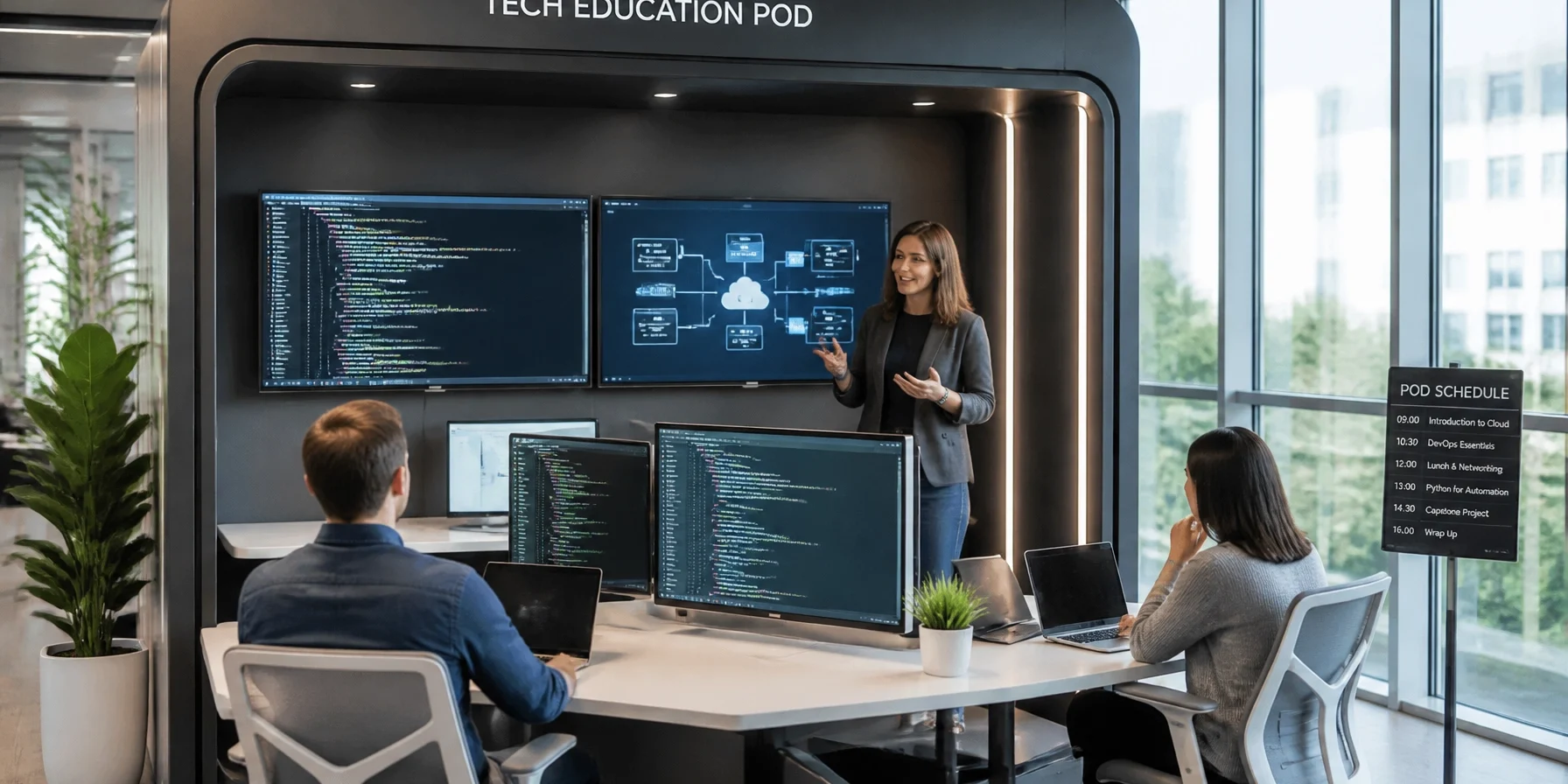
For decades, the standard blueprint for tech education and workforce training remained remarkably static: a large, windowless room filled with dozens of identical desktop computers arranged in rigid rows. These traditional computer labs served their purpose during the dawn of desktop computing, offering a centralized location for typing practice, basic web browsing, and introductory coding. Today, however, the rapid acceleration of cloud computing, remote workflows, and specialized industry demands has rendered the one-size-fits-all computer lab largely obsolete.
Enter the pod: self-contained, modular, high-tech workspaces designed around specific career pathways. As educational institutions and corporate developers rethink physical infrastructure, pod-based environments are rapidly replacing legacy computer labs. From modernizing workforce training to driving strategic business development, these modular micro-environments are transforming how learners transition from the classroom into high-demand careers.
The Shift from General-Purpose Labs to Specialized Environments
In modern workforce development, general-purpose computing is no longer enough. Employers in sectors ranging from global supply chain management to digital media production require candidates who are already fluent in industry-specific workflows and hardware. Traditional labs: where a student might practice coding on a generic PC one hour and write an essay the next: fail to replicate the specialized environments found in modern workplaces.
Pod-based spaces solve this disconnect by acting as "lab-in-a-box" solutions. These prefabricated, acoustically treated, and ergonomically optimized units can be dropped into open campus areas, corporate offices, or training centers with minimal construction. By simulating actual professional command centers, pods bridge the gap between theoretical classroom learning and real-world execution. Organizations partnering with strategic management experts, such as those at USA Entertainment Ventures, increasingly recognize that investing in agile physical infrastructure is critical to preparing talent for the modern economy.
Logistics Command Centers: Navigating Global Supply Chains
One of the most profound transformations in career-aligned infrastructure is occurring in logistics and supply chain training. Modern logistics is a high-stakes, fast-moving field driven by global data analytics, automated warehousing, and real-time tracking.

Logistics pods function as miniature corporate control rooms. Equipped with triple-monitor arrays, live global shipping dashboards, and interactive touch interfaces, these spaces simulate complex supply chain networks. Learners inside a logistics pod practice:
- Rerouting freight around sudden geopolitical or weather-related disruptions.
- Managing inventory fluctuations across automated fulfillment centers.
- Analyzing real-time shipping data to optimize transport routes and minimize overhead.
By working within environments that mirror corporate logistics floors, students develop immediate operational fluency. This hands-on familiarity accelerates career pathways into supply chain management, logistics coordination, and operations analysis without requiring institutions to build costly permanent control rooms.
Cybersecurity SOC Pods: High-Stakes Threat Simulation
Cybersecurity education demands an environment where learners can test defenses, analyze malware, and respond to live threats without endangering institutional or corporate networks. Traditional labs struggle to provide this level of secure isolation.

Cybersecurity pods act as localized Security Operations Centers (SOCs). These spaces feature isolated, sandboxed network architecture paired with enterprise-grade firewalls, multi-monitor threat intelligence dashboards, and specialized hardware. In a cyber pod, learners can safely:
- Build and defend entire simulated corporate networks within an air-gapped environment.
- Execute Red Team versus Blue Team adversary emulation exercises.
- Follow rigorous incident response playbooks during simulated cyber attacks.
This physical and digital isolation creates an authentic training ground for aspiring SOC analysts, cloud security specialists, and incident responders. By engaging with enterprise-grade security tools from day one, learners enter the job market with proven, practical expertise.
Content Creation Studios: Powering the Digital Economy
The modern digital economy thrives on high-quality media, video production, and digital marketing. However, training students for careers in content creation requires more than a standard computer with video editing software; it requires professional acoustics, lighting, and rendering power.

Content creation pods compress turn-key media studios into compact, high-performance footprints. These pods incorporate studio-grade acoustic treatment, professional broadcast microphones, ring lighting, and high-end workstations equipped with powerful GPUs for rapid 4K and 8K rendering. Within these spaces, learners can:
- Record podcasts, webinars, and professional video essays with pristine audio quality.
- Execute complete post-production workflows, from motion graphics to color grading.
- Produce marketing campaigns and digital content for real-world brand portfolios.
This infrastructure opens direct career pathways into digital media production, corporate communications, and independent content entrepreneurship, equipping students with the exact tools utilized by top creative agencies.
The Business and Educational Case for Pod Infrastructure
Beyond pedagogical effectiveness, modular pods offer significant financial and logistical advantages for educational institutions and enterprises alike. Traditional computer labs require extensive square footage, specialized wiring, and complete overhauls every few years as hardware ages.
In contrast, pod-based spaces offer modular scalability. Organizations can start with a small cluster of pods: perhaps a combination of a logistics pod and a cyber pod: and expand incrementally by simply installing additional units as programs grow. This flexible approach optimizes real estate utilization, reduces long-term capital expenditure, and aligns physical spaces with evolving workforce demands. For organizations exploring tailored operational frameworks, examining comprehensive corporate services can help streamline infrastructure investments for maximum impact.
Looking Ahead: The Future of Learning Spaces
As industries continue to evolve at breakneck speed, physical infrastructure must keep pace. The transition from generic computer labs to career-aligned pods represents a fundamental shift in how we prepare individuals for the future of work. By embedding real-world realism directly into physical workspaces: whether through logistics dashboards, cybersecurity SOCs, or creative media studios: educational and business leaders are creating pathways that are both engaging and immediately actionable.
To learn more about how agile strategies and modern development initiatives are shaping tomorrow's industries, reach out to explore our about us page or get in touch with our team today.





