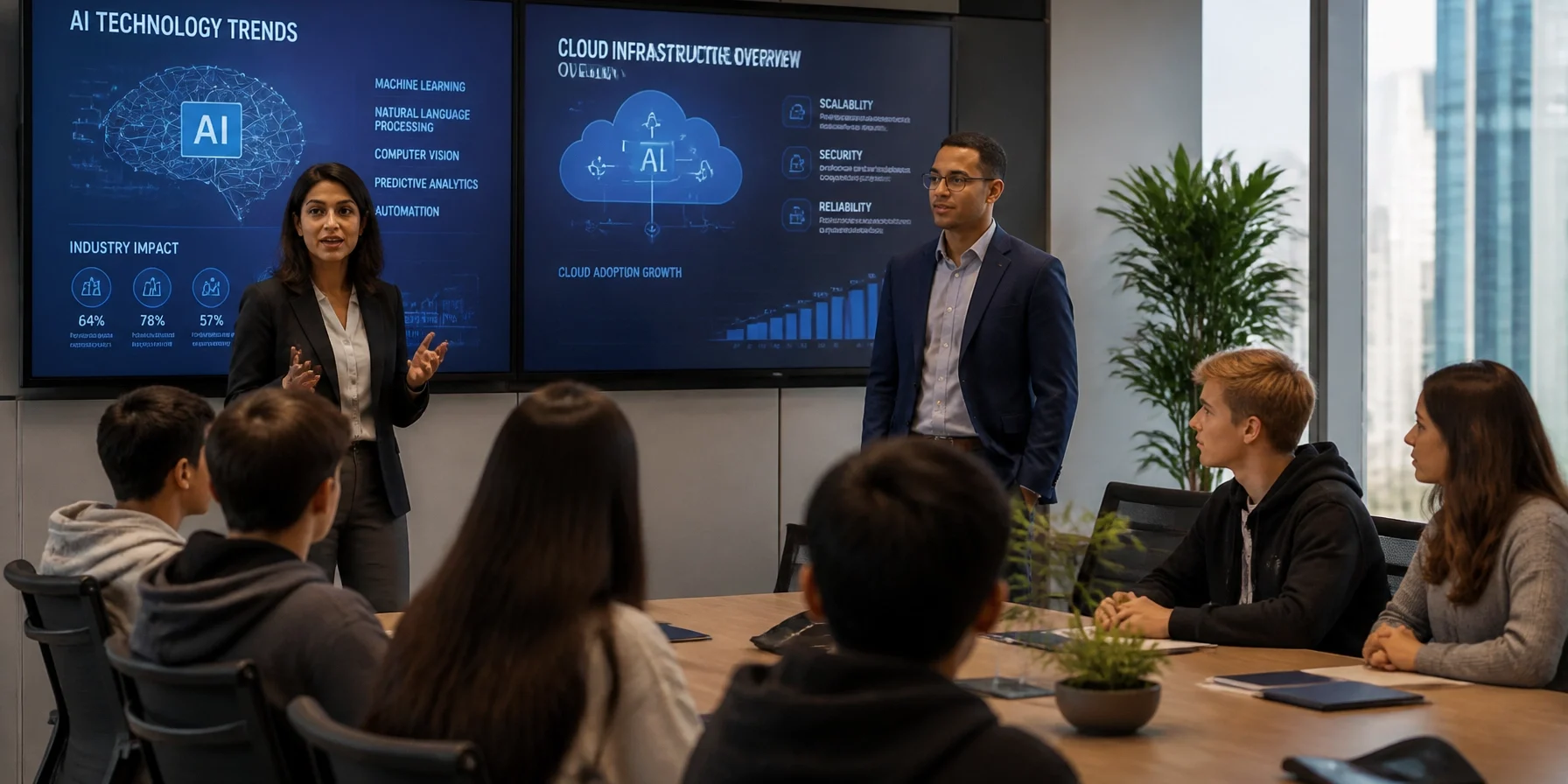
A company may identify a shortage of cloud engineers, cybersecurity analysts, data scientists, or AI specialists only after the need becomes urgent. By then, the strongest candidates are often already committed to other employers, degree programs, or career paths.
The more reliable approach is to begin earlier.
High school students are already making decisions about technology, education, and work. Companies that engage with them before college can help shape awareness, build practical skills, and create relationships that develop over several years. This is not a replacement for university recruiting or experienced hiring. It is an additional layer of workforce planning: one that starts before the talent market becomes crowded.
The workforce case for early engagement
Demand for technology skills continues to expand across nearly every industry. Cloud infrastructure supports business applications, AI systems, cybersecurity operations, logistics networks, and content platforms. Data analytics informs decisions in finance, healthcare, manufacturing, government, and marketing.
The U.S. Bureau of Labor Statistics projects that employment for software developers will grow by 17.9% between 2023 and 2033. Information security analyst employment is projected to grow by 32.7%. Within the professional, scientific, and technical services sector, data scientist employment is projected to increase by nearly 42% over the same period. Each rate is significantly higher than the average projected growth for all occupations.
These figures describe more than hiring demand. They show why companies need to think differently about how technical talent is developed.
A student who learns about cloud computing, data analysis, or cybersecurity in high school has more time to build foundational skills. That student can explore related college programs, certifications, apprenticeships, and entry-level roles with greater confidence. For employers, early exposure creates more opportunities to develop talent gradually rather than searching for fully trained professionals at the last moment.
The risk of waiting until college graduation
Many organizations still concentrate most recruiting activity on college juniors, seniors, and recent graduates. That approach remains useful, but it creates several risks when used as the only strategy.
More competition for the same candidates
University recruiting places companies in direct competition for a limited number of students with computer science, data, engineering, or cybersecurity backgrounds. Larger organizations may have greater name recognition, recruiting budgets, and compensation flexibility.
A company that begins building relationships in high school has more time to demonstrate its work, culture, and career opportunities before students reach the most competitive hiring stage.
Less time to develop practical skills
Academic programs provide valuable foundations, but employers often need skills that are specific to their environments. Students may understand programming or statistics without knowing how those skills apply to cloud operations, data governance, logistics, security monitoring, or content production.
Early employer engagement helps connect classroom learning to practical work. It also gives businesses a chance to explain which abilities matter most, allowing schools and students to prepare more intentionally.
Fewer opportunities to broaden the talent pool
Students are less likely to pursue technical careers when they have never met a professional in the field or seen how the work affects real organizations. This can limit participation from students who do not already have family, community, or professional connections in technology.
Early outreach can make technical careers more visible and accessible. It can also help organizations reach students based on curiosity and potential: not only on prior access to advanced courses or professional networks.
Build relationships before building a recruiting campaign
Early engagement should not begin with a job advertisement. It should begin with education.
The goal is to help students understand what technology work looks like, what skills are useful, and how different career paths connect. A cloud professional might explain how applications store and process information. A data analyst might demonstrate how a dashboard supports a business decision. A cybersecurity specialist might show how organizations identify and respond to threats.
The MDRC guide to employer-school partnerships identifies several practices that support lasting partnerships: formal agreements, regular communication, equitable access, virtual work-based learning, and maintaining contact with students over time.
That last point is especially important. A single career-day presentation may create awareness, but repeated engagement builds familiarity. Students should encounter employers through multiple stages:
- Awareness: Career talks, classroom visits, and demonstrations.
- Exploration: Projects, competitions, facility tours, and mentoring.
- Preparation: Job shadows, certifications, internships, and capstone work.
- Transition: College connections, apprenticeships, and entry-level opportunities.
This progression creates a talent funnel rather than a one-time recruiting event.

Use physical infrastructure to make technology tangible
Technology education is more effective when students can work with environments that resemble the workplace.
Traditional Computer Labs often provide general-purpose access to computers. That is useful for basic instruction, but many modern careers require more specialized practice. Physical Infrastructure can help schools create learning environments that support specific career pathways.
Modular Pods, for example, can be configured as small-scale environments for cloud operations, logistics, cybersecurity, media production, or data analytics. They do not need to replicate an entire corporate facility. Their purpose is to give students a practical setting where they can apply concepts, collaborate, and solve problems.
A cloud and data pod might include secure sandbox access, dashboards, storage systems, and project workstations. A cybersecurity pod might use isolated networks for threat detection and incident-response exercises. A media pod could provide lighting, audio, editing, and rendering tools for Content Creation.
These environments help students understand that technology is not a single career. It is a network of roles supporting many kinds of work.

Connect technical learning to business problems
Students often engage more deeply when technical work has a clear purpose. Organizations can support schools by providing realistic, age-appropriate challenges based on business and community needs.
Logistics
A logistics project could ask students to analyze delivery data, identify inefficient routes, or visualize inventory movement. These exercises introduce data quality, forecasting, optimization, and operational decision-making.

Cybersecurity
A cybersecurity project could involve identifying suspicious activity in a simulated network, developing a password policy, or responding to a fictional security incident. Students learn that cybersecurity includes communication, process, risk management, and teamwork: not only technical tools.

Content creation
Content Creation can introduce students to digital storytelling, video production, audio engineering, visual design, and audience analytics. These skills connect technology with communications, marketing, education, and entrepreneurship.

The purpose is not to train high school students for a specific job immediately. It is to show how technical skills solve practical problems across an organization.
Five steps companies can take this year
Organizations do not need a large department or a major capital investment to begin. A focused pilot can provide useful learning for both the company and its school partners.
1. Identify future skill needs
Start with a workforce planning discussion. Which roles will be difficult to fill over the next three to five years? Which foundational skills support those roles?
The list may include data interpretation, cloud concepts, programming, communication, digital content, networking, logistics, or cybersecurity awareness.
2. Find the right school partners
Contact local school districts, Career and Technical Education programs, STEM coordinators, community colleges, and workforce organizations. Look for partners that already have technology, engineering, business, media, or analytics programs.
Establish one point of contact on both sides and define what each organization can realistically provide.
3. Begin with a repeatable activity
A 30-minute virtual presentation, monthly mentorship session, or small data challenge may be enough to begin. The format should be consistent, practical, and easy for teachers and employees to support.
4. Add work-based experiences
As the relationship develops, offer job-shadow days, office tours, project reviews, teacher externships, or short micro-internships. Follow school policies, child-safety requirements, privacy rules, and applicable labor regulations.
The Jobs for the Future overview of work-based learning summarizes the employer value clearly: “It’s hard to get a job without previous work experience, and it’s hard to get work experience without a job.” Structured experiences help close that gap while giving employers a better view of emerging talent.
5. Measure progress over time
Track participation, project completion, student feedback, mentor involvement, certifications earned, internship applications, and postsecondary outcomes. Avoid measuring success only by immediate hires. The value of an early talent funnel is cumulative.
The long-term advantage
Early talent outreach is a workforce strategy, an education strategy, and a community strategy at the same time. It gives students a clearer view of future opportunities. It gives schools access to current industry knowledge. It gives employers more time to develop relationships and understand potential candidates.
The organizations that prepare for future demand will not rely on a single recruiting channel. They will combine experienced hiring, college partnerships, apprenticeships, military transition programs, and sustained high school engagement.
Companies can begin by supporting one classroom, one project, or one school partnership. Over time, those efforts can become a structured pathway into Cloud, AI, Data Analytics, Cybersecurity, Logistics, and Content Creation.
For additional perspectives on workforce strategy and career-aligned learning environments, explore Physical Infrastructure: Why Pods Are the New Computer Labs and the available business services. Organizations planning a new partnership can also contact the team.
The next generation of technical talent is already in school. The most effective time to build that relationship is before the competition begins.