
Let’s take a moment of silence for the traditional computer lab. You remember it: that windowless room smelling faintly of ozone and stale pretzels, filled with rows of beige towers and flickering monitors. It was a place where we learned to type "The quick brown fox" and accidentally deleted our homework on a floppy disk.
Well, it’s 2026, and the "row-of-PCs" model has officially gone the way of the dial-up modem. The world has moved on, and if your tech education space still looks like a 90s call center, you’re essentially training people to operate a steam engine in the age of SpaceX.
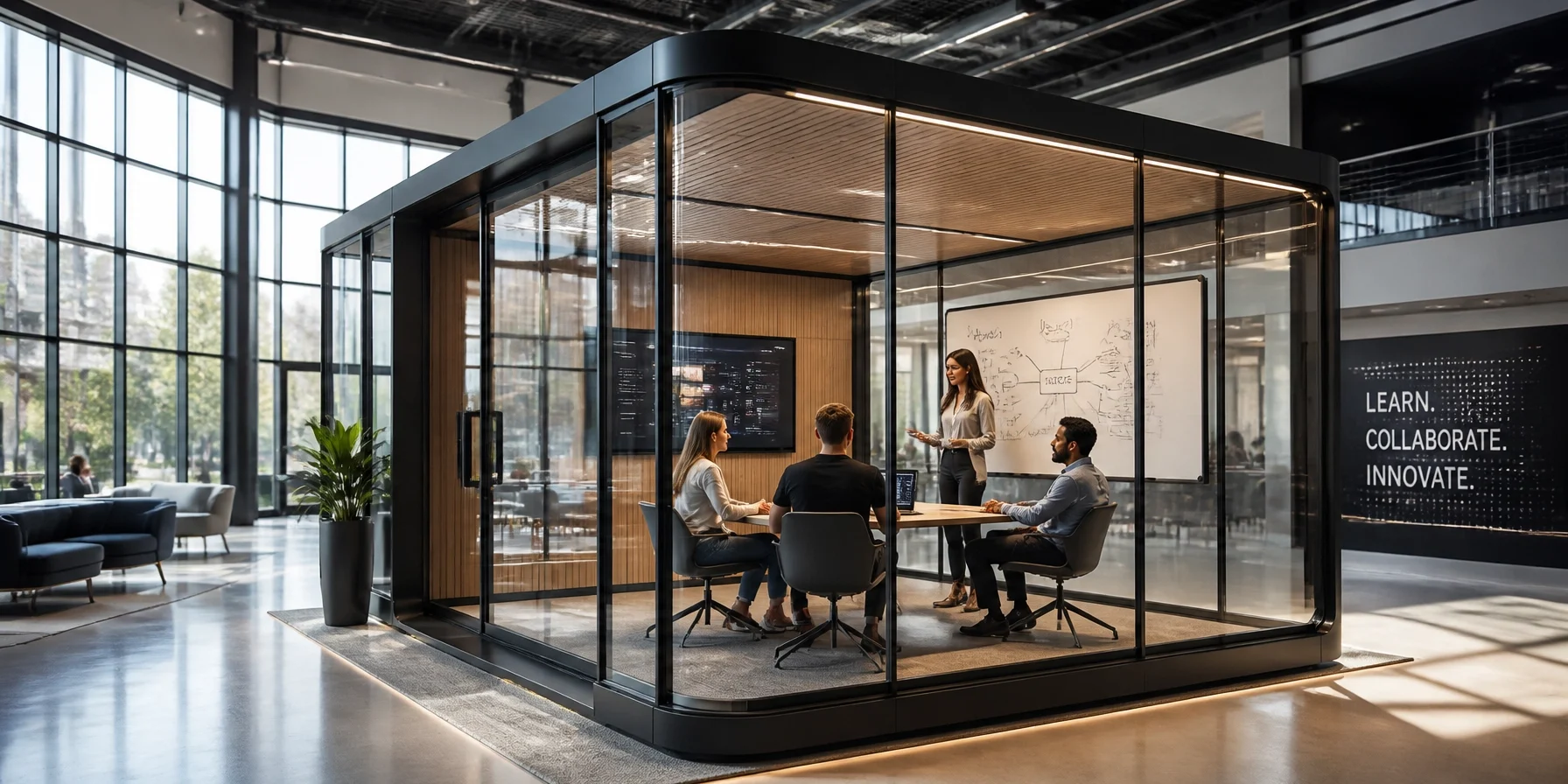
Enter the Pod. These aren't just fancy phone booths for people who want to hide from their coworkers; they are the modular, high-tech future of physical infrastructure. From cybersecurity war rooms to logistics command centers, pods are redefining how we train for modern careers.
The Death of the Generic Desktop
The problem with old-school labs is that they’re generic. They try to be everything to everyone and end up being perfect for nothing. You can’t exactly run a high-stakes Red Team cybersecurity simulation in an open room where someone next to you is printing out a recipe for sourdough.
Modular pods flip the script by providing specialized, career-specific environments. Instead of 30 mediocre PCs, we’re seeing institutions invest in high-performance, self-contained hubs. These pods are reshaping career pathways by providing the realism that generic labs simply can't touch.
Logistics: Not Just Moving Boxes Anymore
When people hear "logistics," they often think of a guy with a clipboard in a dusty warehouse. In reality, modern logistics is more like playing SimCity but with real-world consequences. It involves managing global supply chains, tracking AI-driven fleets, and responding to port closures in real-time.

Logistics pods act as "digital twins" of actual control towers. Equipped with multi-monitor setups and integrated WMS (Warehouse Management Systems), these pods allow trainees to practice rerouting shipments or managing inventory in a space that feels exactly like a professional command center. It turns out that learning physical infrastructure matters when you’re trying to prevent a global supply chain meltdown.
Cybersecurity: War Rooms in a Box
If there’s one field where the "pod life" is non-negotiable, it’s cybersecurity. Traditional labs are a security nightmare. If you’re training someone to analyze live malware, the last thing you want is that malware hopping onto the main school or corporate network.

Cyber pods are often "air-gapped", meaning they have their own isolated servers and networking. This creates a safe "sandbox" where you can break things, get hacked, and fight back without bringing down the entire company's HR system. Plus, let’s be honest: doing a "Red Team vs. Blue Team" exercise in a dedicated, soundproof pod with cool ambient lighting just feels more like Mr. Robot and less like a math class. That kind of immersion isn't just fun; it builds the "muscle memory" needed for high-pressure SOC (Security Operations Center) roles.
Content Creation: From Lab to Studio
We’re in the era of the creator economy, where every business is essentially a media company. The "computer lab" version of this was a slow PC with a cracked version of Photoshop. The pod version? A fully integrated, sound-dampened studio.

Content creation pods come pre-wired with 4K cameras, professional microphones, and acoustic panels. Whether you're an executive recording a thought-leadership podcast or a student learning to stream, these pods lower the barrier to entry. You don’t need to spend four hours setting up lights; you just walk in, sit down, and start creating. It’s "plug-and-play" for the TikTok generation.
Why This Matters for Career Transition
At USA Entertainment Ventures LLC, we spend a lot of time thinking about how to bridge the gap between "learning a skill" and "getting the job." This is especially critical for initiatives like DOD SkillBridge, where transitioning service members need to rapidly adapt to civilian tech roles.
Moving from a military environment to a corporate one is a culture shock. Training in a pod that mirrors a real-world cybersecurity desk or a logistics hub helps bridge that gap. It’s about more than just software; it’s about the environment. When you’ve trained in a pod that looks and feels like a professional workplace, day one on the job doesn’t feel like an alien planet.
The Bottom Line: Agility Wins
The best part about pods? They aren't permanent. If you build a $500,000 brick-and-mortar computer lab, you’re stuck with it for twenty years. If your needs change, say, you need fewer coding desks and more AI-processing units: you can just swap out the pods. They are scalable, portable, and way more sustainable than traditional construction.
So, if you’re still clinging to your old computer lab, it’s time to look at the pod. They’re faster to deploy, cheaper to maintain, and a whole lot cooler. The rows of beige are dead. Long live the pod.
Ready to see how modern infrastructure can transform your business development or recruitment strategy? Check out our services to learn more about how we’re managing the future of tech education.





