
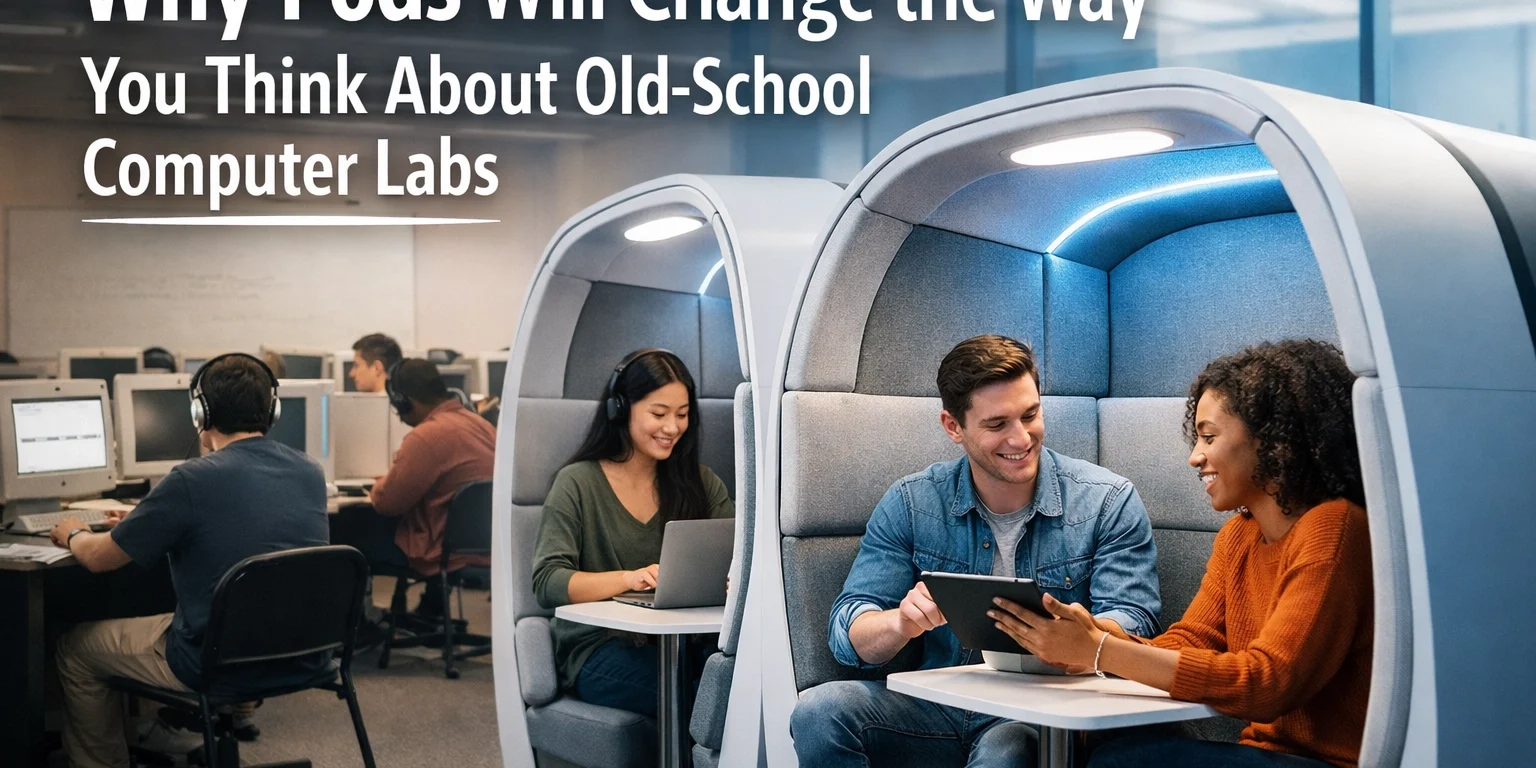
If you grew up anytime between 1990 and 2015, you probably have a very specific sensory memory of the "computer lab." It was a room that smelled faintly of ozone and floor wax, filled with rows of beige (and later, silver) monitors. You sat there, isolated in a plastic chair, perhaps learning how to type or: if you were lucky: playing Oregon Trail while trying not to die of dysentery.
Fast forward to today, and that model is about as useful as a floppy disk in a cloud-storage world. At USA Entertainment Ventures LLC, we’re seeing a massive shift in how physical spaces are designed to prepare people for the workforce. The era of the generic workstation is over. The era of the "Pod" has arrived.
The Death of the Generic Workstation
The traditional computer lab was built on a simple, albeit flawed, premise: give everyone the same machine and the same generic software, and they’ll figure out how to be "tech-savvy."
But "tech-savvy" isn't a job title. You don't get hired for being "good at computers." You get hired to be a cybersecurity analyst, a logistics coordinator, or a digital media producer. According to recent industry research, organizations that switch from generic labs to specialized "Pods" see a staggering 50 to 75 percent reduction in infrastructure costs while drastically increasing the "work-readiness" of their participants.
So, what exactly is a Pod? Think of it as a career-specific ecosystem. It’s not just a computer; it’s a physical and digital environment designed to mirror a real-world professional setting. Instead of rows of desks facing a whiteboard, Pods are modular, collaborative, and: most importantly: purpose-built.
Career Pathway #1: The Cybersecurity Command Center
Let’s talk about cybersecurity. In the old-school lab model, you might read about a firewall or watch a video on packet sniffing. In a Pod-based environment, you are essentially walking into a miniature Security Operations Center (SOC).
Cybersecurity Pods aren't just about having the right software; they are about the infrastructure of defense. These spaces feature isolated network environments where students can practice "ethical hacking" without accidentally taking down the entire building’s Wi-Fi. They include multi-monitor setups for threat monitoring and collaborative "war room" areas where teams can huddle to respond to a simulated breach.
Industry experts often point out that the biggest hurdle for new cyber hires isn't their technical knowledge: it's their ability to handle the pressure of a live incident. Pods simulate that pressure. By moving away from the isolated cubicle, students learn that cybersecurity is a team sport. If you're looking to dive into this world, checking out our career opportunities is a great place to start seeing where these specialized roles are heading.

Career Pathway #2: The Logistics and Supply Chain Hub
When people think of "logistics," they often think of warehouses and forklifts. But in 2026, logistics is a high-tech game of chess played with real-time data, AI, and global positioning.
A Logistics Pod is designed to look less like a classroom and more like a flight control tower. It’s an environment where data visualization is king. Participants in these pods work with real-time tracking software, simulating the movement of goods across oceans and continents.
The shift here is from "learning the theory" to "managing the flow." In a traditional lab, you might fill out a spreadsheet. In a Logistics Pod, you’re responding to a simulated port strike in Los Angeles or a weather delay in the Suez Canal. You’re learning the "soft skills" of crisis management alongside the "hard skills" of supply chain software. It turns a dry subject into an immersive, high-stakes career trial.
Career Pathway #3: Content Creation and Digital Media
This is where the physical design of Pods really shines. The "content creator" economy is no longer just kids in their bedrooms; it’s a multi-billion dollar industry that requires serious technical chops.
A Content Creation Pod is a far cry from a computer on a desk. We’re talking integrated lighting rigs, acoustic treatment, professional-grade audio interfaces, and high-speed render stations.
The genius of the Pod model here is the "compression of the academic-to-workplace gap." When a student moves from a Pod to a professional studio, the equipment is the same. The workflow is the same. The collaborative "vibe" is the same. They aren't just learning how to use an editing suite; they are learning how to manage a production pipeline from pre-production to distribution.

Why This Changes the Way You Think
You might be asking, "Dan, why does the physical layout matter so much? Can’t they just learn this on a laptop?"
The answer lies in how our brains process environment. A generic computer lab signals "school." A specialized Pod signals "work." When you step into a space that looks, feels, and operates like a professional environment, your mindset shifts.
Here are three reasons why Pods are the future of our services:
- Contextual Learning: You aren't learning tools in a vacuum. You’re learning them in the context of a specific career.
- Collaboration by Design: Traditional labs emphasize "do your own work." Pods emphasize "solve the problem together." Modern work rarely happens in isolation, and our training spaces should reflect that.
- Economic Efficiency: As mentioned earlier, concentrating resources into specialized Pods is actually cheaper than trying to keep a 100-machine generic lab updated with the latest high-end specs. You invest where it matters most.
The Philosophical Shift: From Labs to Launchpads
The most significant change isn't the hardware; it's the philosophy. Traditional labs operate on the "just-in-case" model of education: learn everything just in case you might need it one day. Pods operate on the "just-in-time" model: learn the specific, high-level skills you need for a specific career path.
This approach also provides "career pathway clarity." A student might think they want to be in cybersecurity until they spend a week in a Pod and realize the constant monitoring drives them crazy. Conversely, someone might discover a hidden talent for logistics once they see the data come to life.
It’s about discovering whether you actually enjoy the work before you spend four years and thousands of dollars pursuing it. It's a pragmatic, business-first approach to education that we at USA Entertainment Ventures LLC believe is long overdue.

Looking Ahead
As we look toward the rest of 2026 and beyond, the "beige lab" will continue to fade into history, replaced by vibrant, career-focused hubs. Whether it's mastering the intricacies of a global supply chain, defending a network from a digital heist, or producing the next viral media sensation, the environment where we learn these skills is just as important as the skills themselves.
The world is moving fast. The way we prepare for it should move even faster. By embracing the Pod model, institutions can ensure that their students aren't just "good at computers," but are ready to step into high-demand roles with confidence and competence.
If you're interested in how these shifts are impacting the broader business landscape, feel free to explore our showcase or reach out via our contact page. We’re always looking for new ways to bridge the gap between today’s technology and tomorrow’s careers.
The computer lab is dead. Long live the Pod.





