
Remember the computer labs of the late 90s? The rows of beige towers, the glowing CRT monitors that hummed like a beehive, and that one kid in the corner trying to play Oregon Trail while the teacher wasn’t looking? For a long time, that was the gold standard for "tech training."
Fast forward to 2026, and the beige towers are in a landfill. The world has moved on, but for some reason, our training infrastructure is still stuck in the past. We’re trying to train the workforce of tomorrow using the office layouts of yesterday. It’s like trying to teach someone to drive a Formula 1 car by giving them a bicycle and a very enthusiastic PowerPoint presentation.
At USA Entertainment Ventures LLC, we’re seeing a massive shift. We aren’t just talking about software updates; we’re talking about a complete overhaul of physical training infrastructure. Enter: The Pod.
What Exactly is a "Pod"? (Hint: It’s Not a Sleeping Bag)
When we talk about Pods, we aren't talking about those sci-fi cryo-chambers where people hibernate for a trip to Mars. We’re talking about modular, high-tech, physical environments designed specifically for talent development.
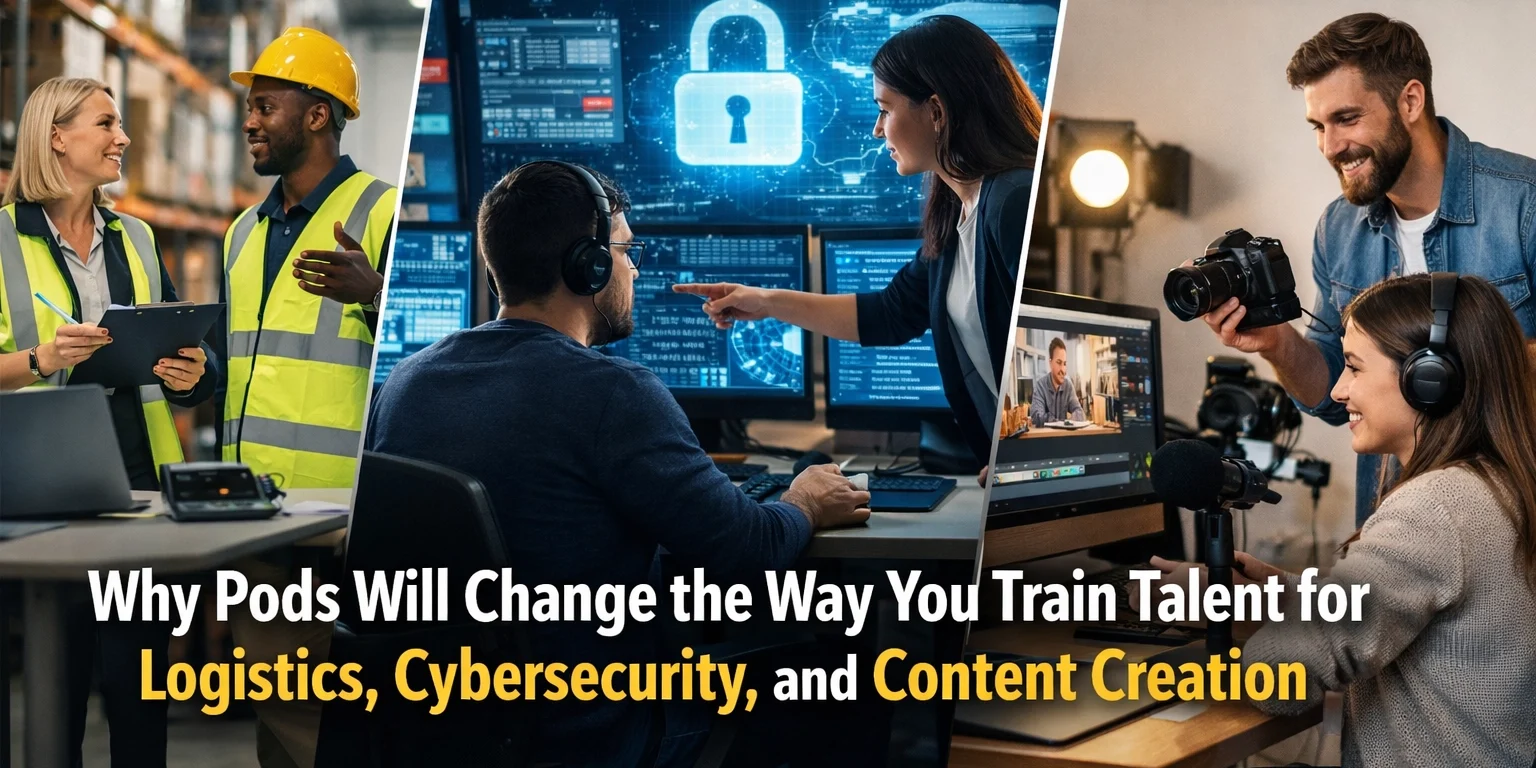
Think of a Pod as a "Computer Lab 2.0," but on steroids. It’s a self-contained, hyper-focused workspace that bridges the gap between a classroom and the front lines of industry. Whether you are scaling a logistics empire or defending against a global cyber threat, these units provide the controlled, collaborative environment necessary to turn a "new hire" into a "heavy hitter."

Logistics: Training the Wizards of the Supply Chain
Let’s be real: Logistics isn’t just about moving boxes from Point A to Point B anymore. It’s a high-speed game of Tetris played with real-world consequences. We’re talking about drone fleets, autonomous trucking, and AI-driven warehouse management.
You can’t learn how to manage a fleet of autonomous delivery robots in a standard cubicle. You need a Pod. In a dedicated Logistics Pod, trainees can simulate real-world disruptions: like a port strike or a localized blizzard: in a controlled environment.
Why Pods work for Logistics:
- Real-World Simulation: It creates a "psychological safety" zone. If a trainee crashes a virtual drone fleet inside a Pod, it costs $0. If they do it in the real world, the CEO (shoutout to Dan Kost) is going to have a very long Tuesday.
- Rapid Deployment: Once a team masters the Pod, they can be deployed to a new distribution center with their skills already "baked in."
- Cross-Functional Magic: Logistics Pods allow the person managing the inventory to sit right next to the person managing the fleet, teaching them how their roles intersect in real-time.
For more on how we view the future of this infrastructure, check out our National Workforce Infrastructure Rollout.
Cybersecurity: Building a Digital Fortress in a Box
In the world of Cybersecurity, the stakes couldn't be higher. One wrong click on a "You’ve won a free toaster!" email can bring a Fortune 100 company to its knees. Traditional training often involves watching boring videos and taking multiple-choice quizzes. Groundbreaking, right? (Not really.)
Pods change the game by functioning as digital "war rooms." Imagine a physical space where a team is dropped into a simulated ransomware attack. The lights dim, the screens go red, and they have to work together to patch the breach before the clock hits zero.
The Pod Advantage for Cyber:
- Controlled Chaos: It’s an ethical hacking playground. You can let the "viruses" run wild inside the Pod’s isolated network without risking the actual company servers.
- Team Cohesion: Cybersecurity isn't a solo sport. Pods force communication. You learn who keeps a cool head and who starts sweating through their shirt when the "hackers" start winning.
- Skill Transfer: It’s about muscle memory. When a real threat hits, the team doesn't panic: they just do what they practiced in the Pod.
Content Creation: The New Factory Floor
The "Creator Economy" is no longer a hobby; it’s a multi-billion dollar industry. But here’s the problem: training professional content creators requires specialized hardware, soundproofing, and collaborative spaces that most office buildings simply don't have.
A Content Creation Pod is a modular studio. It’s got the lighting, the acoustic treatment, and the processing power to handle 8K video rendering without blowing a fuse.
Why Content Pods are a No-Brainer:
- Standardization: If you have ten Pods across ten different cities, your content is going to look and sound the same everywhere. No more "Why does the New York office's video look like it was filmed in a basement?"
- Collaboration: Writers, editors, and videographers can sit in the same physical space, iterating on ideas in real-time.
- Speed to Market: In the content world, being late is the same as being invisible. Pods streamline the production pipeline, moving from "idea" to "upload" faster than ever.
Why Fortune 100 Executives are Taking Note
If you’re sitting in a C-suite office, you might be thinking, "This sounds cool, but why should I invest in physical Pods when everyone is talking about the Metaverse?"
The answer is simple: Results.
Research shows that Pod-based models fundamentally transform talent training by creating a structured environment with real accountability. When you put people in a dedicated physical space designed for a specific purpose, their focus skyrockets. It’s the difference between "working from home with a cat on your keyboard" and "stepping onto the field for the Super Bowl." (And speaking of the Super Bowl, check out our Fan Experience Guide if you want to see how we handle high-stakes environments).
The Business Case:
- Retention: People stay where they feel they are being invested in. Providing state-of-the-art Pods tells your talent, "We care about your growth."
- Efficiency: Pods allow for "accelerated skill transfer." You can get a new hire up to speed in weeks instead of months.
- Future-Proofing: As we approach 2027, the gap between "skilled" and "unskilled" labor is widening. Pods are the bridge that keeps your company on the right side of that gap.
Final Thoughts: The Death of the Cubicle
The "one-size-fits-all" office is dead. It just doesn't know it yet. The future of training isn't a desk in a sea of gray fabric; it’s a specialized, high-intensity Pod where talent is forged in the fires of simulation and collaboration.
Whether you are in logistics, cybersecurity, or content creation, the message is clear: if you want elite talent, you need an elite environment. At USA Entertainment Ventures LLC, we’re committed to helping businesses navigate this transition.
So, next time you’re walking through your office and you see those dusty old computer labs or rows of empty desks, ask yourself: "Is this a place where winners are made, or is it just a place where people check their email?"
If you’re ready to stop training like it’s 1998 and start building the infrastructure of 2026, it’s time to talk about Pods.
Want to learn more about how we're changing the game? Visit our About Us page or dive into our portfolio of projects to see what we're building next.





