
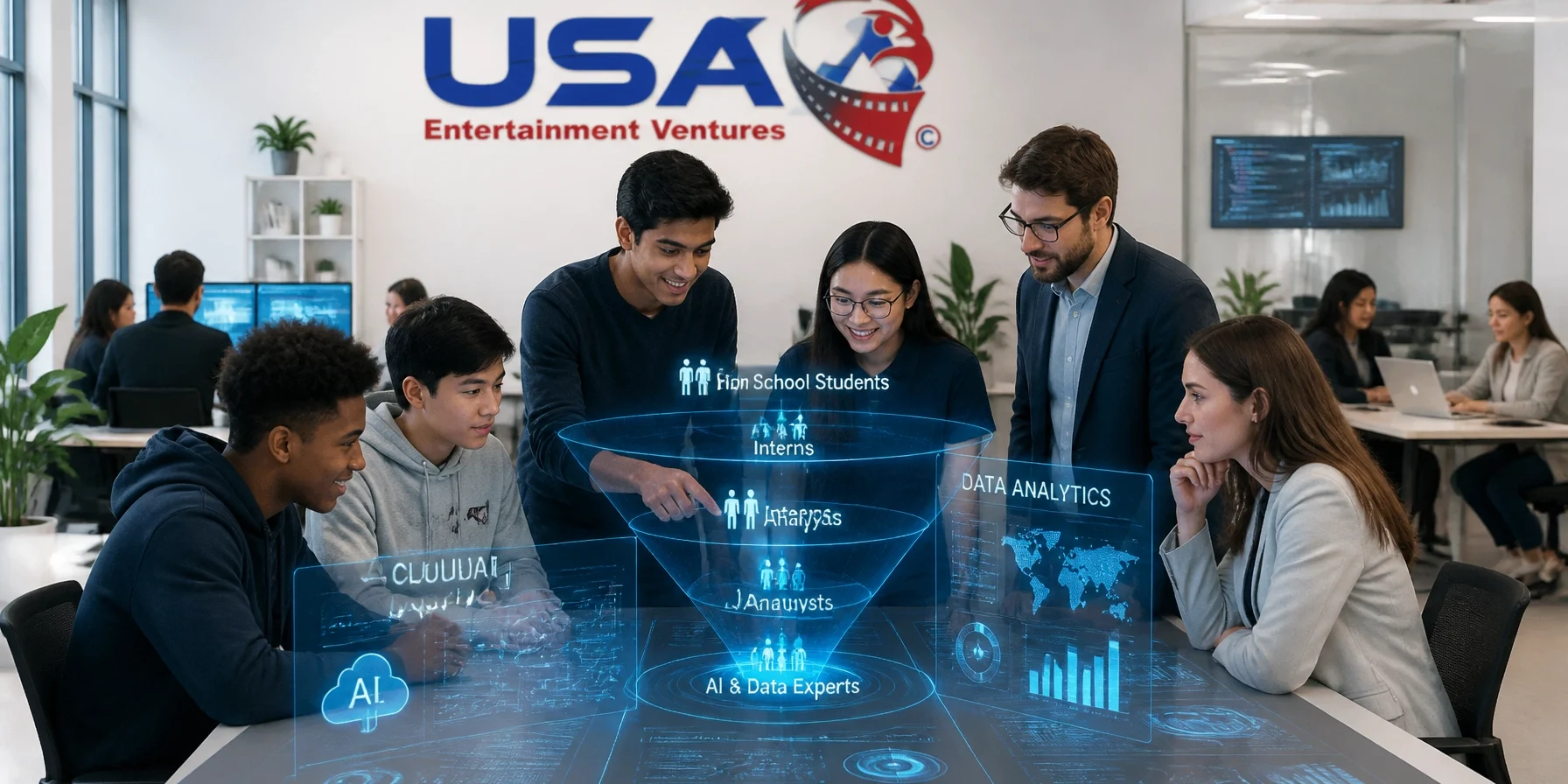
In the rapidly evolving landscape of 2026, the race for technical supremacy is no longer won in the boardroom; it is won in the classroom and the transition center. Organizations across the globe are grappling with a widening chasm in specialized roles: specifically within Cloud Computing, Artificial Intelligence (AI), and Data Analytics. While the demand for these "Next-Gen" skills continues to skyrocket, the traditional methods of acquiring talent are failing to keep pace.
At USA Entertainment Ventures LLC, we observe a recurring pattern: companies wait for talent to be "market-ready" before engaging, only to find the most capable candidates have already been scooped up by more agile competitors. The traditional "post-and-pray" recruitment model is obsolete. To secure a future-proof workforce, businesses must shift from being passive consumers of talent to active architects of talent funnels.
Below, we outline seven critical mistakes currently hindering your talent acquisition and provide actionable, evidence-based strategies to fix them.
1. Starting Outreach at the "Graduation Gap"
The most pervasive mistake in modern recruitment is beginning engagement at university career fairs during a student's senior year. By the time a computer science major reaches their final semester, they have likely already completed multiple internships and potentially signed letters of intent with firms that engaged them years earlier.
Research indicates that forward-thinking firms are now identifying top performers as early as their freshman or sophomore years. However, the true frontier is even earlier. The Next-Generation Talent Funnel starts in high school. Today’s digital natives are learning Python and experimenting with Large Language Models (LLMs) before they even have a driver's license.
The Fix: Establish early-identification programs. Partner with high schools to offer job-shadowing days or "micro-internships." By building brand affinity at age 16, you secure a three-to-five-year lead over your competitors.

High school students represent the new frontier for securing the future of Cloud and AI infrastructure.
2. Maintaining the "Paper Ceiling"
For decades, the four-year degree was the ultimate gatekeeper. In 2026, this "paper ceiling" is a liability. While academic foundations are valuable, they often lag behind the frantic pace of AI and Cloud innovation. A student who has spent their high school years earning AWS certifications or contributing to open-source AI projects on GitHub may possess more relevant, "hands-on" experience than a theoretical degree holder.
Industry experts increasingly advocate for skills-based hiring. According to recent labor market summaries, prioritizing demonstrated competency over credentials opens your funnel to a massive, overlooked pool of talent: including self-taught coders and community college graduates.
The Fix: Redesign your assessment process. Replace "degree required" with "equivalent experience or certifications." Implement technical screenings that mimic real-world tasks, such as debugging a cloud instance or optimizing a data pipeline.
3. Overlooking the DOD SkillBridge Goldmine
One of the most significant missed opportunities in business consulting and technical recruitment is the DOD SkillBridge program. This initiative allows transitioning service members to spend their final 180 days of active duty training with civilian employers: all while the Department of Defense continues to pay their salary and benefits.
Service members bring a level of discipline, leadership, and operational excellence that is rare in the civilian market. Many have already worked with high-stakes data, intelligence systems, and complex communications networks that translate directly into Cloud and Data Analytics roles.
The Fix: Become an approved SkillBridge partner. This provides you with a 6-month, zero-cost "audition" period. If you aren't utilizing this program, you are effectively turning away pre-vetted, high-quality talent that is literally being funded by the government to work for you.

Leveraging military transitions through DOD SkillBridge offers a low-risk, high-reward pipeline for technical roles.
4. Vague Role Definitions in Emerging Tech
A common pitfall in tech recruitment is the "Rockstar" or "Jedi" job description. Using vague buzzwords instead of precise technical requirements confuses candidates and signals a lack of internal clarity. In the domains of Cloud and AI, there is a vast difference between an ML Engineer, a Data Scientist, and a Cloud Architect.
When companies fail to distinguish these roles, they attract a high volume of mismatched candidates, clogging the funnel and slowing down the hiring process.
The Fix: Audit your job descriptions for technical precision. Define exactly what your "Next-Gen" talent will be doing. Will they be managing modular pods for cyber careers, or are they building predictive analytics models? Clarity reduces friction and improves candidate quality.
5. Moving Too Slowly in a Candidate-Driven Market
Speed is a competitive advantage. In the AI and Cloud sectors, a six-week hiring process is a death sentence for your funnel. High-potential talent, especially those coming out of elite programs or the military, often have multiple offers on the table simultaneously.
Data shows that long interview cycles and excessive rounds of testing significantly increase dropout rates. If your process takes 45 days, you will lose 80% of your top-tier candidates to companies that can close in 14 days.
The Fix: Streamline your "Assessment to Offer" timeline. Use automated scheduling tools and limit the interview process to three impactful stages. Empowerment is key: ensure hiring managers have the authority to move quickly when they find a "unicorn."

In 2026, the velocity of your talent funnel is just as important as the quality of its inputs.
6. Neglecting Employer Branding for Gen Z and Alpha
Younger generations: the ones currently in high school and early university: are heavily influenced by a company’s digital footprint and social impact. If your brand is invisible or perceived as "stuffy" and "analog," you will struggle to attract the very people who built their first AI bot in middle school.
A weak employer brand fails to articulate why a candidate should choose you over a high-growth startup or a tech giant. You must sell the mission, the tech stack, and the growth potential.
The Fix: Lean into your company’s story. Use your current employees as brand ambassadors. Showcase your commitment to innovation, such as how you are using data to fix workforce strategies. Engagement on platforms where these students reside is not optional; it is essential.
7. The "Hire and Forget" Mentality
The funnel doesn't end with a signed offer letter; it ends with successful integration and retention. Many organizations invest heavily in attraction but fail in development. This is especially damaging for early-career talent and SkillBridge participants who require structured mentorship to bridge the gap between their training and your specific business needs.
Without a clear roadmap for growth, your "Next-Gen" talent will view your company as a mere stepping stone, leading to high turnover and a wasted recruitment budget.
The Fix: Implement structured mentorship and continuous learning programs. Offer clear pathways for advancement: from junior analyst to senior cloud architect. When employees see a future with you, they are far more likely to contribute to your long-term success.

Mentorship is the final, crucial step in converting raw talent into a long-term organizational asset.
Conclusion: Building for 2026 and Beyond
The talent gap in Cloud, AI, and Data Analytics is not a temporary hurdle; it is a fundamental shift in the global economy. By correcting these seven mistakes, you transform your talent funnel from a leaky bucket into a robust engine for growth.
Whether it is engaging students in high school, leveraging the untapped potential of the DOD SkillBridge program, or accelerating your hiring speed, the time to act is now. The future of your organization depends on the talent you secure today.
At USA Entertainment Ventures LLC, we specialize in managing these complex transitions and help businesses build sustainable, next-generation talent pipelines. Let us help you turn these mistakes into your greatest competitive advantages.





