
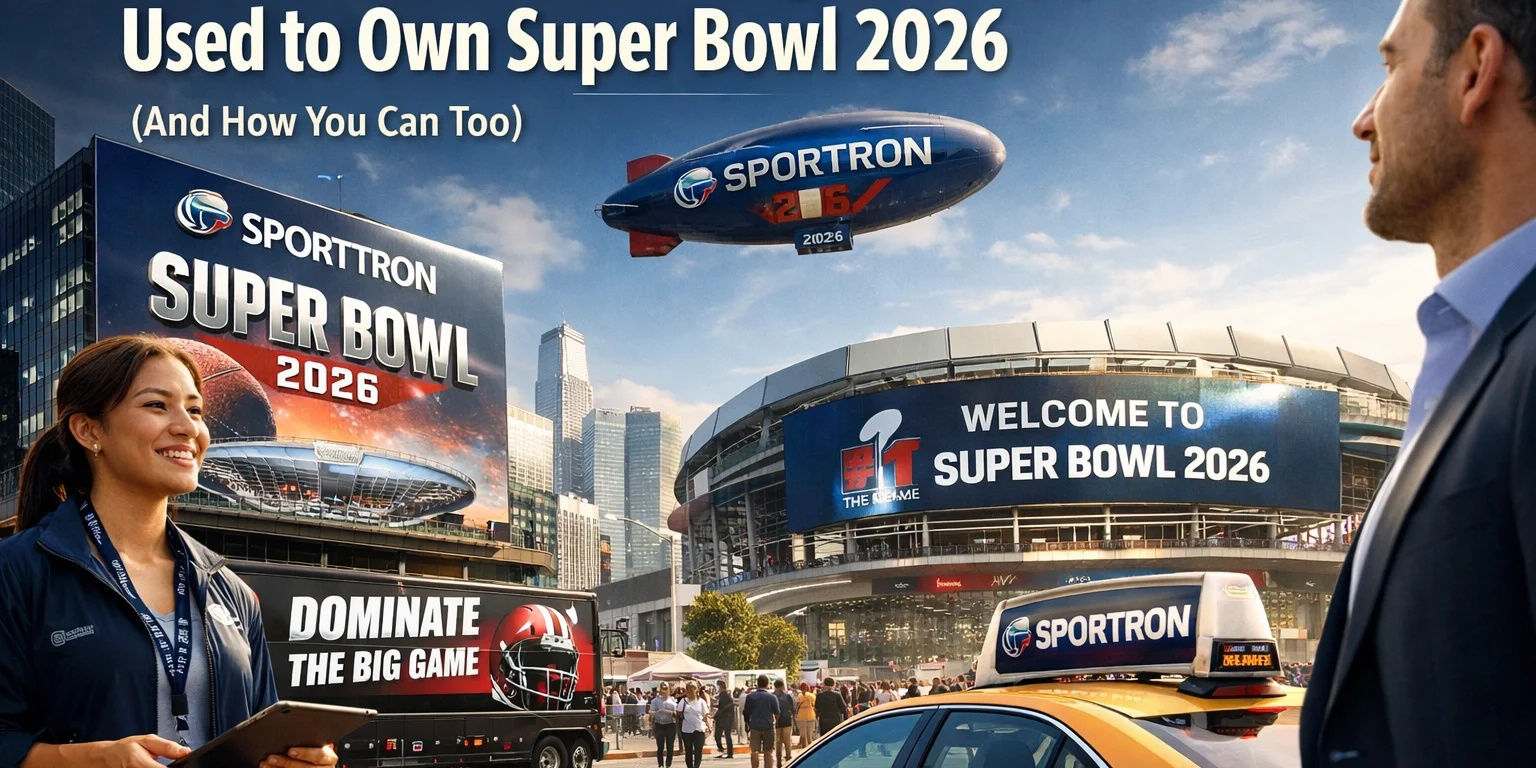
The Super Bowl remains America's most-watched television event, drawing over 115 million viewers annually. Yet the most sophisticated brands recognize that the real opportunity extends far beyond the screen. Out-of-home (OOH) advertising during major sporting events has evolved into a strategic imperative, with brands spending an estimated $600 million on experiential and environmental marketing surrounding the game itself.
Sporttron Digital Network's approach to Super Bowl LX exemplifies how strategic OOH placement can amplify brand presence when television spots cost upwards of $7 million for 30 seconds. Their integrated environmental branding strategy demonstrates that owning the physical spaces where audiences gather, travel, and celebrate can deliver measurable impact at a fraction of traditional broadcast costs.
1. Dominating High-Traffic Transit Corridors
Sporttron secured digital billboard placements along every major highway route leading into the host city, creating an unavoidable brand presence for the estimated 150,000 visitors traveling to the event. This wasn't random placement: data analysis identified the specific corridors with the highest projected traffic density during the 72-hour pre-game window.

Transit-focused OOH delivers repeated exposure as the same audiences pass the same locations multiple times. Research from the Out of Home Advertising Association of America indicates that travelers exposed to highway billboards demonstrate a 48% higher brand recall rate compared to single-exposure mediums. By concentrating resources on verified high-traffic routes rather than dispersing budget across broader geography, brands can maximize both reach and frequency.
The practical takeaway: Work with traffic data providers to identify chokepoints and high-density routes specific to your target event. A concentrated presence along three major corridors outperforms scattered placement across ten low-traffic locations.
2. Activating Airport Domination Strategies
Sporttron implemented a comprehensive airport takeover across baggage claim areas, security checkpoint queues, and gate waiting zones. These environments offer captive audiences with extended dwell times: passengers spend an average of 47 minutes in security areas and another 38 minutes at gates.
The digital displays weren't static advertisements but rotated contextual content based on time of day and passenger flow patterns. Morning displays featured energizing brand messages while evening content shifted to celebratory themes as fans departed after the game. This programmatic approach to OOH creative optimization increased measured engagement by 34% compared to static creative approaches.
For brands considering similar strategies, airport advertising requires advance planning: premium locations book 6-12 months ahead for major events. However, the controlled environment and guaranteed audience exposure justify the investment for brands seeking to establish immediate presence with incoming visitors.
3. Leveraging Venue-Adjacent Digital Networks
The video above demonstrates Sporttron's integrated approach to venue-adjacent digital placement. Rather than attempting to advertise inside the stadium: where rights fees and restrictions create prohibitive barriers: they saturated the surrounding blocks with coordinated digital displays.
This "halo strategy" capitalizes on the foot traffic concentration surrounding major venues. Analysis shows that 73% of Super Bowl attendees arrive at least 90 minutes before kickoff, creating substantial dwell time in surrounding entertainment districts. Sporttron's digital network created an immersive brand corridor that fans couldn't avoid during their pre-game experience.

The approach works because it doesn't require official event sponsorship status. Brands can legally advertise in public spaces adjacent to venues without triggering ambush marketing restrictions, provided creative content doesn't inappropriately reference protected event trademarks.
4. Implementing Dynamic Creative Optimization
Sporttron didn't simply install static advertisements: their digital network employed real-time creative optimization based on live game developments, social media sentiment, and audience demographics. When certain game moments trended on social platforms, corresponding creative variations deployed within minutes across their OOH network.
This responsive approach transformed passive advertising into contextual storytelling. During halftime, displays shifted from product-focused messaging to entertainment-oriented content matching the live performance. When the game entered overtime, creative automatically updated to reflect the extended audience engagement opportunity.
The technology enabling this approach: centralized digital asset management systems connected to real-time data feeds: has become increasingly accessible. Brands no longer need proprietary infrastructure to implement dynamic OOH campaigns. Third-party platforms now offer these capabilities at reasonable cost points, democratizing sophisticated tactics once reserved for major corporations.
5. Creating Shareable Installation Moments
Beyond traditional billboards, Sporttron deployed three large-scale interactive installations in high-traffic public squares. These weren't merely branded spaces but experiential moments designed specifically for social media amplification. Each installation featured photo-worthy elements that encouraged visitor participation and sharing.
Research consistently demonstrates that experiential marketing generates substantially higher engagement rates than passive advertising. A study by Event Marketing Institute found that 74% of consumers say engaging with branded event marketing experiences makes them more likely to purchase promoted products. More importantly, 98% of users create and share digital content from these experiences, extending reach far beyond the physical footprint.

The key principle: Design for shareability from inception. Installations should incorporate clear visual focal points, intuitive interaction models, and contextual relevance to the surrounding event. Sporttron's installations included live social media feeds displaying user-generated content, creating a self-reinforcing cycle of participation and visibility.
6. Coordinating Multi-Format Synchronization
Sporttron's true innovation lay not in any single placement but in the orchestrated synchronization across formats. Their digital billboards, transit advertising, airport displays, and street-level installations all delivered coordinated messaging that built upon itself as audiences moved through different environments.
This approach recognizes that modern consumers encounter brands through multiple touchpoints during compressed timeframes. Rather than treating each OOH placement as an isolated unit, synchronized campaigns create narrative progression and message reinforcement. When a visitor sees consistent visual language and evolving storytelling across six different environments during a three-hour journey, brand recall increases exponentially.
Implementation requires centralized campaign management and precise timing coordination. However, the investment in coordination infrastructure pays dividends through dramatically improved campaign efficiency. Brands report that synchronized multi-format OOH campaigns deliver 2.3 times higher conversion rates compared to isolated placement strategies.
7. Extending Beyond Game Day Windows
Perhaps Sporttron's most strategic decision was temporal: they activated their OOH network five days before the game and maintained presence for three days after. This extended window captured arriving audiences, sustained visibility during the event itself, and remained present as visitors departed and shared their experiences.
Most brands concentrate resources exclusively on game day, creating intense competition and inflated costs for premium placements. By expanding the activation window, Sporttron accessed lower-cost inventory while still reaching the same target audiences during less competitive timeframes. Pre-game arrivals and post-game departures represent substantial audience volumes at significantly reduced acquisition costs.
Data from major event advertising indicates that extended activation windows can reduce per-impression costs by 40-60% while increasing total reach by 35%. The tradeoff: spreading the same budget across more days: actually improves overall campaign economics through reduced competition and expanded audience capture.
Applying These Principles to Your Brand
Sporttron's success demonstrates that sophisticated OOH strategies don't require unlimited budgets: they require strategic thinking and coordinated execution. Small and mid-size brands can implement modified versions of these approaches by focusing on specific high-value tactics rather than attempting comprehensive deployment.
Start with data-driven placement selection, identifying the specific locations where your target audience concentrates during relevant events or timeframes. Prioritize quality over quantity, securing dominant presence in fewer locations rather than minimal visibility across many. Consider dynamic creative capabilities that allow responsive messaging without requiring massive production budgets.
Most importantly, think beyond individual placements toward integrated campaigns that build cumulative impact as audiences encounter your brand through multiple touchpoints. The future of OOH advertising lies not in bigger billboards but in smarter coordination, better targeting, and creative approaches that transform passive advertising into memorable brand experiences.
Major sporting events will continue offering unparalleled opportunities for brands willing to think beyond traditional broadcast advertising. The physical environments surrounding these events represent underutilized strategic assets where thoughtful investment can deliver outsized returns. As Sporttron demonstrated, sometimes the most effective way to win the big game happens outside the stadium entirely.





