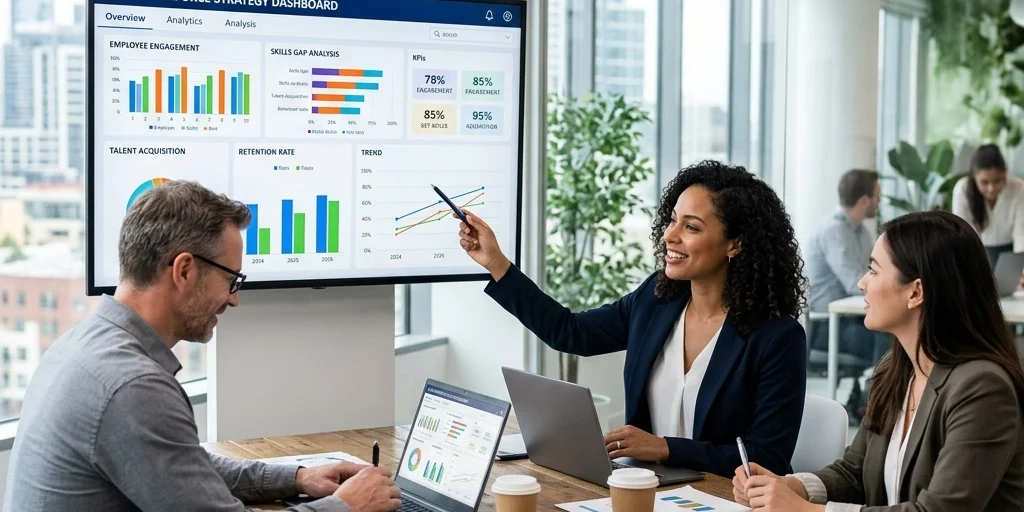
As we approach 2026, the landscape of workforce management is undergoing a fundamental shift. The traditional methods of "gut-feeling" leadership and annual performance reviews are no longer sufficient to maintain a competitive edge. In an era defined by rapid technological advancement and shifting economic paradigms, data is the most valuable asset an organization possesses. However, data alone is not enough; it is the accessibility and visualization of that data, specifically through integrated analytics dashboards, that transform raw numbers into strategic power.
For executive leaders, the challenge is no longer about collecting data, but about integrating it into a cohesive workforce strategy. This is especially true as schools and corporations alike look to become "Future Ready." At USA Entertainment Ventures LLC, we specialize in the business consulting necessary to bridge the gap between educational foundations and high-stakes branding. Our focus is on empowering organizations to use data not just as a rearview mirror, but as a high-definition navigation system for the future.
The Strategic Importance of Real-Time Analytics
The shift toward a data-driven workforce is backed by compelling evidence. Organizations that successfully implement real-time analytics dashboards have seen a 32% increase in employee productivity and a 25% to 39% improvement in staff longevity. These figures are not merely coincidences; they are the result of leaders having the ability to identify bottlenecks, recognize high performance, and predict attrition before it happens.
A dashboard provides a centralized view of your organization's health. By integrating data from HR systems, performance management tools, and even educational outcomes, executives can gain a holistic understanding of their human capital. This integration allows for proactive rather than reactive management. Instead of wondering why turnover is high in a specific department, a well-integrated dashboard can show the correlation between training gaps, compensation benchmarks, and employee engagement scores in real-time.

NIL Education: A New Pillar of Workforce Readiness
One of the most significant developments in the 2026 workforce landscape is the rise of Name, Image, and Likeness (NIL) education. While once confined to the world of collegiate athletics, the principles of NIL, personal branding, contract literacy, and digital reputation management, are now essential skills for the modern professional.
Integrating NIL education into a workforce strategy means preparing employees and students to manage their personal brands as assets. For "Future Ready" schools, this means providing students with the tools to navigate a world where their digital footprint is their first interview. Data analytics dashboards can track the progress of these educational programs, measuring outcomes such as financial literacy levels and brand sentiment.
When students and young professionals understand their value and how to protect it, they become more engaged and productive members of the workforce. By positioning your organization or school as an anchor for NIL education, you are not just teaching a skill; you are building a resilient, media-savvy workforce. For more on how to navigate these high-stakes environments, you can explore The Ultimate Guide to High-Stakes Branding.
Enhancing Media Literacy Outcomes
In tandem with NIL education, media literacy has become a critical requirement for workforce stability. The ability to discern fact from fiction and understand the nuances of digital communication is no longer optional. Misinformation can lead to reputational damage, internal discord, and poor decision-making.
A robust 2026 workforce strategy must include measurable media literacy outcomes. By utilizing data dashboards, organizations can assess the effectiveness of media literacy training modules. Are employees better at identifying phishing attempts? Can they navigate social media crises with composure? Data-driven insights allow executives to tailor training programs to specific weaknesses, ensuring that the entire organization is "Future Ready."
Media literacy is not just about avoiding "fake news"; it is about understanding the mechanics of communication in a digital-first world. It is the foundation upon which effective branding and corporate communication are built.
A Step-by-Step Framework for Integration
Integrating data analytics into your workforce strategy is a journey, not a destination. To move from static reporting to predictive intelligence, organizations should follow a structured implementation framework.
1. Establish a Focused Pilot Approach
Before rolling out a dashboard to the entire organization, start with a high-impact use case. This might be turnover forecasting in a high-growth department or measuring the ROI of a new media literacy program. A pilot project, typically lasting 8 to 12 weeks, allows you to refine your data sources and dashboard design before scaling.
2. Build a Solid Data Foundation
Data integration is the most common hurdle. You must pull information from various silos, HR, finance, workforce management, and CRM systems, into a unified view. For large enterprises, a centralized data warehouse is often necessary. For mid-sized organizations, federated queries may offer a faster path to implementation. The goal is to create a "single source of truth" that every executive can trust.
3. Design for Actionable Intelligence
A dashboard is only as good as the actions it inspires. Avoid "vanity metrics" that look good but provide no direction. Instead, focus on actionable intelligence. Use trend lines to compare headcount forecasts against actual results, and employ heatmaps to identify skills gaps within specific locations or roles. If the data shows a spike in attrition risk, the dashboard should ideally suggest a recommended next step, such as a compensation review or a leadership check-in.

Positioning Schools as "Future Ready"
Schools are the primary pipeline for the future workforce. By integrating data analytics and NIL education into the curriculum, educational institutions can transform into "Future Ready" hubs. USA Entertainment Ventures LLC works closely with schools to implement these strategies, ensuring that students are not only academically prepared but also professionally equipped for the 2026 economy.
The integration of dashboards in an educational setting allows administrators to track student outcomes beyond standard testing. They can monitor the success of media literacy programs and the real-world application of NIL principles. This data provides the evidence needed to iterate on curricula and demonstrate the school's value to the community and future employers.
Governance and Continuous Optimization
Effective dashboard integration requires strong governance. This means designating an executive sponsor, a data steward, and an analytics owner. It also means setting a regular cadence for review.
- Weekly: Operational dashboards for management and recruiting teams.
- Monthly: Scorecards for senior leadership and finance.
- Quarterly: Strategic reviews with the executive board to adjust the long-term workforce strategy.
Governance ensures that data remains accurate, secure, and relevant. As privacy regulations evolve, maintaining strict role-based access controls and anonymizing sensitive employee information is paramount.
The Forward-Looking Executive Perspective
The integration of data analytics dashboards into your 2026 workforce strategy is not a luxury, it is a necessity for survival in a complex global market. By focusing on data-driven insights, NIL education, and media literacy, you are creating an organization that is proactive, resilient, and prepared for whatever the future holds.
As we look toward 2026, the successful executive will be the one who views the workforce not as a cost center, but as a dynamic ecosystem that can be optimized through technology and education. We invite you to learn more about our approach to business consulting and how we can help your organization or school become an anchor for future readiness by visiting our Services page.
The tools are available, the data is there, and the strategy is clear. The only question remains: Is your organization ready to lead?
If you are ready to begin your journey toward a data-integrated workforce strategy, please contact us to schedule a consultation. Together, we can build a future that is grounded in data and elevated by innovation.

USA Entertainment Ventures LLC is a business consulting firm dedicated to navigating the intersection of entertainment, education, and corporate strategy. For more information on our initiatives and partnerships, please visit usaentertainmentventures.com.