
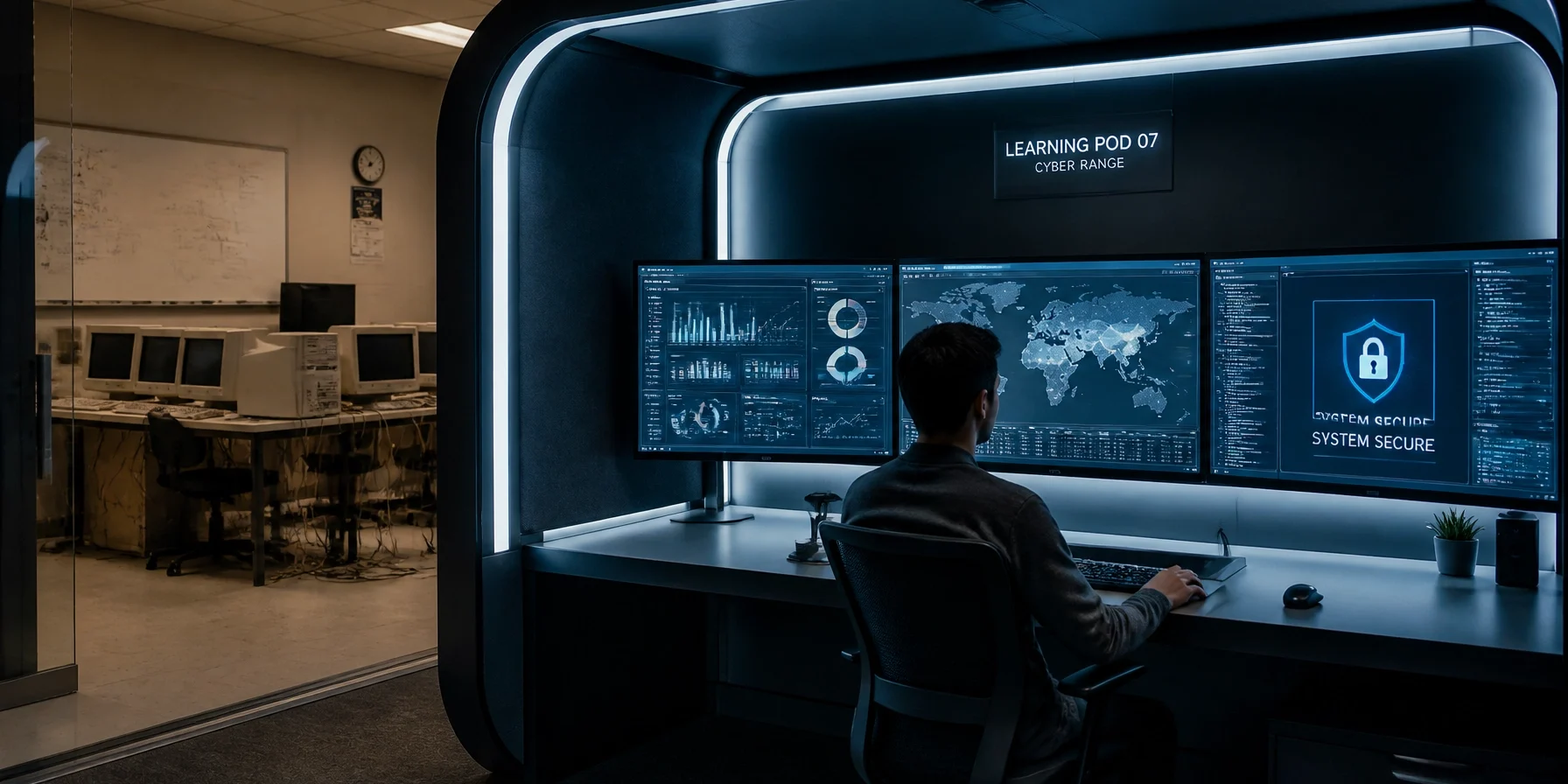
For decades, the "computer lab" was a staple of the educational and professional landscape. It was a room defined by rows of identical beige towers, flickering CRT monitors (and later, flat screens), and the unmistakable hum of dozens of cooling fans. These spaces were designed for general literacy, teaching students how to type, navigate a spreadsheet, or browse the early internet.
However, as we move deeper into the mid-2020s, the traditional computer lab is increasingly being viewed as a relic of a bygone era. In its place, a more agile, specialized, and effective model is emerging: the modern Learning Pod.
At USA Entertainment Ventures LLC, we observe these infrastructure shifts daily through our work in Business Consulting and workforce development. The transition from the "general lab" to the "specialized pod" is not just an architectural trend; it is a fundamental reimagining of how we prepare individuals for high-stakes careers in cybersecurity, logistics, and content creation.
The Problem with the "General Purpose" Model
Traditional labs were built on the principle of uniformity. Every station had the same processor, the same software, and the same cramped desk space. While efficient for teaching 30 people how to use Microsoft Word simultaneously, this model fails the modern professional.
Today’s high-growth industries require specific, high-performance environments. A cybersecurity analyst needs a multi-monitor setup to track real-time threats; a logistics coordinator needs a command-center interface to manage global supply chains; and a content creator needs acoustic treatment and professional-grade rendering power.
When you try to force these specialized workflows into a generic computer lab, the results are often underwhelming. Engagement drops, technical bottlenecks emerge, and the "real world" feels a thousand miles away.
Enter the Pod: Modular, Specialized, and Immersive
A "Pod" is a purpose-built, modular environment designed to simulate a specific professional ecosystem. Unlike the rows of desks in a traditional lab, pods are often clustered, collaborative, and highly specialized.
According to recent industry data, organizations transitioning to pod-based models report a 50% to 75% reduction in maintenance and build-out costs. This is driven by modularity, instead of upgrading an entire room of 40 PCs, a facility can upgrade a single 4-person "Cyber Pod" with high-performance hardware, leaving other pods focused on less resource-intensive tasks.
1. Cybersecurity: From the Lab to the SOC
In a traditional lab, a student might follow a static tutorial on network security. In a modern Cybersecurity Pod, that student enters a simulated Security Operations Center (SOC).

These pods are designed for "Red Team vs. Blue Team" exercises. One pod may act as the attacker, while another defends, forcing real-time communication and strategic decision-making. The infrastructure supports virtualized, isolated networks where learners can safely deploy simulated malware without risking the broader network. This hands-on, high-intensity environment is what turns a student into a "Day 1 ready" analyst.
2. Logistics: The Modern Command Center
Logistics is no longer just about moving boxes; it is about managing a complex digital twin of the physical world. A Logistics Pod functions like a high-tech control room.

Here, learners engage with live dashboards showing global shipment maps, fleet tracking, and warehouse inventory levels. These pods often integrate physical hardware like barcode scanners and RFID readers, allowing participants to experience the cognitive load of managing live operations. By simulating supply chain disruptions, such as a port closure or a hurricane, within the pod, professionals learn to navigate the chaos of modern commerce before they ever step onto a warehouse floor.
3. Content Creation: The Mini-Studio Revolution
The rise of the creator economy has made content production a core business skill. However, a traditional computer lab is perhaps the worst place to record audio or video. The lack of lighting, poor acoustics, and shared noise make professional work impossible.

A Content Creation Pod acts as a compact, integrated studio. It features acoustic treatment, professional lighting, and high-performance GPUs capable of 4K and 8K video rendering. In these pods, collaboration is natural: one person may be editing a sequence, another mixing audio, and a third managing digital assets, all within a space that mirrors a modern media agency.
Connecting the Dots: DoD SkillBridge and Future Careers
At USA Entertainment Ventures LLC, we are particularly focused on how these modern infrastructures support our service members. Through the DoD SkillBridge program, transitioning service members can utilize their final 180 days of service to train in these high-demand fields.
We believe that providing veterans with access to "Pod-based" training is the most effective way to translate military experience into civilian success. A veteran who managed complex logistics in the field can step into a Logistics Pod and immediately see the parallels between military operations and supply chain management. Similarly, those with a background in communications or intelligence find a natural home in Cybersecurity or Content Creation pods.
As part of our commitment to veteran success, we invite those interested in these high-growth pathways to explore our current career opportunities and learn more about how we facilitate these transitions.
The Benefits of Moving to the Pod Model
The shift from labs to pods offers several tangible benefits for businesses and educational institutions alike:
- Authenticity: Pods mimic the actual workplace, reducing the "culture shock" when a new hire starts their first day.
- Scalability: You can add one pod at a time as your needs grow, rather than committing to a full-room renovation.
- Efficiency: Hardware is targeted. You only pay for high-end GPUs in the creator pods and high-end networking in the cyber pods.
- Retention: Immersive, team-based learning leads to higher engagement and better skill retention compared to solitary lab work.
A Future-Focused Outlook
The era of the "one-size-fits-all" computer lab is coming to a close. As the digital economy becomes more specialized, our physical infrastructure must follow suit. Modern pods are not just rooms with computers; they are specialized career launchpads that bridge the gap between theory and practice.
Whether you are an employer looking to modernize your training facility or a professional seeking a new career path, the move toward modular, specialized "Pods" represents a significant opportunity for growth and innovation. At USA Entertainment Ventures LLC, we are proud to be at the forefront of this transition, helping both businesses and individuals navigate the future of work.
To learn more about our approach to business consulting and recruitment, please visit our About Us page.





