
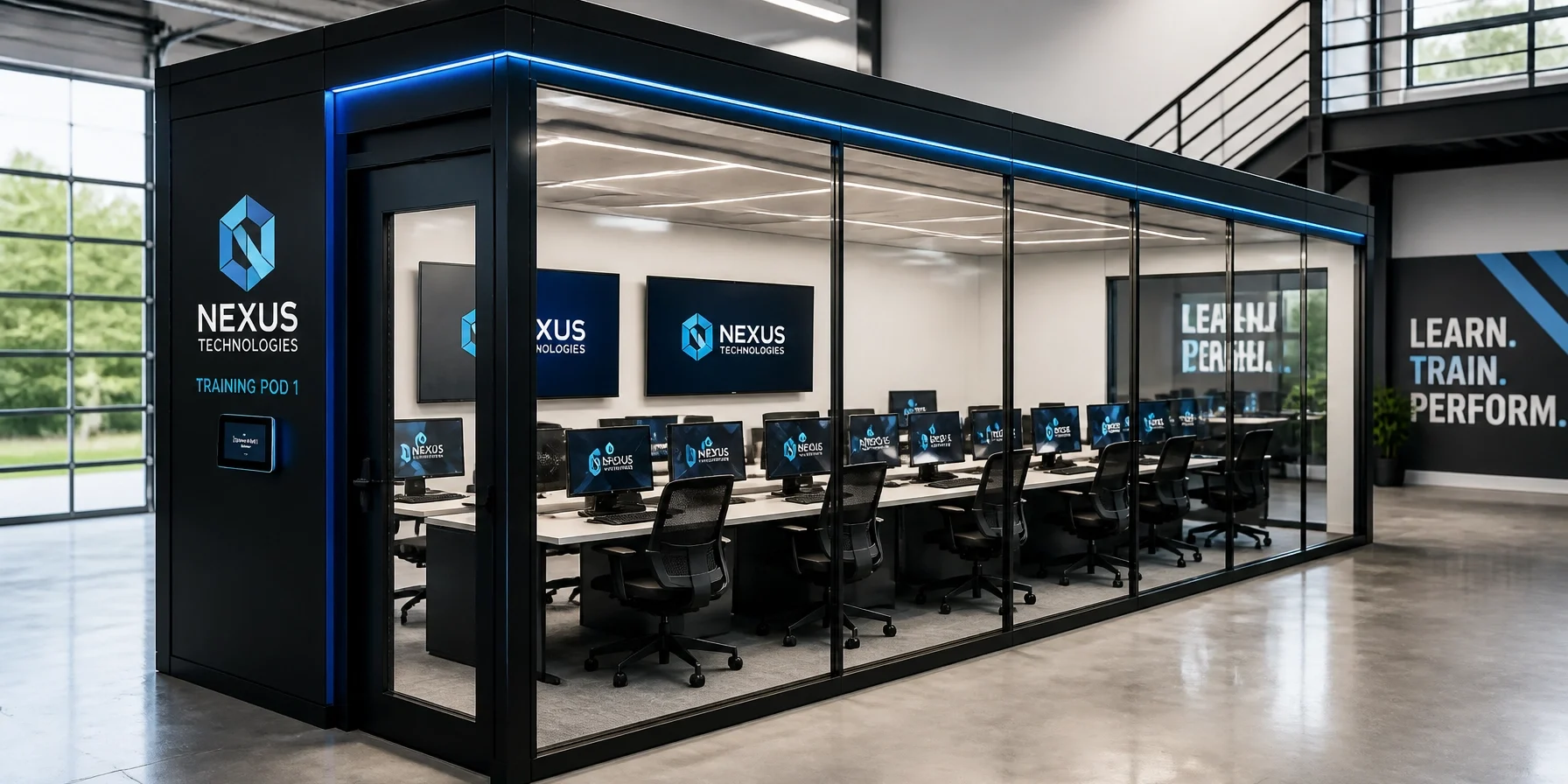
The landscape of professional development is undergoing a fundamental shift. Traditionally, workforce training was confined to rigid, permanent structures, large-scale computer labs or dedicated brick-and-mortar facilities that required significant capital investment and long-term planning. However, as the pace of technological change accelerates, these static environments are increasingly viewed as liabilities rather than assets.
The emergence of modular infrastructure, specifically in the form of "Pods," is redefining how organizations approach skill acquisition. These prefabricated, self-contained units represent a departure from traditional construction, offering a scalable and adaptable solution for industries ranging from logistics to cybersecurity. At USA Entertainment Ventures LLC, we recognize that the future of managing and workforce development lies in the ability to deploy high-tech environments rapidly and where they are needed most.
The Concept of Modular Infrastructure: The New Training Standard
Modular infrastructure refers to the use of prefabricated units that can be deployed individually or clustered together to create comprehensive learning ecosystems. Unlike traditional buildings, these pods are constructed off-site and delivered ready for immediate use. This approach significantly reduces the time from project inception to operational training, a critical factor for businesses responding to sudden market shifts or technological advancements.
According to industry data, modular construction can reduce project timelines by as much as 30% to 50% compared to traditional methods. For workforce development, this means that a company can establish a state-of-the-art computer lab in weeks rather than months. These units are fully insulated, climate-controlled, and equipped with the electrical and data infrastructure necessary to support high-density computing workloads.
The versatility of these pods allows for a tailored approach to curriculum delivery. By standardizing the external "chassis" of the pod while customizing the internal configuration, organizations can create specialized environments for distinct career pathways.
Logistics Pathways: Precision Training in a Controlled Environment

The logistics and supply chain sector has become increasingly data-dependent. Modern logistics professionals must navigate complex Warehouse Management Systems (WMS), real-time tracking software, and predictive analytics tools. Training for these roles requires a dedicated space that can simulate the high-pressure environment of a distribution center without interrupting live operations.
Modular training pods provide an ideal solution for logistics education. By outfitting a pod with dual-monitor workstations, large-scale dashboard displays, and even virtual reality (VR) simulation zones, companies can provide immersive training experiences.
Practical Application in Logistics:
- Simulated Operations: Trainees can practice managing peak-season inventory surges in a risk-free, simulated environment.
- WMS Mastery: Real-time access to logistics software allows for hands-on learning that directly translates to the warehouse floor.
- Scalability: As a logistics operation expands, additional training pods can be added to the site to accommodate new hires, ensuring that career opportunities are met with adequate preparation.
Industry experts emphasize that hands-on, simulation-based training significantly improves retention and reduces error rates in logistics operations. Modular pods facilitate this high-level training by providing the necessary technical infrastructure in a compact, efficient footprint.
Cybersecurity Resilience: Security Through Isolation

As cyber threats grow in sophistication, the demand for skilled cybersecurity professionals continues to outpace the available talent pool. Training the next generation of security analysts requires a unique environment, one that is secure, isolated, and capable of simulating complex network attacks.
Modular cybersecurity pods, often referred to as "Cyber Ranges," offer a controlled setting for these high-stakes simulations. These pods can be equipped with isolated network infrastructure, enhanced power distribution, and secure rack space for servers and firewalls. This physical and logical isolation ensures that training exercises do not pose a risk to the organization's broader IT infrastructure.
The Strategic Advantage of Cyber Pods:
- Isolated Environments: Trainees can engage in "red team vs. blue team" exercises, where simulated attacks are launched and defended against in a closed loop.
- High-Density Computing: The specialized HVAC and cooling systems integrated into modular pods are designed to handle the heat generated by the high-performance servers used in cybersecurity training.
- Regulatory Compliance: For organizations working in sensitive sectors, having a dedicated, secure training pod helps meet stringent compliance and security standards.
The ability to deploy these secure environments on a corporate campus or even near a military installation makes them a powerful tool for DOD Skill Bridge recruitment initiatives, where security and technical proficiency are paramount.
Content Creation: Professional Media Production in a Modular Studio

The digital media landscape has shifted the requirements for workforce communication and marketing. Today, many organizations require internal teams capable of producing high-quality video content, podcasts, and digital media. However, traditional office spaces are often ill-equipped for media production due to poor acoustics and inadequate lighting.
Modular content creation pods solve this problem by providing a purpose-built, acoustically treated environment. These pods are designed with sound-dampening materials and integrated studio lighting, allowing for professional-grade production in any location.
Features of Content Creation Pods:
- Acoustic Excellence: Specialized wall panels prevent sound leakage and minimize echo, which is essential for high-quality audio recording.
- Integrated Tech: High-bandwidth connectivity supports the rapid upload of large video files, while studio-grade power ensures that lighting and cameras function without interruption.
- Creative Flexibility: These pods can be used for everything from internal training videos to corporate podcasts and live-streaming events.
By providing employees with access to professional-grade tools within a modular framework, companies can foster a culture of innovation and digital literacy that is vital in the modern creative economy.
The DOD SkillBridge Connection: Facilitating Transitions

One of the most significant applications for modular training infrastructure is the DoD SkillBridge program. This program allows active-duty service members to participate in civilian job training during their final 180 days of service. The challenge for many industry partners is providing a structured, high-tech environment that can accommodate transitioning veterans at or near military installations.
Modular pods provide a "plug-and-play" solution for SkillBridge partners. Because they are mobile and easy to install, these pods can be placed on or near military bases, bringing the training directly to the service members.
The Benefits for Transitioning Veterans:
- Standardized Competencies: Training is organized into discrete, modular blocks that align with civilian job roles in logistics, cybersecurity, and media.
- Efficient Use of Time: The 180-day SkillBridge window is maximized by using high-density, focused training environments that minimize downtime.
- Direct Career Pathways: By completing training in a pod designed to replicate the employer's real-world environment, veterans gain a significant advantage in the transition to civilian employment.
At USA Entertainment Ventures LLC, we believe that providing these advanced infrastructures is a key component of a successful recruitment and retention strategy for our nation's veterans.
Future Outlook and Scalability
The future of workforce training is undeniably modular. As businesses and educational institutions seek to balance cost with the need for high-tech facilities, the pod model offers a path forward that is both sustainable and scalable. These units are not merely "temporary" solutions; they are high-performance structures built to commercial standards, capable of serving as permanent fixtures or mobile assets.
Furthermore, the environmental impact of modular infrastructure is significantly lower than that of traditional construction. The controlled factory environment where pods are built results in less waste, and the ability to relocate and repurpose units extends their lifecycle indefinitely.
Actionable Takeaways for Your Organization
- Assess Your Immediate Needs: Identify skill gaps in your organization that require specialized environments, such as cybersecurity or media production.
- Evaluate Space and Budget: Consider modular pods as a cost-effective alternative to traditional office renovations or new construction.
- Engage with SkillBridge: If you are looking to hire veterans, explore how modular training infrastructure can facilitate a SkillBridge partnership at your location.
- Prioritize Scalability: Start with a single pod and expand as your training programs grow, ensuring that your investment scales alongside your workforce.
Conclusion
Modular infrastructure represents more than just a change in building technique; it represents a change in the philosophy of learning. By decoupling high-tech training environments from the constraints of traditional architecture, we can create a more responsive, agile, and effective workforce. Whether you are training logistics managers, cybersecurity analysts, or digital creators, modular pods provide the foundation for excellence in the modern era.
For more information on how we manage these innovative programs, please visit our services page or contact us directly to discuss your training infrastructure needs.





