
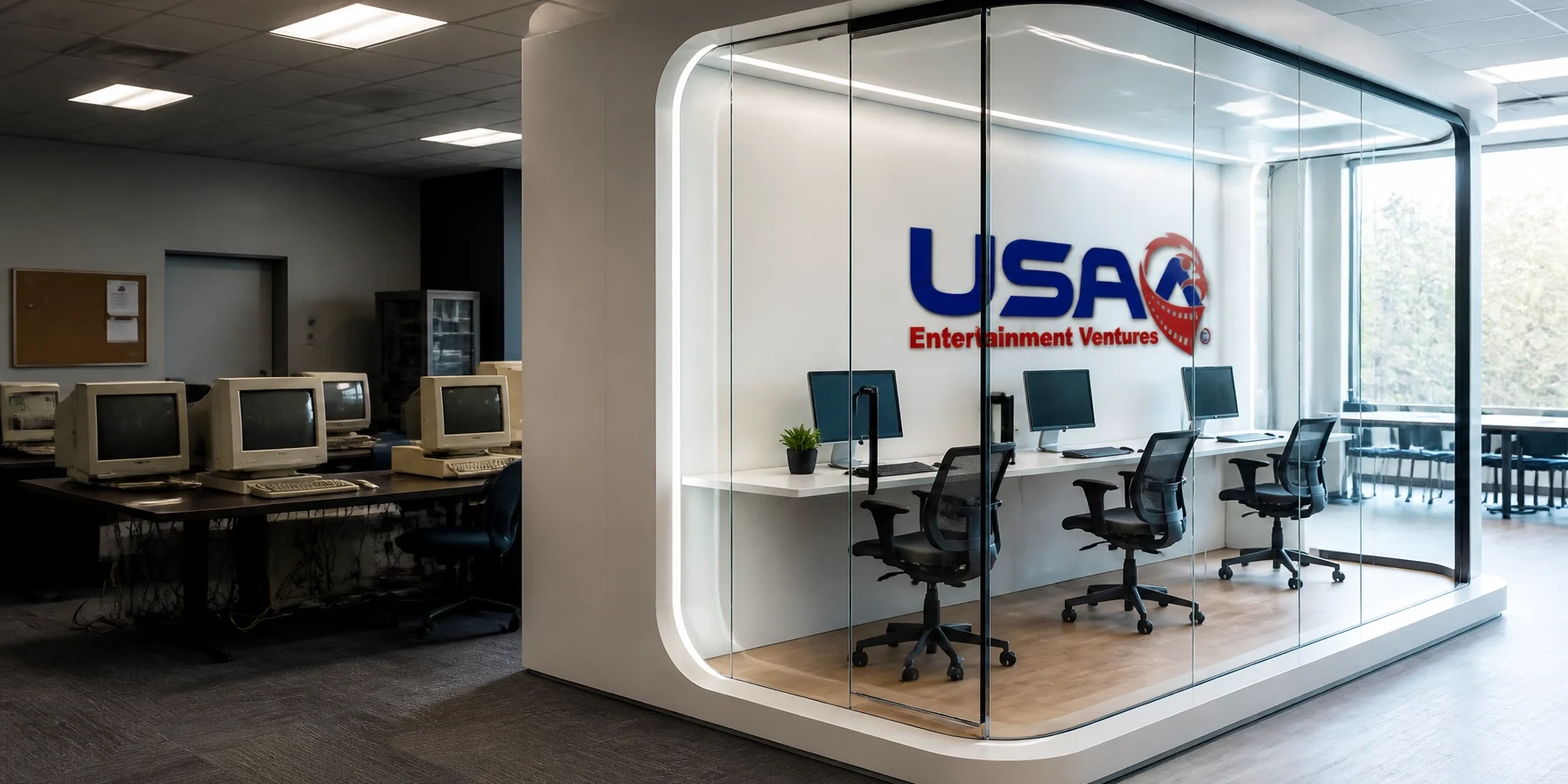
Let’s be honest: when you walk into a traditional computer lab, you can almost hear the ghost of a 56k modem screaming in the distance. There’s a specific, unmistakable smell: a cocktail of dust, ozone, and the despair of a thousand students trying to save a Word document to a floppy disk. For decades, the "computer lab" was a room filled with rows of beige towers and tangled cables, designed for a world that no longer exists.
In 2026, the idea of tethering students or trainees to a static, dusty room is not just outdated: it’s a bottleneck. The world has moved on to agile, modular, and tech-dense environments. Enter the "Pod." These aren't just fancy phone booths; they are the physical manifestation of a career-ready future. At USA Entertainment Ventures LLC, we’ve seen how infrastructure directly impacts talent development. If you want to train the next generation of logistics experts, cyber warriors, and content moguls, you need to stop thinking about rooms and start thinking about environments.
The Death of the Row: Why Pods are Winning
The traditional lab was built for "one-to-many" instruction: a teacher at the front, rows of students in the back. But modern career training is collaborative, intense, and often loud. Or, conversely, it requires deep, silent focus. Pods offer a solution that balances these conflicting needs without requiring a full architectural overhaul.
Why the Shift is Happening Now
The demand for specialized environments has skyrocketed as the skills gap in high-tech industries widens. According to industry research, modular educational spaces can be up to 40% more cost-effective than traditional renovations. More importantly, they provide the "psychological safety" required for deep learning. As we noted in our recent deep dive on why modular pods are the new hotspot for cyber careers, the shift is about more than just aesthetics: it’s about outcomes.
Pods offer three primary advantages over the old-school lab:
- Acoustic Isolation: You can’t learn to be a podcast host or a cybersecurity incident responder if you can’t hear yourself think over thirty other people typing.
- Modular Flexibility: Need to turn a study hall into a logistics simulation center? You don’t need a contractor; you just need to move a few panels.
- Tech-Density: Modern pods are pre-wired for the high-bandwidth, high-power needs of 2026, from triple-monitor setups to dedicated fiber connections.
Career Pathway 1: Logistics and Supply Chain Mastery
Logistics isn’t just moving boxes anymore; it’s a high-stakes game of digital chess. Training for this career involves managing "digital twins" of warehouses, overseeing fleet movements in real-time, and mastering Warehouse Management Systems (WMS).
In a traditional lab, this looks like a student staring at a single screen in a noisy room. In a Logistics Pod, it looks like a mission control center. We’re talking dual or triple vertical monitors displaying live data feeds, a dedicated headset for "dispatch" simulations, and enough desk space for a physical tablet and a keyboard.

These pods create an immersive environment where a trainee feels the weight of the supply chain. When you’re in a pod, you aren’t just "at school": you’re on the job. This is the heart of the next-generation talent funnel: creating environments that mimic the professional reality. By removing the distractions of a shared lab, logistics students can practice high-pressure decision-making in a controlled, professional setting.
Career Pathway 2: The Cybersecurity "Blue-Team" Bunker
If logistics is digital chess, cybersecurity is a digital fire drill. Training for cyber roles requires a level of focus that is impossible to achieve in a room where someone behind you is watching YouTube and someone to your left is eating loud chips.
Modular pods are the perfect "Cyber Range" components. They allow for the creation of "Red-Team" and "Blue-Team" zones. By clustering pods together, you can have teams collaborating within their soundproof bubbles while the "enemy" is just ten feet away, unable to overhear the defensive strategy.
From a technical standpoint, these pods are designed for high-density power. You aren't just running a browser; you're running virtual machines, network analyzers, and heavy-duty encryption tools. The ventilation in a modern pod is designed to handle the heat of high-performance workstations, ensuring that the only thing getting hot is the competition, not the hardware.
For organizations involved in DOD Skill Bridge recruitment, this infrastructure is a game-changer. Transitioning service members are used to structured, mission-focused environments. A dusty computer lab feels like a step backward; a high-tech Cyber Pod feels like a command center. It provides the gravitas and technical capability that veterans expect and deserve as they transition into the civilian workforce.
Career Pathway 3: The Content Creation Studio
We’ve moved past the era where "content creation" was a hobby. In 2026, it is a multi-billion dollar industry and a critical corporate skill. Companies need people who can produce professional-grade webinars, podcasts, and video tutorials.
The traditional computer lab is a nightmare for audio. The high ceilings and hard surfaces create an echo chamber that ruins even the best microphone's performance. A Content Pod, however, is lined with acoustic panels and features integrated mounting points for studio-grade microphones and ring lights.

These pods essentially democratize high-end production. A school or a training center doesn't need to build a $50,000 dedicated recording studio. They can simply drop in two or three content pods. Students can record high-fidelity voiceovers, stream live tutorials, or edit 4K video in a space that was literally built for sound control. This "plug-and-play" studio model allows organizations to keep pace with the rapidly evolving media landscape without massive capital expenditure.
Why You’ll Love the Swap: The Professional and Practical Benefits
Change can be scary, especially when it involves moving furniture that has been bolted to the floor since the early 2000s. However, the transition from open labs to modular pods isn't just about following a trend: it's about maximizing the efficiency of your space and your people.
1. Retention and Results
Data consistently shows that students in focused, private environments retain information better than those in crowded classrooms. By reducing "cognitive load": the distractions of people moving, talking, or peripheral activity: you allow the brain to engage fully with the material. In high-complexity fields like cybersecurity or logistics, that focus is the difference between mastery and mediocrity.
2. The Professional Aesthetic
In the world of business development and recruitment, appearances matter. When a prospective partner or a high-level recruit walks through your facility, the infrastructure tells a story. Do you want them to see rows of beige plastic, or a sleek, futuristic array of glass and steel? Modern pods signal that your organization is invested in the future and understands the needs of the modern workforce.
3. Unmatched Scalability
In the old world, if you wanted to add five more workstations, you had to find a bigger room or knock down a wall. In the world of pods, you just order five more units. They are the "Lego blocks" of professional development. As your programs grow: whether you’re expanding your cybersecurity range or adding a new logistics track: your infrastructure can grow with you, often within a single weekend.
Taking the First Step: How to Transition
The transition from a dusty lab to a career-ready pod environment doesn't have to happen overnight. In fact, we recommend a phased approach:
- Identify High-Impact Tracks: Which of your programs requires the most focus or specialized gear? Start there.
- Start with a "Pilot Cluster": Introduce four to six pods dedicated to a specific high-priority track like cybersecurity or digital media.
- Gather Feedback: Talk to the trainees. What do they love? What would they change? Modular pods are inherently adjustable, so use that to your advantage.
- Phase Out the Old: As the pods prove their worth, gradually replace the static lab rows with more versatile, modular units.
At USA Entertainment Ventures LLC, we believe that the physical space where learning happens is just as important as the curriculum itself. Whether you are focused on business development or specialized recruitment, the environment speaks volumes about the value you place on your talent.
It's time to retire the "lab" and embrace the "hub." The floppy disks are gone, the 56k modems are silent, and the future of career readiness is waiting inside a pod.






