
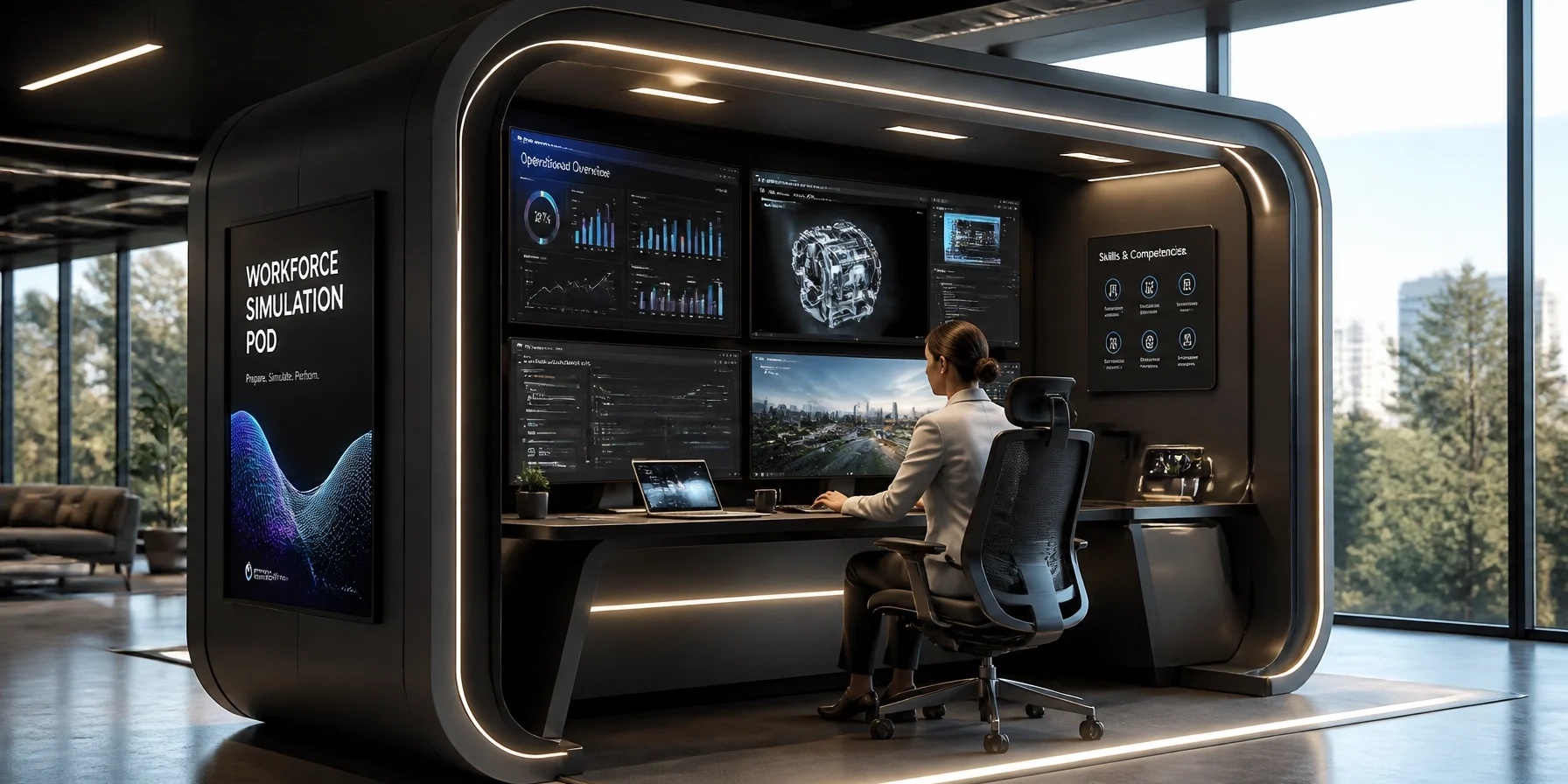
Walk into most high school or community college computer labs today, and you are greeted by a scene from a 2005 sitcom: rows of beige (or dusty black) towers, sticky membrane keyboards, and monitors that seem to hum with the collective boredom of a thousand Microsoft Word tutorials. These labs were built for "general computing", a polite way of saying they do everything adequately and nothing exceptionally.
But a quiet revolution is unfolding. Across the country, the "Old Lab" is being dismantled, replaced by a sleek, modular successor: The Pod.
If you have three minutes, we can explain exactly what these are and why they are currently the most important physical infrastructure in workforce development. If you are an old computer lab, you might want to look away. This is going to hurt.
The 3-Minute Breakdown: What is a Pod?
At its core, a Workforce Simulation Pod is the evolution of the computer lab. Instead of a generic room for generic tasks, a Pod is a self-contained, career-aligned environment. Think of it as a "Modern Shop Class" for the digital age.
Traditional labs offer access to computers; Pods offer access to careers.
Each Pod is engineered around a specific industry cluster, logistics, cybersecurity, or content creation, to name a few. They are equipped with the exact hardware, software stacks, and network configurations found in professional environments. When a student or trainee enters a Pod, they aren't just "logging on"; they are stepping into a simulated Security Operations Center (SOC), a global logistics hub, or a professional media studio.
This shift is more than cosmetic. Recent industry trends, notably highlighted by workforce advocates like Richard Harris, suggest that over 500 school districts are already pivoting toward this model, often replacing entire legacy labs with modular, $25,000 workforce simulation units.
The reason? Efficiency. A Pod removes the "translation layer" between school and work. You don't learn about the tools; you learn on the tools.
Logistics Pods: Managing the Global Pulse

Logistics used to be taught with a whiteboard and a prayer. Today, it is a high-stakes game of data, timing, and predictive analytics. The Logistics Pod transforms this abstract concept into a tangible reality.
Inside a Logistics Pod, you won't find students just typing in Excel. You will find them navigating professional Warehouse Management Systems (WMS) and Transportation Management Platforms (TMS). These Pods are designed to simulate the chaotic, fast-paced environment of a global supply chain.
Why Logistics?
Logistics is the backbone of the modern economy. According to recent economic data, the demand for logistics coordinators and supply chain analysts is projected to grow significantly as "just-in-time" delivery models evolve into "just-in-case" resilience models.
What’s inside a Logistics Pod?
- Real-time Dashboards: Integration with global shipping data.
- Optimization Software: Tools used to calculate the most efficient "last-mile" delivery routes.
- Simulation Scenarios: Learners are tasked with solving real-world disruptions, like a port closure or a sudden spike in fuel costs, using the same platforms used by Fortune 500 companies.
For companies like USA Entertainment Ventures LLC, which focuses on management and business development, the availability of a workforce trained in these "simulation-first" environments is a game-changer. It reduces onboarding time from months to weeks.
Cybersecurity Pods: Training the Digital Sentinels

If the Logistics Pod is about keeping the world moving, the Cybersecurity Pod is about keeping it safe.
In the old computer lab, "learning cybersecurity" usually meant a teacher lecturing about firewalls while students poked around a locked-down Windows desktop. In a Cybersecurity Pod, the gloves are off. These units are built with isolated networks and virtual machine sandboxes, allowing learners to practice both offensive and defensive maneuvers without bringing down the building's actual Wi-Fi.
The SOC Experience
The most advanced Cybersecurity Pods simulate a Security Operations Center (SOC). Students use professional-grade tools like Splunk for log analysis and Wireshark for network packet inspection. They aren't just reading about "threat hunting"; they are identifying real (simulated) malware as it attempts to move laterally through a network.
The Impact on Career Pathways:
The cybersecurity industry faces a massive talent gap. By training in a Pod, candidates gain hands-on experience that mirrors the daily grind of a Junior SOC Analyst or an Incident Responder. This isn't just education; it's a "pre-apprenticeship" in a box.
Content Creation Pods: The New Media Engine

Perhaps the most radical departure from the traditional lab is the Content Creation Pod. For decades, "media lab" meant a few computers with Photoshop installed. But in the age of the creator economy, that is no longer enough.
Content Creation Pods are designed for the end-to-end production of digital media. We are talking about podcasting, high-end video editing, 3D motion graphics, and live-streaming. These Pods provide the physical infrastructure, soundproofing, professional lighting, DSLR camera integration, and high-fidelity microphones, that a generic lab simply cannot offer.
Professionalism by Design
A student in a Content Creation Pod isn't a "student with a hobby." They are a media professional in training. They learn to manage Social Publishing Workflows and use high-end editing suites to produce portfolios that actually get them hired in digital marketing or corporate communications.
As businesses increasingly move toward "in-house" content production, the demand for creators who understand the technical side of the booth is skyrocketing. The Pod ensures they aren't just good at "making TikToks," but are capable of running a professional-grade media department.
The Economic Reality: Why the "Old Lab" is Crying
So, why are these Pods winning? It comes down to a simple, factual calculation: Utilization and ROI.
Traditional computer labs are notoriously underutilized. They are often empty for half the day, and when they are used, it's frequently for tasks that could be done on a $200 Chromebook. They represent a high-cost, low-impact investment.
A Workforce Simulation Pod, costing approximately $25,000, offers a different value proposition. It is a high-utilization, high-impact asset. Because these Pods are modular, a school can start with one and scale as their local job market dictates. If the local economy needs more logistics specialists, they add a Logistics Pod. If a major tech firm moves in, they add Cybersecurity Pods.
The Benefits of Modular Infrastructure:
- Standardization: A school district can ensure that a student in a rural area is using the exact same technology as a student in a major tech hub.
- Employer Alignment: Businesses can partner with schools to ensure the Pods are equipped with the software they use, creating a direct talent pipeline.
- Future-Proofing: When technology changes (which it does, roughly every six seconds), you don't need to gut an entire room. You simply update the software stack or the specific hardware module within the Pod.
Conclusion: The Future is Modular
The "Old Lab" served its purpose in a world where just knowing how to use a computer was a skill. But in 2026, digital literacy is the baseline, not the goal. The goal is professional competency.
The Pod Revolution is about recognizing that our physical infrastructure must match our economic ambitions. By providing students and workers with authentic, simulation-heavy environments, we are doing more than teaching; we are preparing.
Whether you are looking to enter the world of logistics, defend the digital frontier in cybersecurity, or build the next great media empire, the Pod is where that journey begins. It is efficient, it is professional, and yes: it is a lot cooler than that beige tower from 2005.
It’s time to stop just "browsing" and start "simulating." The revolution is here, and it’s modular.





