
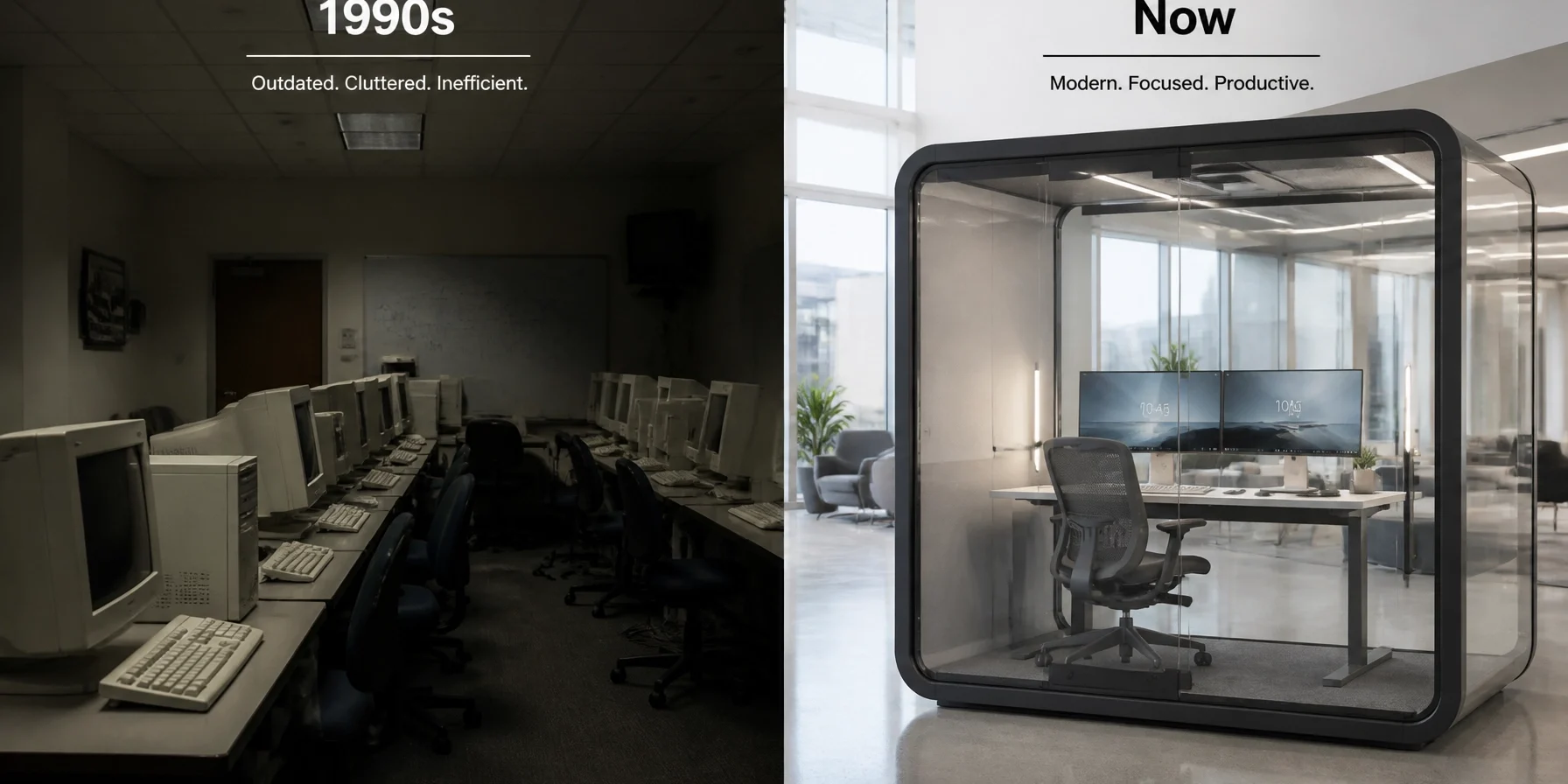
If you grew up in the late 90s or early 2000s, you probably have a very specific sensory memory: the low hum of fifty cooling fans, the faint smell of ozone, and the sight of thirty identical beige towers lined up like tombstones in a windowless room. The "Computer Lab" was a destination, a sacred, slightly chilly place you visited once a week to type "The quick brown fox jumps over the lazy dog" or die of dysentery on the Oregon Trail.
But fast forward to today, and that static room is looking less like a hub of innovation and more like a museum exhibit. Enter the Pod.
Modular, flexible, and surprisingly stylish, pods are fundamentally changing how we approach career-ready training and facility planning. Let’s break down why the "beige box" era is officially over and why pods are the future of how we work and learn.
What Exactly Is a "Pod"? (No, It’s Not a Space Capsule)
If you’re still picturing a computer lab as a room full of immovable desks bolted to the floor, think of a pod as the lab’s cool, mobile, and much more efficient younger cousin.
A pod is a modular, self-contained workspace. Sometimes it’s a physical, soundproof "booth" dropped into the middle of a lobby. Other times, it’s a digital "sandbox": a pre-configured, cloud-connected workstation designed for one specific job.
Instead of a "general purpose" lab where everyone does the same thing, pods are purpose-built. You might have a Cybersecurity Pod loaded with penetration testing tools, a Logistics Pod running real-world supply chain software, or a Content Creation Pod equipped for 4K video editing.
The Death of the Static Room: Why Labs Are Fading
Traditional labs are expensive, inflexible, and: let's be honest: a maintenance nightmare. Here is why administrators and facility planners are making the switch:
- Maintenance Costs: When one computer in a lab of forty breaks, you’re calling IT to a specific room. When an entire modular pod needs an upgrade, it can be swapped or serviced without taking an entire "destination room" offline. Research suggests that pod-based models can be up to 75% more cost-effective to maintain than traditional fixed labs.
- The "Zombie Stare": We’ve all seen it: a room full of students or trainees staring blankly at rows of screens, isolated by high plastic partitions. Pods are designed for collaboration. They are often arranged in clusters of 4–6, encouraging people to actually talk to each other while they work.
- Real Estate is Pricey: Why dedicate 2,000 square feet to a room that sits empty for 60% of the day? Modular pods can be placed in "dead zones": open lobbies, wide hallways, or even the corners of warehouses: turning underutilized space into a high-tech training ground.

Career Pathways: Pods as a Bridge to the Real World
At USA Entertainment Ventures LLC, we see a lot of career transitions, particularly through programs like the DOD Skill Bridge. One of the biggest challenges for career-changers is the "tool gap": the difference between a generic classroom computer and the high-tech gear used on the job. Pods bridge that gap by providing specialized environments:
The Cybersecurity Fortress
In a traditional lab, you can't exactly practice a "brute force" network attack without the IT department having a minor heart attack. Cyber Pods provide isolated, "sandboxed" environments. Trainees can break things, simulate massive data breaches, and practice defense strategies in a safe, controlled bubble that doesn't risk the main building's Wi-Fi.
The Content Creation Studio
Gone are the days when "content creation" meant just opening Microsoft Word. Today’s creators need soundproofing, ring lights, and high-end GPUs. A Content Pod is a turn-key studio. Imagine a student or veteran transitioning into digital marketing; they step into a pod, and they have everything they need to produce a professional podcast or edit a viral video: all in a space the size of a large closet.

The Logistics Command Center
For those entering the fast-paced world of logistics and supply chain management, pods can mimic the exact interface of a global shipping hub. Instead of learning theory, trainees are using the actual Enterprise Resource Planning (ERP) tools used by companies like Amazon or FedEx. It’s not "doing tech"; it's doing the job.
From "Going to a Room" to "Tech Where You Are"
The biggest shift isn't just about the furniture: it’s about the philosophy. In the old world, you "went to the computer lab." Technology was a destination you visited, like the gym or the dentist.
Today, tech is everywhere. Pods reflect that reality. By placing modular workstations where people already congregate: lobbies, breakrooms, or even transition centers: we remove the barrier to entry. If a busy professional or a military member transitioning to civilian life has thirty minutes between meetings, they don't need to hike across campus to a lab. They just step into a pod.

The Bottom Line
The era of the "beige box" was great for learning how to use a mouse, but today’s workforce needs more. They need agility, specialization, and environments that mirror the modern office.
Whether you’re a facility planner looking to maximize your floor plan or an educator trying to boost engagement, pods offer a way to make technology more accessible, more collaborative, and significantly more affordable.
Ready to rethink your space? Explore how our management services can help you navigate the future of modular infrastructure and career development.





