
The talent acquisition landscape has shifted dramatically. Traditional recruitment methods: posting job openings, reviewing resumes, conducting interviews: no longer provide the competitive advantage they once did. Fortune 100 companies now recognize that building exceptional teams requires a more strategic approach: identifying and developing talent years before graduation day.
This evolution centers on data analytics dashboards that transform fragmented information into actionable insights. These platforms enable corporations to track student development from the earliest stages of college through career launch, measuring competencies that extend far beyond academic transcripts. The result is a five-step framework that combines technology, education, and strategic partnerships to create sustainable talent pipelines.
Step 1: Establish Early Identification and Engagement
Fortune 100 companies no longer wait until graduation to identify promising candidates. The most sophisticated organizations begin building talent relationships during the college years, sometimes as early as the sophomore year. This proactive stance represents a fundamental departure from reactive hiring.

Data analytics dashboards enable this early engagement by aggregating information from multiple sources. Companies track participation in industry events, completion of relevant certifications, engagement with corporate mentorship programs, and performance in project-based assessments. This comprehensive view allows talent acquisition teams to identify individuals who demonstrate not just academic capability but also practical aptitude and professional maturity.
The early identification model yields measurable advantages. Companies report that candidates nurtured through multi-year pipeline programs demonstrate stronger cultural alignment and clearer understanding of organizational expectations before their first day of employment. This alignment translates directly to performance outcomes and retention rates that exceed those achieved through traditional recruitment channels.
Step 2: Implement Analytics Infrastructure
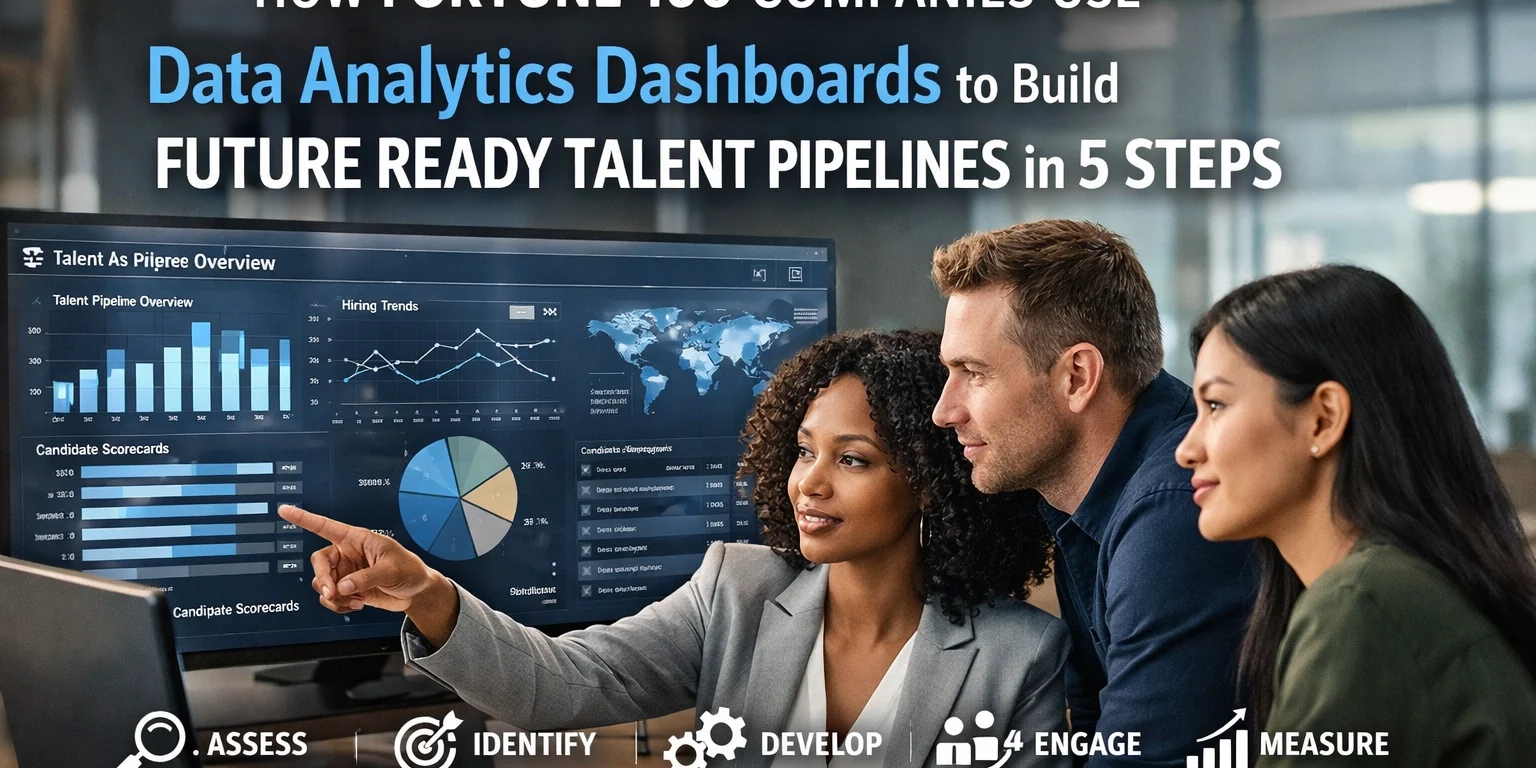
Data analytics dashboards function as the central nervous system of modern talent development initiatives. These platforms provide real-time visibility into program effectiveness, student engagement patterns, and skill development progression across entire talent ecosystems.
The infrastructure requirements extend beyond simple data collection. Effective dashboards integrate information from diverse sources: learning management systems, event attendance records, assessment platforms, and mentorship tracking tools: into unified interfaces that surface meaningful patterns. This integration enables talent teams to answer critical questions: Which educational programs produce the most work-ready graduates? Which competencies correlate most strongly with long-term success? Where should partnership investments be concentrated?

Leading organizations structure their analytics dashboards around three core dimensions. The first tracks individual student progression through defined competency frameworks, providing visibility into skill gaps and development trajectories. The second monitors program-level metrics, measuring engagement rates, completion percentages, and quality indicators across different educational partnerships. The third dimension focuses on business outcomes, connecting pipeline investments to hiring efficiency, time-to-productivity, and retention performance.
This multi-layered approach transforms talent acquisition from an art into a science. Decisions that once relied on intuition now rest on quantifiable evidence, enabling continuous refinement and strategic resource allocation.
Step 3: Integrate Competency-Based Education
The most effective talent pipelines incorporate workforce-relevant curricula that extend beyond traditional academic disciplines. Fortune 100 companies increasingly prioritize competency frameworks that include NIL (Name, Image, and Likeness) education, media literacy, and professional brand development.
NIL education has emerged as a critical component of future-ready talent development. Originally associated with collegiate athletics, NIL principles apply broadly to any professional context where individuals manage their personal brand, negotiate contracts, or navigate rights management. Students who understand NIL concepts demonstrate sophisticated comprehension of value creation, intellectual property, and professional positioning: capabilities that translate directly to business environments.

Media literacy represents another essential competency area. In an era of information abundance and platform proliferation, the ability to critically evaluate content, understand media influence, and communicate effectively across channels has become fundamental to professional success. Analytics dashboards track student progression through media literacy curricula, measuring outcomes such as digital communication effectiveness, source evaluation capability, and platform-appropriate messaging.
Companies integrate these competency areas into their talent development frameworks by partnering with educational institutions to design curriculum modules, sponsor certification programs, and provide real-world project opportunities. Dashboard data reveals which specific modules correlate most strongly with workplace performance, enabling continuous curriculum optimization.
Step 4: Partner With Future-Ready Educational Institutions
Fortune 100 companies increasingly concentrate their talent development investments on institutions that embrace comprehensive frameworks integrating data analytics infrastructure, NIL education, and media literacy curriculum. These partnerships create ecosystems where multiple stakeholders benefit from shared visibility and aligned objectives.
Analytics dashboards facilitate partnership effectiveness by providing transparency across all dimensions of collaboration. Universities track program enrollment rates, completion percentages, and student satisfaction metrics. Corporate partners monitor candidate quality indicators, post-hire performance data, and retention statistics. Students access personal dashboards showing their skill development trajectory, competency achievements, and positioning within talent pools.
This transparency drives continuous improvement. When dashboard data reveals that students from specific programs consistently outperform others in certain competency areas, partnership investments can be adjusted accordingly. If particular curriculum modules show weak correlation with workplace success, educational content can be refined or replaced. The result is a dynamic ecosystem that evolves in response to measured outcomes rather than assumptions or institutional inertia.
Future-ready educational institutions distinguish themselves by embracing this data-driven approach. They view corporate partnerships not as transactional recruiting relationships but as strategic collaborations focused on long-term talent development and mutual value creation.
Step 5: Measure ROI and Optimize Continuously
The final step in building effective talent pipelines centers on rigorous measurement and ongoing optimization. Fortune 100 companies quantify program effectiveness through multiple metrics: cost per qualified candidate, time to productivity, retention rates, and long-term career progression.
These measurements often reveal substantial advantages. One Fortune 100 organization reported that candidates entering through structured pipeline programs reached full productivity 30 percent faster than traditionally recruited employees. The same company documented 25 percent higher retention rates after two years for pipeline participants compared to candidates hired through conventional channels.

Analytics dashboards enable this measurement by connecting early-stage indicators to long-term outcomes. Companies can trace the relationship between specific college experiences: completion of NIL certification, participation in media literacy workshops, engagement with corporate mentorship: and subsequent workplace performance. This longitudinal visibility supports both tactical adjustments and strategic planning.
Optimization occurs continuously as dashboard data surfaces opportunities for improvement. If certain educational modules consistently correlate with superior workplace outcomes, curriculum emphasis can shift to prioritize those areas. If engagement patterns reveal that students respond more positively to specific program formats, delivery methods can be adjusted. If partnership investments in particular institutions yield measurably better candidates, resource allocation can be refined accordingly.
Building the Future Today
The talent pipeline framework employed by Fortune 100 companies represents more than an incremental improvement in recruitment efficiency. It signals a fundamental reimagining of how organizations identify, develop, and onboard exceptional people.
Data analytics dashboards serve as the enabling technology that makes this transformation possible. By providing visibility across complex ecosystems involving multiple educational institutions, thousands of students, and numerous competency frameworks, these platforms convert ambitious vision into operational reality.
The integration of NIL education and media literacy into talent development frameworks reflects an understanding that tomorrow's workforce requires capabilities extending beyond traditional academic preparation. Students who navigate these competency areas successfully demonstrate the adaptability, professional maturity, and practical aptitude that distinguish exceptional performers from adequate ones.
As more organizations adopt this five-step framework, the competitive advantage will shift toward those who execute most effectively. The companies that build the most sophisticated analytics infrastructure, forge the strongest educational partnerships, and optimize most aggressively based on measured outcomes will consistently attract and retain superior talent. For institutions seeking to position themselves as anchors in this emerging ecosystem, the pathway forward centers on embracing comprehensive frameworks that integrate data infrastructure, relevant curriculum, and authentic corporate partnerships focused on long-term value creation.





