
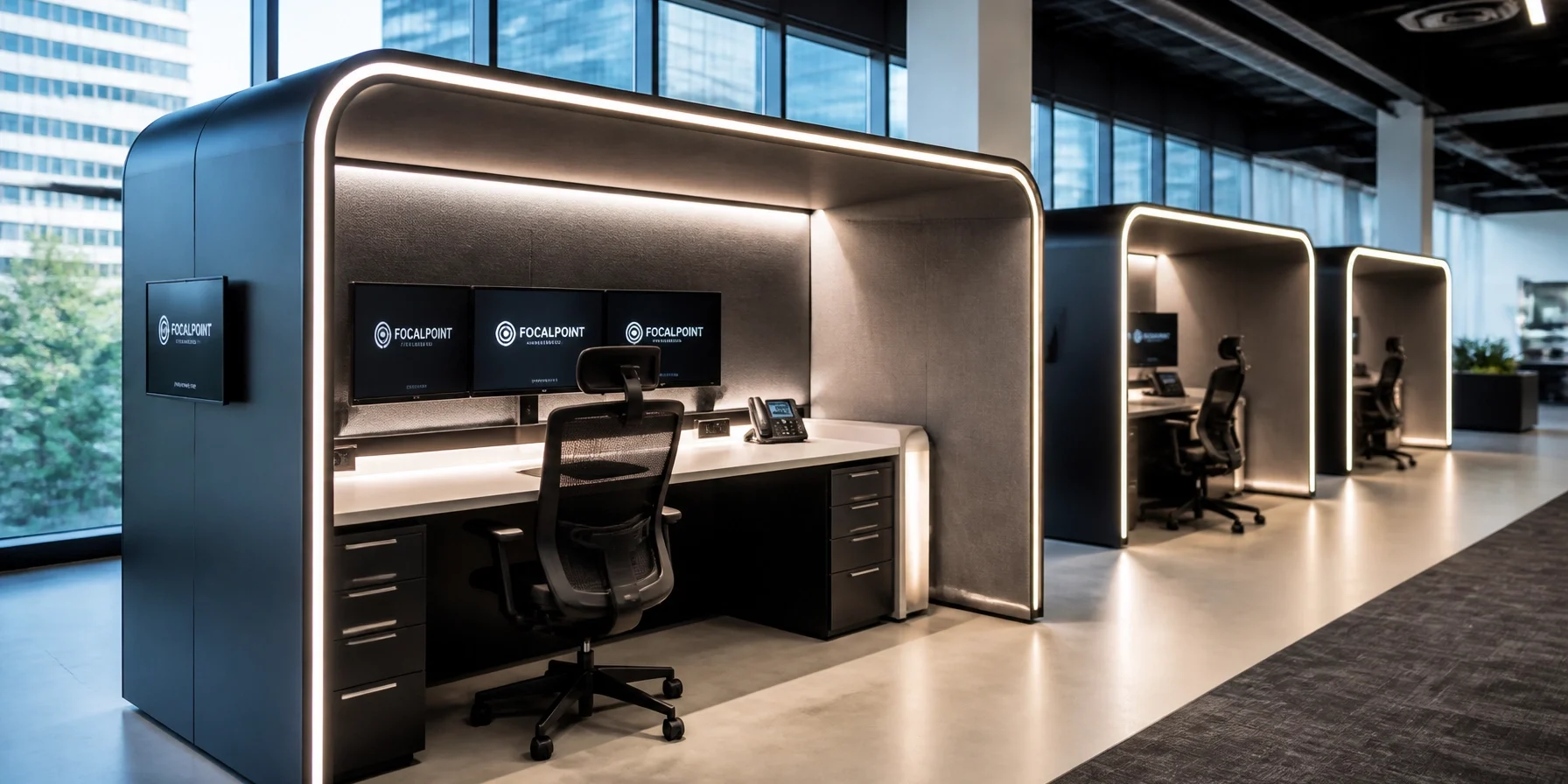
Remember the classic high school computer lab? That windowless room smelling faintly of ozone and ancient carpet, where the mice were sticky, the monitors were thick enough to use as boat anchors, and every station was identical? Yeah, we’re happy to report that era is officially on its deathbed.
In the world of modern tech education and professional development, the "one-size-fits-all" row of dusty desktops is being replaced by something much sleeker, smarter, and infinitely more effective: The Pod.
At USA Entertainment Ventures LLC, we’ve seen how physical infrastructure dictates the quality of talent coming out of the pipeline. Whether you’re training for a high-stakes role in cybersecurity or mastering global logistics, the environment matters. Pods aren't just trendy office furniture; they are purpose-built "mission control" units that turn a generic classroom into a specialized launchpad for the future of work.
What Exactly is a "Pod"? (And Why Should You Care?)
Think of a pod as the first-class cabin of workstation design. Unlike the open-plan chaos of a traditional lab, a pod is a modular, semi-enclosed unit designed for deep focus and specific technical workflows. They are the Swiss Army knives of infrastructure, reconfigurable, tech-integrated, and acoustically isolated.
While the computer labs of yore were designed to teach you how to type or browse the (early) web, pods are designed to simulate the actual job you’re going to get. It’s the difference between reading a book about flying and sitting in a flight simulator.
1. Cybersecurity: Building Digital Fortresses

If you’re training to be a cybersecurity analyst, you don't just need a browser; you need a sandbox. Traditional labs are usually tethered to a campus network that, for very obvious reasons, doesn't want students running live-fire malware simulations.
Modular pods act as "SOC-in-a-box" (Security Operations Centers). They can be physically and digitally isolated, allowing students to engage in Red Team vs. Blue Team exercises without accidentally taking down the school's payroll system. With triple-monitor setups and high-speed data feeds, these pods mirror the high-pressure environments of real-world threat hunting.
As we focus on business consulting and management, we know that the demand for "day-one ready" cyber talent is skyrocketing. Pod-based training ensures that when a graduate hits a real SOC, their first thought isn't "Wow, where are all the buttons?" but rather "Let’s get to work."
2. Logistics: The Classroom as a Control Tower

Logistics isn't just about moving boxes; it's about managing complex, shifting puzzles of data. To learn this, you need more than a spreadsheet on a 15-inch monitor.
Modern logistics pods function like miniature mission control centers. They are equipped to handle transportation management systems (TMS), real-time inventory tracking, and route optimization dashboards simultaneously. This "role realism" is a game-changer. By the time a student completes their program, they’ve already lived the daily workflow of a supply chain manager.
At USA Entertainment Ventures LLC, we bridge the gap between military skills and civilian careers through DOD Skill Bridge recruitment. Logistics is a massive part of this transition. Providing veterans with pod-based training environments that mirror the tactical operations centers they used in the field makes for a seamless and highly successful career shift.
3. Content Creation: Where Vibes Meet Value

Let’s be honest: trying to record a professional podcast or edit a high-res marketing video in a standard computer lab is a nightmare. The acoustics are terrible, the lighting is "fluorescent nightmare," and there’s always someone three chairs down eating loud chips.
Content creation pods solve this by bringing studio-grade infrastructure into the learning space. We’re talking acoustic paneling, integrated ring lights, and boom-arm microphones. These pods allow students to produce professional-grade assets: from webinars to streaming content: right as part of their daily curriculum.
In a world where marketing and media are the backbone of every modern business, these pods aren't a luxury; they are a necessity for anyone looking to master digital communication.
The Future is Modular (and Collaborative)

One of the biggest knocks against the old-school lab was the "row effect." Everyone sat in a line, staring at the back of someone else's head. It wasn't exactly a hotbed for teamwork.
Pods are designed to be clustered. They allow for individual deep work when the "hatch is closed," but can be easily grouped for collaborative projects. This mimics the modern tech office, where you might spend three hours coding in a focused "deep work" state before pivoting to a 30-minute team sprint.
Why This Matters for the Long Game
Switching from fixed labs to modular pods isn't just about looking cool (though it definitely helps). It’s about flexibility and cost. Traditional construction for a computer lab is slow, expensive, and permanent. If your tech needs change, you’re stuck with a bunch of bolted-down desks. Pods can be moved, upgraded, and reconfigured in hours, not weeks.
Whether you are looking at current projects in business development or trying to modernize a recruitment pipeline, the infrastructure you choose signals your commitment to excellence.
The era of the "lab" is over. The era of the "pod" has arrived. It’s more private, more powerful, and: let’s face it: a lot more fun.
If you're ready to modernize how your organization trains and retains talent, it’s time to stop thinking in rows and start thinking in pods. Your future cybersecurity experts, logistics gurus, and content creators will thank you.





