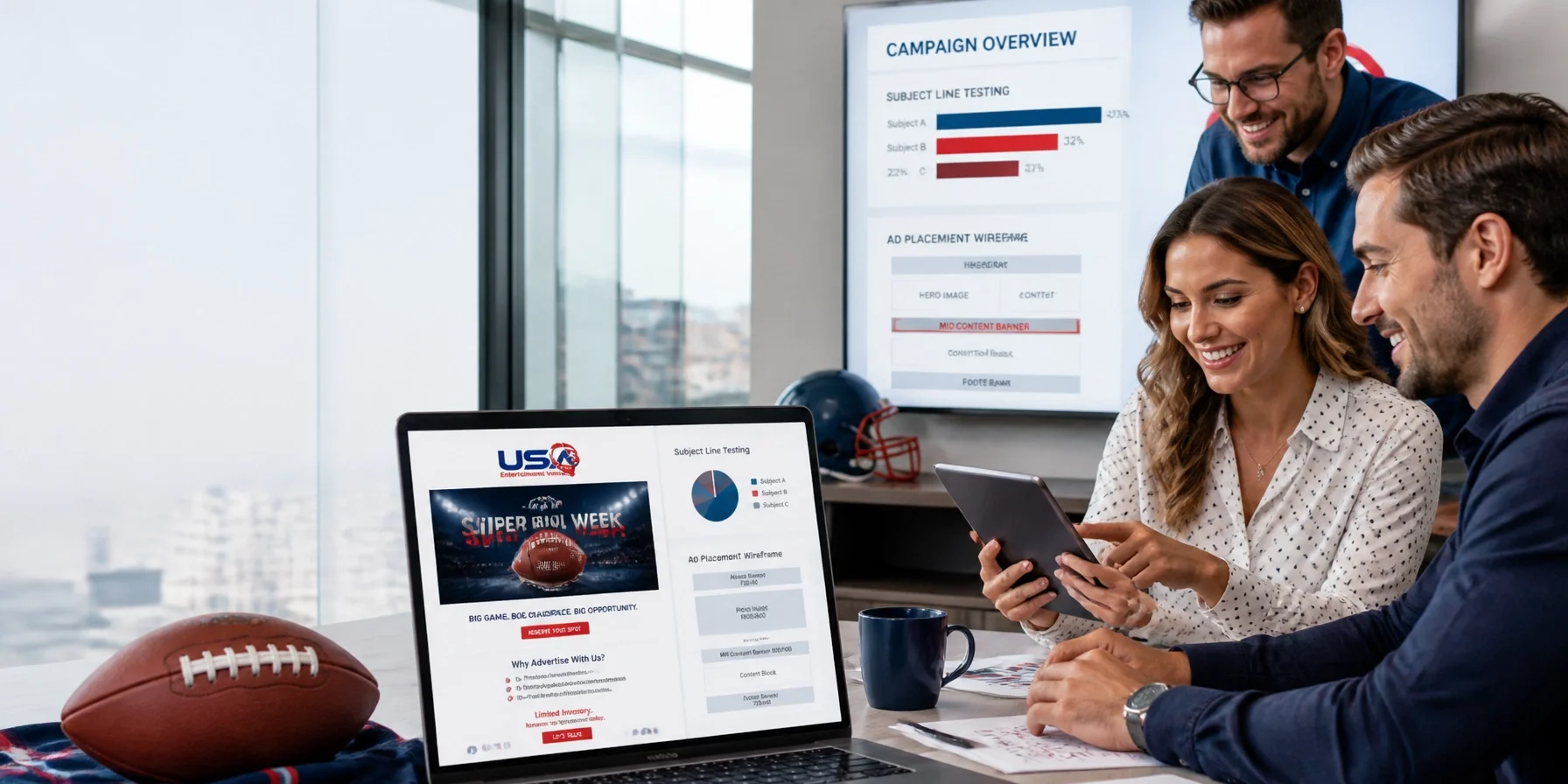
Super Bowl week is not a “normal newsletter week.” Inbox competition spikes, attention spans shrink, and expectations rise: fast. If your newsletter is The Super Bowl Playbook – Sports Media’s Advertising Strategy, your readers (and sponsors) are looking for something more than a generic roundup and a few banner ads.
The good news: sports media has been pressure-testing “big game” messaging for years: under tight deadlines, huge audience swings, and high sponsor stakes. When you borrow those systems, you don’t just get a prettier email. You get a newsletter that behaves more like a revenue-ready media product.
To ground this in reality, it helps to remember two facts:
- Most broad email campaigns land in the “typical” range of roughly ~20–35% opens and ~1.5–3% clicks, depending on the list and industry (benchmarks vary by provider). Targeted and automated emails consistently outperform bulk blasts in the same datasets. (See benchmark summaries from Brevo, Klaviyo, and MailerLite.)
- Email remains one of the most efficient channels in marketing, with industry bodies and research firms widely citing ~$36–$40 ROI per $1 spent in many contexts: but only when relevance and deliverability hold up.
Below are seven common mistakes that quietly erode performance: and the specific fixes sports media teams use to protect attention, deliverability, and advertiser outcomes.
1) Mistake: Sending one “big blast” to everyone
When everyone gets the same newsletter, no one feels like it was written for them. During Super Bowl week, relevance is your advantage: and irrelevance is your fastest path to unsubscribes.
How sports media fixes it: segment by intent, not just demographics
Sports publishers typically segment by signals that map to behavior:
- Interest: “Ads & commercials,” “game preview,” “betting/odds,” “party planning,” “celebrity/halftime”
- Engagement: active clickers vs. quiet readers vs. dormant subscribers
- Geo & legal: especially important if you reference sports betting offers or local activations
Litmus-style thinking is common in mature email programs: personalization is not decoration; it’s a distribution strategy. As McKinsey has reported in its personalization research, 71% of customers expect personalized experiences, and 76% get frustrated when they don’t: a reminder that relevancy isn’t optional in 2026.
Actionable fix: Build three versions of your lead module:
- “Hardcore fan” (fast analysis + key stats + bold prediction)
- “Ad watcher / pop culture” (commercial tracker + halftime + social clips)
- “Sponsor-ready” (best offers + event bundles + party checklist)
You can keep 70% of the email identical. The top 30% should feel tailored.
2) Mistake: Generic subject lines that don’t earn the open
Subject lines like “Super Bowl 2026 Newsletter” are accurate: but they are not competitive. During event weeks, your subject line is competing with breaking news alerts, shopping promos, and other “Big Game” messages.
How sports media fixes it: write for stakes, specificity, and speed
Sports media leans on what editors have always used: tension + utility + time.
Better patterns include:
- Utility + time box: “Your 3-minute Super Bowl Playbook (ads + angles + offers)”
- Stakes: “What to watch: 5 moments that decide the night”
- Curiosity with constraints: “The one stat that changes the matchup”
Benchmark data (across providers) consistently shows that higher-performing emails correlate with clearer targeting and relevance. Personalization can help too: subject lines that reference a user’s interest area (ads vs. game vs. betting) are more likely to earn attention than a one-size-fits-all headline.
Actionable fix: A/B test structure, not just wording:
- “3-minute” vs “Complete”
- “Ads” vs “Game” vs “Best offers”
- A neutral preview vs a bold claim
Also: treat the preheader like a second subject line. Sports desks do this instinctively: because they know the preview text is prime real estate.
3) Mistake: Treating advertising as an interruption
When ads feel random, readers scroll past them: and sponsors notice. The Super Bowl is the biggest advertising moment of the year; that means your newsletter ads should feel intentional.
How sports media fixes it: design ad inventory like a media product
A strong sports media newsletter has repeatable ad placements that sponsors can buy and that readers recognize:
- “Presented by” lead section (native, contextual)
- Mid-scroll sponsor module that matches the content (“Party checklist brought to you by…”)
- End-of-email offer card (clear CTA + tracking)
The point is not “more ads.” The point is better alignment between content and sponsor intent.
Actionable fix: Define 3 sponsor slots with clear rules:
- Top slot = brand story + one CTA
- Mid slot = contextual offer tied to the section theme
- Bottom slot = direct response (coupon, booking, RSVP, etc.)
Then stick to it. Consistency increases performance and makes packaging easier next year.
4) Mistake: Wrong timing (or the wrong cadence)
Many newsletters swing between two extremes:
- one massive send that tries to do everything, or
- a flurry of last-minute emails that fatigue the list
How sports media fixes it: a simple event cadence
Most sports media teams operate around a predictable rhythm:
- T-minus 7 to 3 days: storylines, brand campaigns to watch, early offers
- Morning-of: final “playbook” email with the essentials
- Post-game: winners/losers + “what everyone will talk about Monday”
- (Optional) In-game: only if you can keep it short and genuinely useful
This cadence works because it matches how people experience the event: anticipation → preparation → reaction.
Actionable fix: Instead of one long email, plan two:
- “Prep Edition” (72–24 hours prior)
- “Game Day Edition” (morning of)
Shorter emails, clearer CTAs, and less chaos.
5) Mistake: Ignoring deliverability during your biggest send
If you dramatically increase volume right before the Super Bowl: or suddenly include inactive contacts: you can hurt inbox placement at the exact moment you need it most.
How sports media fixes it: protect sender reputation with engagement-based sending
Modern deliverability has become stricter, especially for high-volume senders. Google and Yahoo’s 2024+ requirements for bulk senders emphasize basics like SPF, DKIM, DMARC, a one-click unsubscribe, and keeping spam complaints under 0.3% (with best practice closer to 0.1%). These aren’t “nice-to-haves.” They are table stakes for staying out of spam.
Credible deliverability practitioners routinely recommend the same operational discipline sports media uses:
- Warm up volume ahead of the spike
- Suppress long-term inactives during the highest-stakes sends
- Track complaints and engagement by mailbox provider
Actionable fix: Create a “Super Bowl A-list” segment:
- opened or clicked in the last 60–90 days
- no hard bounces
- no prior complaints
Send your biggest content to the A-list first. It protects deliverability and typically improves results.
6) Mistake: Calling it “personalization” because you inserted a first name
“Hi {FirstName}” is not personalization. It’s formatting.
How sports media fixes it: personalize the order and modules
Sports publishers often treat the newsletter like a homepage: what matters is what appears first and what gets emphasized.
Examples of simple (but powerful) dynamic content:
- If the reader always clicks “commercials,” move the Ad Watch section to the top.
- If the reader clicks offers, show a stronger “best deal” module earlier.
- If the reader is new, replace jargon-heavy analysis with a plain-language explainer.
McKinsey’s research on personalization (again: 71% expect it; 76% are frustrated without it) matters here because it describes the baseline expectation readers bring to your inbox.
Actionable fix: Use “interest tags” from clicks:
- Ads/Commercials
- Game preview
- Betting/Odds
- Food/Party planning
- Brand deals
Then rotate the top two modules based on the tag.
7) Mistake: Measuring the wrong thing (or measuring too late)
If you only look at open rate after the game, you missed the chance to learn: and missed the chance to optimize sponsor outcomes in real time.
How sports media fixes it: set a scorecard before kickoff
In sports media, a “good” Super Bowl email isn’t just opened. It drives behavior.
A practical scorecard includes:
- Engagement: click-through rate, click-to-open rate, scroll depth (if available)
- Revenue: sponsor CTR, conversions, booked calls, affiliate sales
- List health: unsubscribe rate, complaint rate, inbox placement signals
Then test one variable at a time (subject line structure, top module, ad placement).
Actionable fix: Decide in advance:
- the #1 action you want readers to take (watch video, download guide, book consult, etc.)
- the #1 sponsor outcome you need (traffic, lead form, redemption, etc.)
- the one test you will run (not five)
Video: The Super Bowl Playbook : Sports Media’s Advertising Strategy
Use this video as the anchor for your newsletter’s “why this matters” section, then build the email around a clear set of modules and sponsor slots.
Suggested way to feature it in the newsletter:
- Lead module: 1-sentence promise (“The ad strategy sports media uses when attention is at its peak.”)
- Thumbnail + button: “Watch the Playbook”
- Bullets under it: 3 takeaways (inventory, targeting, measurement)
A simple “Super Bowl Playbook” newsletter layout you can copy
If you want a clean structure that aligns content and ads, this format is proven and easy to build:
- Hero: Video + what readers get in 3 minutes
- Section 1: “What to watch” (3 bullets)
- Sponsor Slot A: presented-by module (native)
- Section 2: “Ads worth watching” or “Top offers” (depending on segment)
- Sponsor Slot B: contextual offer card
- Section 3: “Game-day checklist” (short, practical)
- Sponsor Slot C: direct CTA + tracking
- Footer: unsubscribe clarity + preference center link
How USA Entertainment Ventures LLC supports a smarter event-week strategy
At USA Entertainment Ventures LLC, we help organizations build repeatable, professional growth systems: especially when the stakes are high and the window is short. If you want support aligning messaging, sponsor packaging, and execution, start here:
- Learn more about our approach: About USA Entertainment Ventures LLC
- Explore services: Services
- Talk with our team: Contact
Key takeaways (the “repeat it so it sticks” version)
- Relevance wins during Super Bowl week. Segment by intent and engagement.
- Your subject line is a headline. Make it specific, timely, and testable.
- Ads should feel like content, not clutter. Define consistent sponsor inventory.
- Deliverability is a strategy, not a setting. Protect sender reputation and meet modern bulk-sender requirements.
- Measure what matters (engagement, revenue, list health), and decide your scorecard before kickoff.
Super Bowl 2026 will be noisy. That is exactly why a disciplined, sports-media-style playbook can outperform louder, less structured competitors: while building a repeatable framework you can reuse for every major event after.