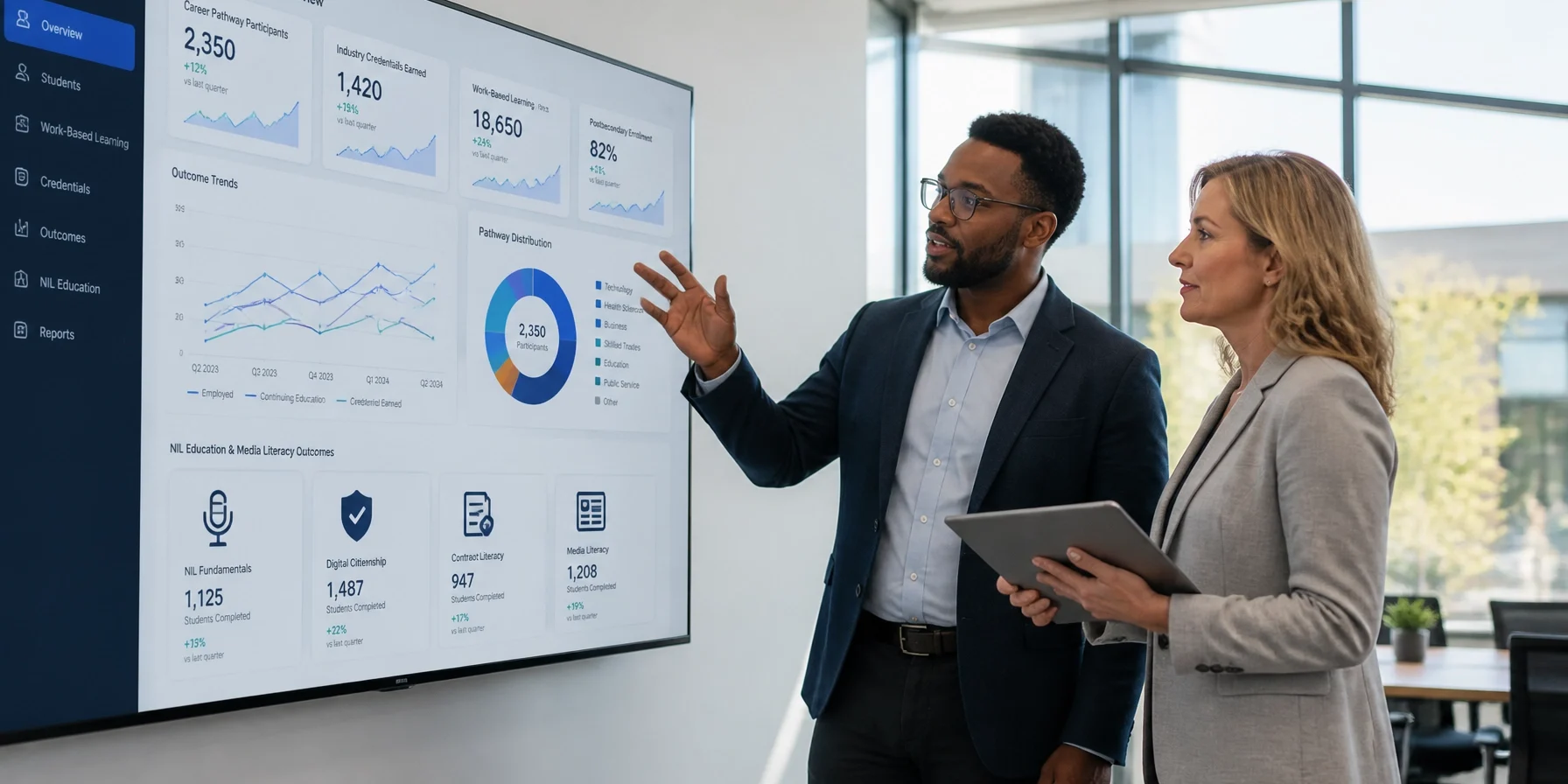
Executives are not short on resumes. They are short on signals.
In boardrooms and talent reviews, the question has shifted from “How many graduates do we have?” to “How many people are workforce-ready: and how do we know early?” That is why dashboards have become a shared language between employers, schools, and workforce partners.
For Fortune 100 leaders, dashboards are not decorative. They are decision tools that determine which programs scale, which partners earn long-term trust, and which cohorts get deeper investment. The best dashboards do one thing exceptionally well: they convert learning experiences into predictive indicators of performance.
This daily executive-style briefing outlines 10 dashboard metrics that large employers increasingly expect from schools: especially “Future Ready” schools that blend data analytics dashboards, NIL (Name, Image, and Likeness) education, and media literacy outcomes into measurable, employer-relevant results.
“What gets measured gets managed.” : Peter Drucker (widely cited in management practice)
This principle is especially true in talent pipelines: if a school cannot measure readiness, an employer cannot confidently plan around it.
As a business consulting and management partner, USA Entertainment Ventures LLC supports organizations that want measurable, scalable programs: where schools become an anchor in a future-ready talent ecosystem, not just a credentialing endpoint.
Why dashboards matter now (and why employers look upstream)
Traditional hiring KPIs: time-to-hire, cost-per-hire, and first-year attrition: are lagging indicators. By the time they show a problem, the organization has already paid for it: recruiting spend, onboarding time, and productivity ramp.
Forward-looking talent teams are building upstream measurement systems with schools and training programs. A practical reference point comes from workforce and HR analytics guidance emphasizing dashboards as tools for pipeline visibility and planning, not only HR reporting (see examples of talent and HR dashboard frameworks such as Headcount365’s “Talent Dashboard” overview and broader HR dashboard discussions like SplashBI’s HR metrics roundup: https://splashbi.com/blog/6-essential-hr-metrics-dashboards-you-need-in-2025/).
In other words: executives want schools to report the same kind of operational clarity that modern organizations demand internally.

The 10 dashboard metrics Fortune 100 leaders want from schools
Below are the metrics leaders tend to prioritize because they are actionable, comparable across cohorts, and closely tied to workplace performance: not simply to seat time.
1) Student Engagement Velocity (from awareness to action)
What it measures: How quickly students move from first exposure (info session, invite, outreach) to active participation (projects, labs, studios, applied assignments).
Why it matters: Velocity reveals friction. Slow conversion often signals unclear program value, weak onboarding, or competing priorities that will later show up as drop-off.
How to show it on a dashboard:
- Median days: “interest” → “first deliverable submitted”
- Funnel conversion rate by week
- Drop-off reasons (coded, not anecdotal)
Future-ready note: Velocity is one of the earliest signals you can intervene on. Executives like it because it can be improved quickly.
2) Skill Acquisition Rate by Domain (measured, not assumed)
What it measures: The pace of skill growth in defined domains (e.g., analytics, communication, content production, policy/legal basics).
Why it matters: Employers do not hire “potential” in the abstract. They hire for competencies: and they want evidence of progression.
How to show it:
- Pre/post proficiency by domain (rubric-based)
- Time-to-proficiency benchmarks by cohort
- Breakdown by learning mode (project, simulation, mentorship)
Plain-language test: If a leader asks, “Are they getting better at the skills we need?” your dashboard should answer in one glance.
3) Cross-Functional Project Completion (the modern work standard)
What it measures: Completion rates for projects requiring multiple skills: technical + communication + teamwork.
Why it matters: Most real jobs are cross-functional. Leaders want proof that learners can finish work that involves dependencies and tradeoffs.
How to show it:
- Completion rate by project type
- On-time delivery rate
- Quality score distribution (rubric)
- “Redo rate” (how often deliverables required rework)

4) Real-World Application Frequency (work in the wild)
What it measures: How often students apply skills outside controlled assignments: client work, competitions, portfolios, community projects, internships, creator outputs.
Why it matters: Application frequency is a strong proxy for confidence and readiness. If learners only perform inside the classroom, performance risk remains high.
How to show it:
- Applications per month (median, distribution)
- Portfolio artifact count (with quality sampling)
- External validation rate (client acceptance, competition placements)
Executive-friendly interpretation: “How much real work did this cohort do?”
5) Media Literacy Outcomes (credibility, bias, verification)
What it measures: Ability to evaluate sources, detect manipulation, separate fact from opinion, and communicate evidence-based conclusions.
Why it matters now: Misinformation risk is operational risk. Media literacy is increasingly a workforce competency: especially in roles touching customer communication, security, public trust, and brand reputation.
A strong foundational benchmark comes from national-level evidence: NAEP has reported that U.S. eighth graders have struggled with writing and related literacy indicators in recent cycles, reinforcing urgency around measurable literacy outcomes (NAEP overview and reporting: https://www.nationsreportcard.gov/).
How to show it:
- Assessment score trends (baseline → exit)
- “Verification task” performance (source checking, citation accuracy)
- Confidence vs. accuracy gap (a key risk indicator)
Reinforcement: If a program claims media literacy, it should report it like a KPI: not like a slogan.
6) NIL Education Engagement (professional identity + risk management)
What it measures: Participation and completion in NIL-related education: personal branding, contracts/deal basics, IP fundamentals, online reputation, disclosure, and compliance behaviors.
Why it matters: NIL is not only athletics. It is a mainstream lesson in identity economics: how individuals create value, protect rights, and avoid reputational harm in public digital spaces.
For baseline context, the NCAA’s NIL guidance provides a clear view of how NIL has formalized across college sports and influenced education priorities (NCAA NIL overview: https://www.ncaa.org/sports/2021/2/8/about-taking-action.aspx).
How to show it:
- Completion rate of NIL modules
- Scenario-based assessment scores (contract red flags, disclosure choices)
- Digital footprint audit outcomes (before/after)
Executive translation: “Do students understand the rules of modern visibility and monetization?”
7) Mentor Interaction Quality (not hours: impact)
What it measures: The quality of mentorship: specificity of feedback, depth of discussion, and evidence of follow-through.
Why it matters: Mentorship is expensive. Leaders want to know if it changes outcomes.
How to show it:
- Post-session value rating (student + mentor)
- “Action taken” rate (did the student implement guidance?)
- Mentorship-to-outcome correlation (e.g., improvement in project quality)
Practical standard: Track the mentorship that produces measurable behavior change.

8) Certification Progress Momentum (pace beats promises)
What it measures: Progress through recognized credentials and micro-credentials: especially in analytics, digital tools, and business readiness.
Why it matters: Completion alone can hide stalls. Momentum flags who is advancing and who needs support now.
How to show it:
- Milestones achieved per 30/60/90 days
- Drop-off points by module
- Attempt counts vs. pass rates
Executive use: Momentum helps forecast “ready talent” supply for specific roles.
9) Collaborative Problem-Solving Index (team performance, measured)
What it measures: Team contribution, peer feedback quality, conflict resolution behaviors, and shared outcomes.
Why it matters: Employers repeatedly cite collaboration as a core capability, but many schools only grade individual work. Leaders want an index that shows team readiness.
How to show it:
- Peer review reliability score (are peer ratings consistent?)
- Contribution analytics (task completion, role rotation)
- Retrospective quality scores (what teams learn and improve)
Key reinforcement: Modern work is a team sport; readiness metrics should prove that.
10) Post-Program Pathway Clarity (the readiness multiplier)
What it measures: Whether learners have an actionable plan: target roles, required skills, timelines, and next credentials: rather than vague aspirations.
Why it matters: Clarity reduces time-to-productivity and reduces early attrition. Leaders like clarity because it makes pipeline planning realistic.
How to show it:
- “Pathway clarity” score (rubric-based)
- % of cohort with verified next step (internship, interview loop, apprenticeship, enrollment)
- Readiness-to-placement time

What “Future Ready” schools do differently (a simple operating model)
Dashboards only matter if they drive decisions. Fortune 100 leaders tend to favor schools that can answer three operational questions continuously:
- Are learners progressing in employer-relevant skills? (Metrics 2, 3, 8)
- Are they safe and credible in modern media environments? (Metrics 5, 6)
- Is the pipeline predictable enough to plan hiring against it? (Metrics 1, 4, 10)
That combination is why NIL education and media literacy belong in workforce readiness conversations. They are not “extras.” They are part of risk management, communication competence, and professional maturity.
A practical dashboard layout executives will actually read
If you want leaders to use your dashboard weekly (or daily), keep it structured:
- Top row (Outcome Forecast): Pathway clarity, certification momentum, project completion
- Middle row (Readiness Drivers): skill acquisition by domain, mentorship quality, collaboration index
- Bottom row (Risk + Trust): media literacy outcomes, NIL engagement, engagement velocity, application frequency
Add filters executives always ask for:
- cohort, school, program, demographic groups (for equity visibility)
- time window (30/60/90 days)
- placement destination (industry cluster)
Action steps: how to start without overbuilding
Schools and partners that succeed usually start small:
- Pick 3 metrics to operationalize in 60 days (often #1, #2, and #5).
- Define rubrics so scores are consistent across teachers and sites.
- Set intervention rules (example: “two-week stall” triggers support).
- Publish a monthly executive summary with the dashboard link and 5 bullets: what changed, why, and what action was taken.
This approach respects a basic executive preference: fewer metrics, higher confidence, clearer actions.
Where USA Entertainment Ventures LLC fits (brand-neutral, outcome-focused)
USA Entertainment Ventures LLC operates as a management and business consulting partner that helps organizations build measurable, scalable programs and partnerships. If your goal is to become an anchor for “Future Ready” schools: where employers can confidently plan around outcomes: start by aligning your dashboards to what leaders already review in talent discussions.
Relevant links:
- Learn more about the company: About USA Entertainment Ventures LLC
- Explore consulting services: Services
- Continue reading on this topic: Looking For Future-Ready Talent? Here Are 10 Dashboard Metrics Fortune 100 Executives Track Daily
- Start a conversation: Contact
Closing perspective: dashboards are the new “transcript”
The next wave of workforce-ready talent will not be sourced solely by degrees or GPAs. It will be sourced by evidence: visible, consistent, comparable indicators that show readiness early: and show improvement over time.
Dashboards make that evidence legible to decision-makers. They also make schools stronger, because what is measured can be improved. The organizations that win the next decade of talent competition will treat schools as strategic partners and will demand the same rigor in school dashboards that they demand in enterprise analytics.
The opportunity is clear: build the dashboard, align it to executive decision-making, and become the kind of “Future Ready” anchor employers plan around( year after year.)